Get Full Government Meeting Transcripts, Videos, & Alerts Forever!
Get email alerts on the Transportation Wildlife topic
No spam. Unsubscribe anytime.
House approves bill directing ODOT to consider wildlife crossings during project planning
Summary
House Bill 29‑78 A passed the House after floor debate. The bill directs the Oregon Department of Transportation (ODOT) to integrate consideration of wildlife crossings into feasibility studies and guidance, and to coordinate with the Oregon Department of Fish and Wildlife (ODFW); funding for construction was left to separate appropriations.
The Oregon House on April 1 passed House Bill 29‑78 A, a measure requiring the Oregon Department of Transportation (ODOT) to consider wildlife crossings in its project planning and guidance, coordinate with the Oregon Department of Fish and Wildlife (ODFW), and pursue training and advisory work to identify feasible crossing opportunities.
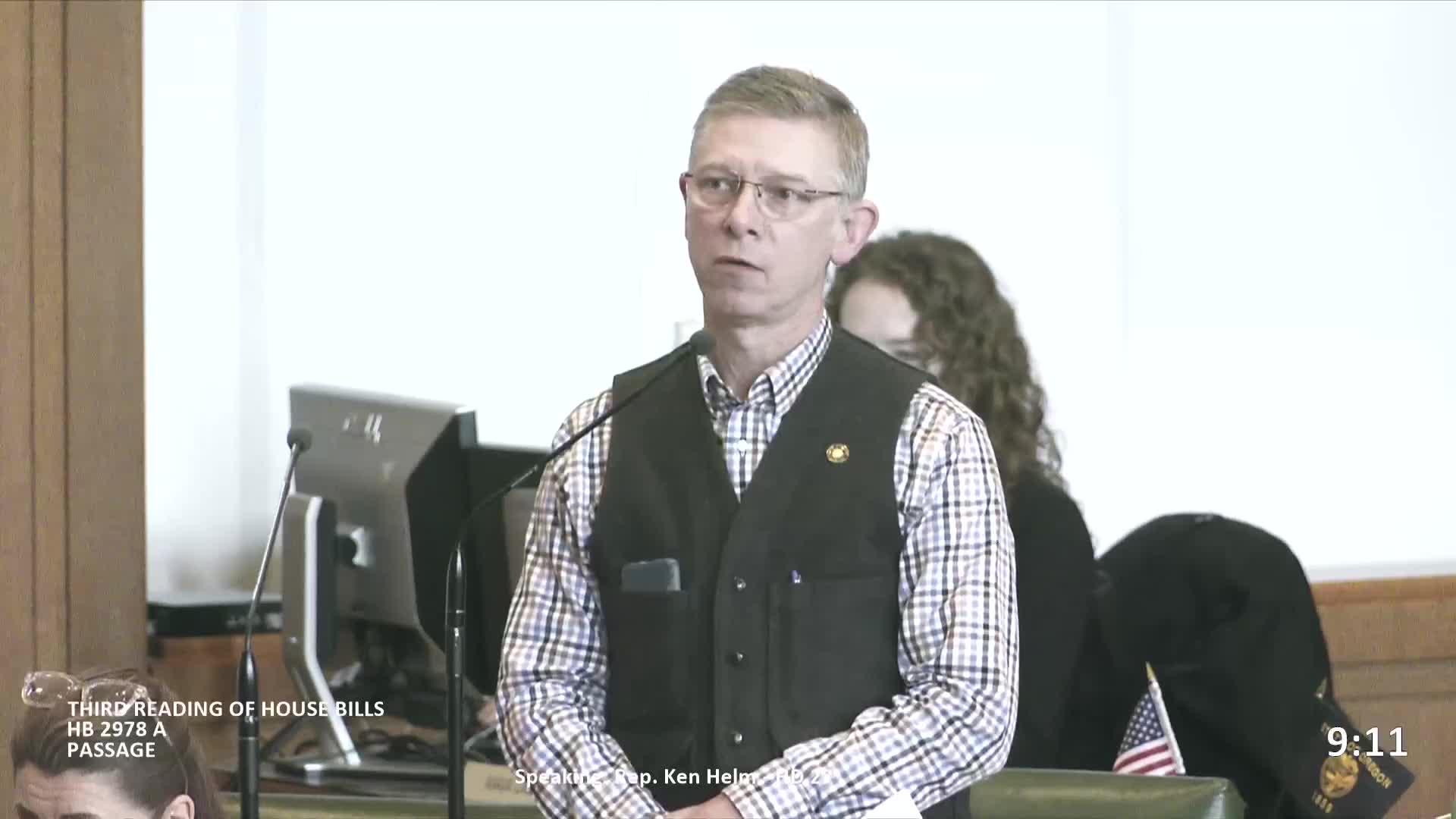
Representative Ken Helm, the bill carrier, told the House the measure directs ODOT to integrate wildlife-crossing considerations into its planning documents and feasibility studies and to develop internal training so project planners will "at least look" for crossing opportunities during related construction or reconstruction projects. Helm said the bill does not itself appropriate construction funding; he said funding must come from a separate budget or grant process.
On the floor, Representative Bossard Davis questioned whether the bill should include a fiscal note to ODOT given looming budget pressures and cited a 2022 expansion of ODOT's wildlife program to include "small wildlife species" (House Bill 5202, 2022); Bossard Davis warned administrative costs could be significant. Representative Reschke asked whether ODFW has a budget line for this work; Helm replied migration- and corridor-mapping work already exists at ODFW and the bill's requirements are contingent on funding.
Supporters, including Representative Mannix and Representative Bobby Levy, argued the bill opens opportunities to seek philanthropic or federal grant funding and highlighted existing underpass projects that have reduced collisions at specific sites. Representative Helm said an example underpass in Central Oregon had reduced animal-vehicle collisions by nearly 90 percent, and he emphasized the bill "does not mean they will be built" without funding but ensures ODOT will consider crossings when feasible.
The clerk declared House Bill 29‑78 A passed after debate. Sponsors characterized it as a policy and planning directive to improve wildlife safety and reduce vehicle collisions while leaving capital funding to other appropriations processes.