Get Full Government Meeting Transcripts, Videos, & Alerts Forever!
Get email alerts on the Military Budget topic
No spam. Unsubscribe anytime.
Senate subcommittee reviews Oregon Military Department budget; governor’s plan funds retention bonus and armory projects
Summary
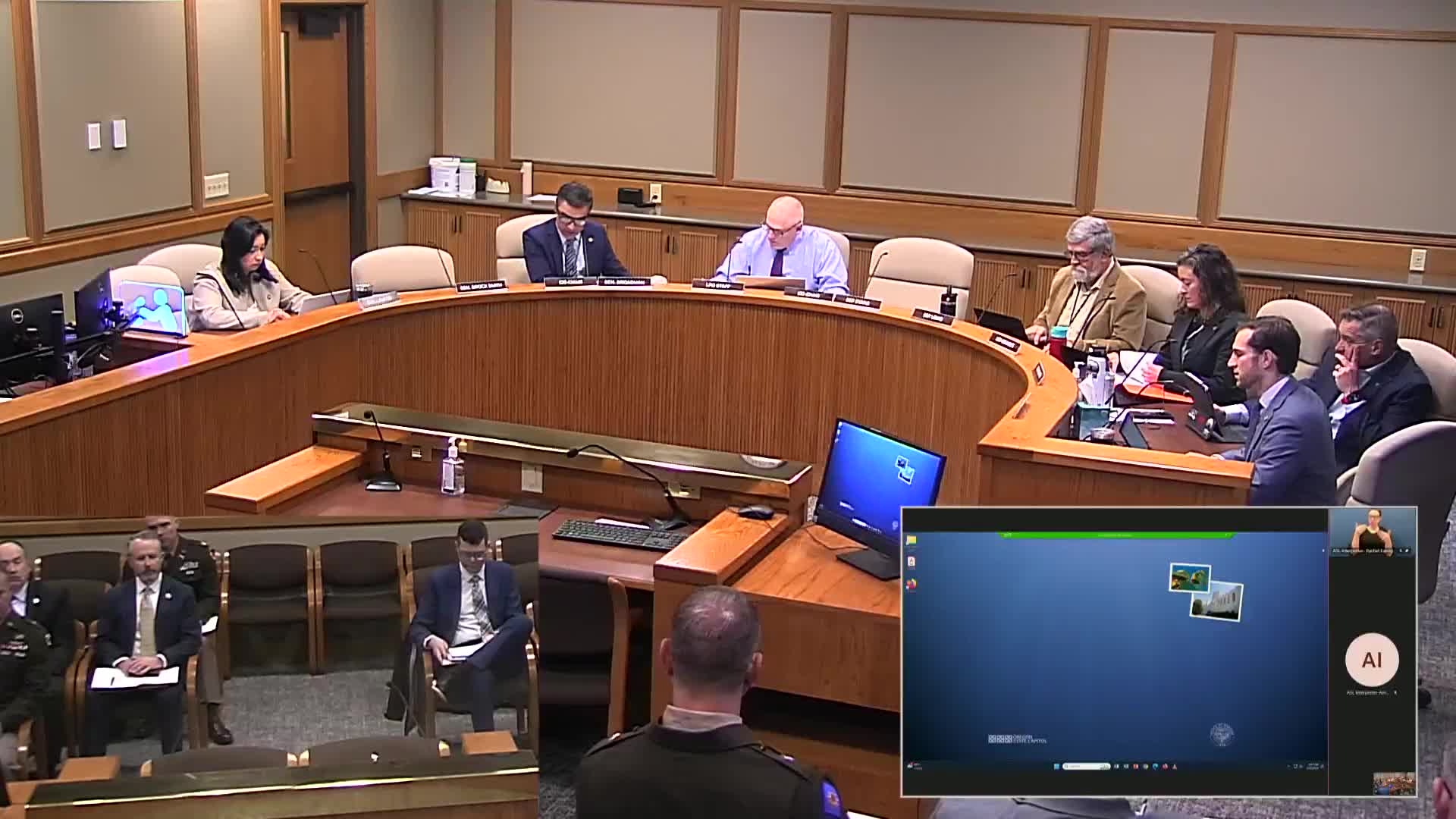
Senate members on the Public Safety Subcommittee heard an overview March 31 of Senate Bill 5533, the Oregon Military Department’s (OMD) primary budget for the 2025–27 biennium, with agency and fiscal staff emphasizing proposals to shore up recruitment and retention, pay debt service on armory projects and sustain youth education programs.
SALEM, Ore. — Senate members on the Public Safety Subcommittee heard an overview March 31 of Senate Bill 5533, the Oregon Military Department’s (OMD) primary budget for the 2025–27 biennium, with agency and fiscal staff emphasizing proposals to shore up recruitment and retention, pay debt service on armory projects and sustain youth education programs.
Legislative Fiscal Office analyst Mr. Borden told the panel the department’s current‑service level budget is $229.2 million and includes 495 positions (457.12 full‑time equivalent). He said federal funds make up the largest share of the agency’s resources and that the current service level reflects loss of previous capital construction limitations that do not carry forward into the next biennium.
The budget matters because the Oregon National Guard provides both national defense and state emergency response. The proposed investments would affect wildfire and search‑and‑rescue capacity, facilities that host training and community programs, and reimbursement‑dependent operations, the presenters said.
At the hearing, Department of Administrative Services finance lead Jonathan Bennett summarized the governor’s recommendations and budget structure. Bennett said general fund accounts for roughly one‑fifth of the department’s service‑level budget and is used primarily to match federal funding for day‑to‑day operations. He noted the department’s single largest general‑fund expense is debt service for prior construction, about $12.9 million.
Brig. Gen. Alan Gronewald, the Adjutant General and agency director, highlighted the Guard’s dual federal and state missions and touted the force’s year of deployments, training and domestic response. “We provide an exponentially greater economic impact,” he said, characterizing a modest state investment as returning broad value to Oregon communities. He also said the department’s top budget priority is a reenlistment bonus program to improve retention.
Reenlistment bonus: the proposal and tradeoffs
Agency leaders described a state reenlistment bonus as a key retention tool. General Gronewald and staff said the original internal request was about $9.5 million for the biennium; the governor’s recommended package reduces that to $5 million and — if funded at that level — the state bonus would apply initially to the Army component only. Sean McCormack, chief of state affairs for OMD, explained the $5 million figure reflects an assessment of the population approaching reenlistment windows and a state bonus of roughly $5,000 per eligible soldier.
OMD leaders told senators the department has lost personnel since 2020 (the Air Guard by about 11% and the Army Guard by about 15%) and that retention incentives are intended to reverse that trend.
Facilities, capital projects and debt service
Committee witnesses described ongoing capital work and a portfolio of armory service‑life extension projects and training‑site construction. The governor’s package includes state and federal funding for multiple projects, including a readiness center in Linn County, armory work in Klamath Falls and upgrades at the Rees Training Center. Bennett said the governor’s budget phases out roughly $38.0 million of prior capital construction limitations and reduces debt service slightly from the prior biennium; the recommended budget includes new debt service additions totaling about $1.9 million for three specific projects.
Agency staff emphasized the department manages a large real‑estate footprint—several million square feet across armories and air bases—and that capital investments are often paired with federal cooperative agreements that require state matches.
Youth and community programs
Subcommittee members also heard about STARBASE and the Oregon Youth Challenge Program. McCormack said STARBASE (a federally funded STEM program serving elementary students) briefly faced staff layoff notices during a federal continuing resolution but was restored after subsequent federal action. He said the program expects to serve roughly 5,500 students in federal fiscal 2026 across four locations and that operating costs are 100% federally funded (schools pay only transportation).
McCormack said the Youth Challenge Program operates a 22‑week residential phase plus a 12‑month nonresident mentoring phase. He thanked the Legislature for a 2017 bond allocation of $5 million that the agency leveraged with $5.3 million in federal funds to overhaul the campus and said the facility has capacity for 240 students but current staffing limits admissions to about 80. He said the long‑term goal is to reach full capacity with a balanced gender mix.
State emergency missions and funding risks
McCormack described the two authorities the Guard uses for domestic missions: state active duty (statutory authority under ORS 399) and Title 32 federal status. “The first and most common is what we call state active duty, and that’s outlined in ORS 399,” he said. He told senators state active‑duty responses can be covered fully by state funds or partially reimbursed after a federal disaster declaration; when federal reimbursement is not available, OMD often fronts costs and may seek legislative funding.
Witnesses repeatedly warned of federal funding uncertainty — both from occasional changes in cooperative agreement rules and the timing of federal reimbursements — which can create cash‑flow stress for programs that rely on matched federal dollars.
Performance measures and staffing risks
OMD officials walked the committee through key performance measures showing mixed results: several measures were rated green (for example, youth‑program completion and customer satisfaction), while recruiting remained below target. McCormack said the agency is piloting a self‑funded enlistment incentive and is seeking legislative support for the retention bonus and tuition assistance programs. He also cited IT staffing and stormwater rate increases at Portland Air National Guard Base as carry‑forward issues that could affect operations if not addressed.
What the subcommittee did and what’s next
The March 31 session was an informational hearing; no final votes were taken on SB 5533. Staff told the panel the subcommittee will continue hearings on the Military Department budget on subsequent days and will review both the primary budget bill and separate capital construction requests.
Quotes from the hearing
"always ready and always there," Brig. Gen. Alan Gronewald said of the Guard’s role.
"The first and most common is what we call state active duty, and that's outlined in ORS 399," Sean McCormack said when explaining authorities for domestic missions.
Ending
With the informational hearing closed, the subcommittee signaled follow‑up briefings and additional days of testimony on the agency’s budget and capital requests. Lawmakers and staff asked agency officials for further details on reenlistment modeling, deployment‑history data and facility timelines for subsequent hearings.