Get Full Government Meeting Transcripts, Videos, & Alerts Forever!
Get email alerts on the Stadium Financing topic
No spam. Unsubscribe anytime.
Senate committee adopts amendment expanding stadium financing tool for potential MLB team in Portland
Summary
The Senate Committee on Finance and Revenue on March 31 advanced Senate Bill 110, adopting the Dash 8 amendment and sending the bill to the Senate floor with a due-pass recommendation; the measure would broaden a statute that uses incremental personal income tax revenue tied to a prospective Major League Baseball franchise to help repay private stadium financing.
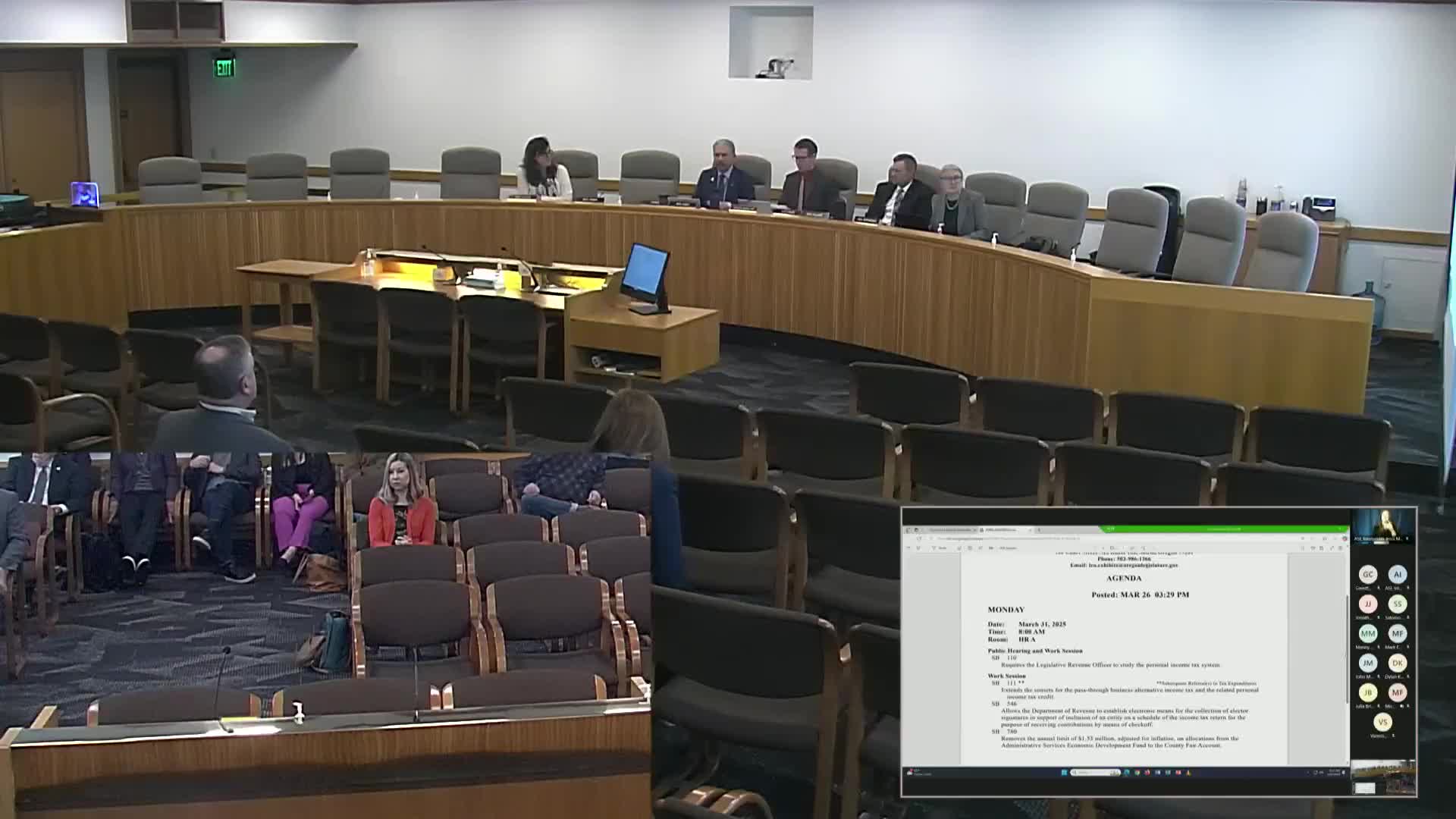
The Senate Committee on Finance and Revenue on March 31 advanced Senate Bill 110, a measure that would change how personal income tax revenue associated with a prospective Major League Baseball franchise could be used to help repay private stadium financing in Portland.
Legislative staff told the committee that the bill would update an existing framework created in 2003 (Senate Bill 5) and in current Oregon law that allows a portion of wages and associated personal income taxes from players and team staff to be captured for a grant agreement to repay stadium financing. Staff said the Dash 8 amendment the committee adopted raises the statutory grant cap from $150,000,000 to $800,000,000 (plus financing costs), raises the minimum estimated stadium cost from $300,000,000 to $2,000,000,000 and increases the per-person wage threshold for counting diverted income taxes from $50,000 to $100,000.
Why it matters: Under the proposal the state would not write a general-fund check up front, committee members and staff repeatedly clarified. Instead, the mechanism would direct incremental personal income tax revenues tied to a Major League Baseball franchise—players and certain team employees—to a grant fund used to repay private financing. Department of Revenue staff would identify the taxable wages associated with the team; the Department of Administrative Services would sign the grant agreements, committee staff said.
Supporters told the committee that the change modernizes an existing statutory tool and could help Portland compete for a franchise without immediate general-fund exposure. Mike Barrett, managing partner of Portland Diamond Project, said, “The more people understand what SB 110 truly is, the more they become fans of this mechanism… it leverages new revenue from player income taxes” and emphasized the proposal does not “front” state taxpayer dollars to cover the bonds. Multnomah County Commissioner Julia Brim Edwards and other local business owners and civic leaders described expected civic and economic benefits, including jobs, tourism and youth-program engagement.
Opponents and skeptical witnesses urged caution. Andrew Allen said the state faces federal funding uncertainty and warned the bill should be deferred until the broader fiscal picture is clearer; he also flagged what he described as a possible legal gap in “subparagraph I” that, in his view, could leave the state exposed if grantees declared bankruptcy. Steve Wright summarized decades of academic research he said shows public subsidies for stadiums often fail to deliver net economic benefits and argued the proposal carries reputational and financial risk.
Committee staff noted the bill’s revenue impact analysis treats the exercise as hypothetical because none of the statutory preconditions have been met: a franchise must commit to locate in Portland, commit to remain for the term of the grant agreement, and private financing for the stadium must be in place before incremental tax revenues could be granted. Staff also cited a range in the revenue-impact statement showing total repayment costs (face value plus interest/financing) could range roughly from $1.1 billion to $1.4 billion over the 30‑year period, depending on salaries and future interest rates.
Votes and formal actions: The committee first adopted the Dash 8 amendment. Vice Chair McClain (mover) sought adoption; the roll call recorded Senator Patterson as a courtesy yes, Senator Starr excused/absent, Senator Taylor aye, Vice Chair McLean aye and Chair Meek aye; the amendment was adopted. Vice Chair McLean then moved the bill, as amended, to the Senate floor with a due-pass recommendation; the committee recorded the same roll-call pattern and approved the motion. Chair Meek and Senator Lieber were assigned as carriers to carry the bill to the floor.
What the bill would not do now: Several senators and staff emphasized the measure does not itself obligate the general fund or create an immediate bond; payments to grantees would be triggered only after the statutory preconditions are met and the legislature authorizes transfers based on Department of Revenue calculations.
Next steps: With the committee’s due-pass recommendation, SB 110 moves to the Senate floor for further consideration. Committee members asked staff to continue to develop fiscal and economic analyses; one senator specifically requested additional work on the section identified as “subparagraph I.”
Ending note: Committee debate combined technical fiscal explanations from staff with emotional appeals from longtime sports figures and local business leaders. Supporters argued the measure would create long-term civic and economic benefits if a franchise materializes; critics urged tightening statutory safeguards and delaying action until fiscal uncertainty abates.