Get Full Government Meeting Transcripts, Videos, & Alerts Forever!
Get email alerts on the Public Health Fees topic
No spam. Unsubscribe anytime.
Committee hears bill to raise and restructure licensing fees for food, lodging and pools
Summary
House Bill 853 would increase and reclassify licensing fees for food establishments, public accommodations, camps and pools to shift some program costs from property taxpayers to users and establishments.
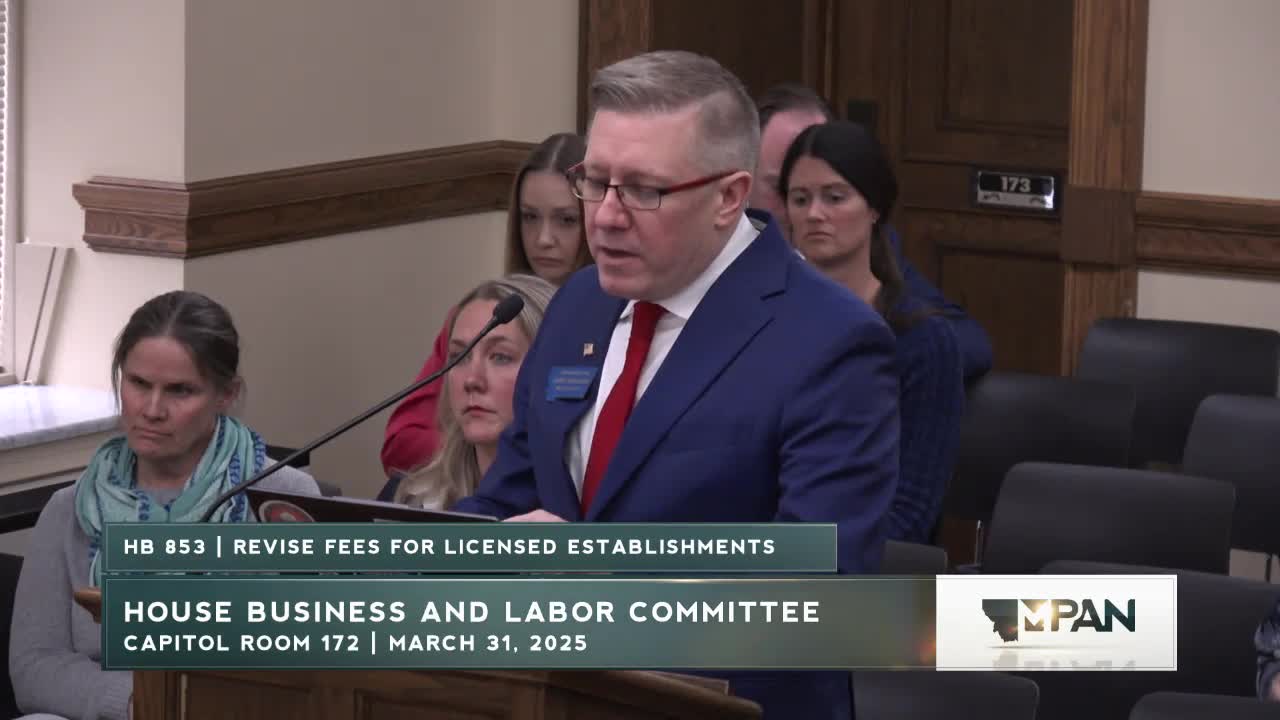
Representative George Nikolicakos presented House Bill 853 to the House Business and Labor Committee as a targeted adjustment to licensing fees that have not been updated for about 15 years. The sponsor said the bill would add categories (for example, a medium food‑service tier and a mobile food category) and require hotels that serve food to obtain a retail food license.
Nut graf: Public health officials and business representatives said the change would rebalance who pays for environmental‑health programs so that roughly half the program cost is covered by license fees and the remainder by local taxes, rather than the current arrangement in which an estimated 75% of program costs are borne by property taxes.
Brad Griffin of the Montana Restaurant Association and Gina Miller, health officer for Missoula Public Health, both described extensive stakeholder work during the interim and data collection from counties; Miller said 37 counties representing 88% of Montana’s population responded to a survey. The bill adds more nuanced fee categories (for mobile food trucks, medium food establishments, seasonal vs. year‑round pools) and preserves that 90% of the collected fee revenue would be returned to the local health departments to fund inspections and environmental health functions.
Local health officers and county commissioners offered proponent testimony: Laurie Christianson (Gallatin County health officer) and Joe Briggs (Cascade County commissioner and chairman of the Cascade City‑County Board of Health) told the committee the fee changes would support local environmental health operations without increasing inspection frequency or adding new regulatory programs.
Tom Jacobson, a restaurant operator, told the committee the tiered structure would be fairer for small businesses. Several small business owners joining online testimony echoed that sentiment.
Stacy Evangeline of the Department of Public Health and Human Services appeared as an informational witness to explain how license fees are collected and reimbursed to counties. Committee members asked for clarification that the bill would preempt duplicative local licensing fees; the department and sponsor confirmed the bill preempts duplicate local fees for the same license but local jurisdictions may still charge nonduplicative fees such as temporary‑food permits or plan‑review fees.
Representative Nikolicakos closed by asking the committee to pass the bill; the hearing was closed without a committee vote recorded in the transcript.