Get Full Government Meeting Transcripts, Videos, & Alerts Forever!
Get email alerts on the Criminal Justice Data topic
No spam. Unsubscribe anytime.
Sponsor seeks clarity on criminal‑history data for a statewide criminal justice data warehouse; DOJ and DCI warn on confidentiality and repository risks
Summary
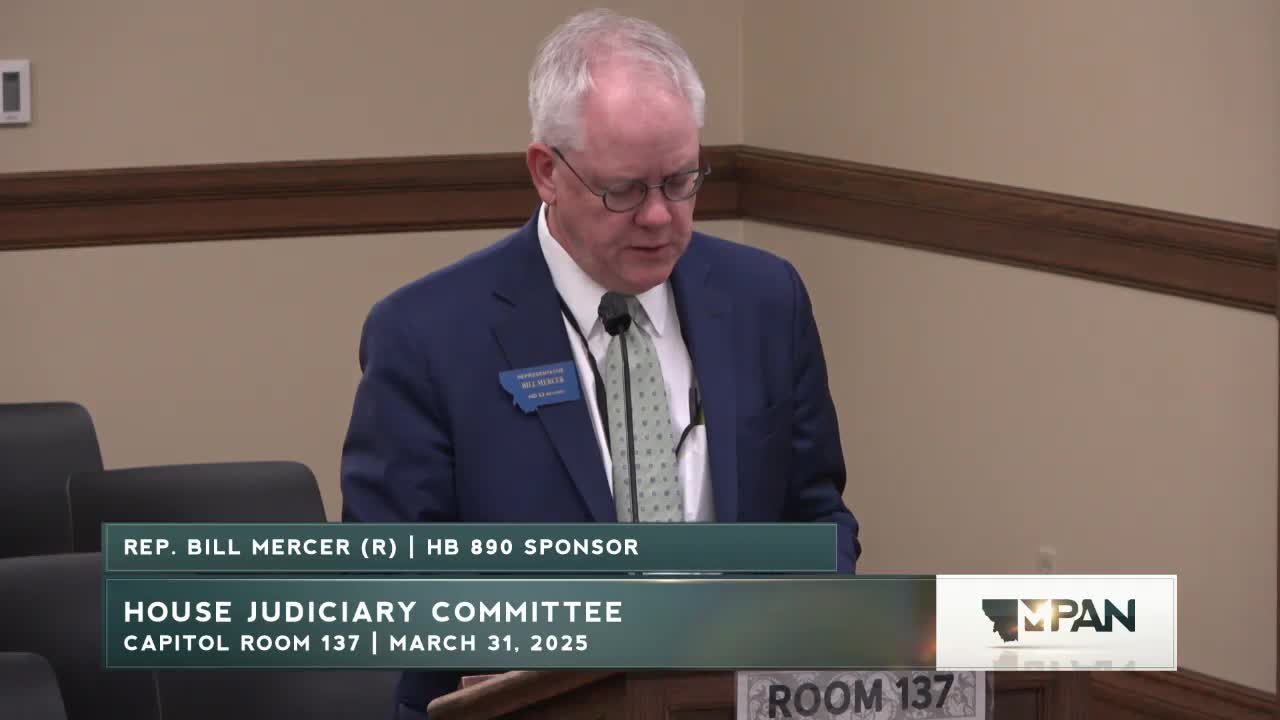
Rep. Bill Mercer told the committee he had drafted a provision requiring agencies to confer on who will supply criminal‑history data to a planned criminal justice data warehouse and, if they cannot agree, to assign Department of Corrections as the provider.
Rep. Bill Mercer, R‑Billings, told the House Judiciary Committee that a follow‑up to earlier study work was to ensure the planned criminal justice data warehouse receives reliable criminal‑history information and that agencies with authoritative data confer and decide which will provide the records. His draft would require the responsible agencies to confer and choose a provider by Oct. 1; if they cannot agree, the Department of Corrections (DOC) would be tasked with providing criminal history data for the warehouse.
The Department of Justice (DOJ) and Division of Criminal Investigation (DCI) witnesses described legal and operational constraints. Assistant Attorney General Selene Koepcke told the committee that the state’s central criminal repository contains confidential criminal justice information (CCJI) received via NCIC (the FBI’s National Criminal Information Center), including arrest records without convictions, biometric data and sealed records; federal and state law tightly limit who may receive that information. A DOJ representative noted that dissemination of CCJI to an entity not authorized by law could be a misdemeanor under Montana law (citing state confidentiality provisions).
DCI’s records chief, Anne Dormady, explained that the state repository is biometric‑based and requires manual entry of court dispositions; updating can lag because dispositions are entered by repository staff after fingerprints are transmitted, creating a delay before the repository reflects sentencing information. Dormady and Koepcke told the committee that many of the public pieces of criminal history are available from courts and local law‑enforcement originators without exposing the central repository to security risk. Dormady asked whether those originators could supply the warehouse instead of routing repository data through a single system to avoid additional cybersecurity exposure.
The sponsor said his intent was not to include biometric repository data if that created legal or security barriers; he emphasized that the committee needed clarity about what the warehouse should collect and how agencies would cooperatively provide it. Members discussed whether a statutory carve‑out authorizing the data warehouse to receive specified criminal‑history records (for example, court convictions and dispositions that are public) would address the DOJ’s confidentiality concerns without exposing NCIC or the central fingerprint repository.
No committee action was taken at the hearing; the sponsor invited technical amendments to define the scope of “criminal history information” for the warehouse and suggested that public court data might be the preferred, lower‑risk source for most analytic needs.