Get Full Government Meeting Transcripts, Videos, & Alerts Forever!
Get email alerts on the Youth Court topic
No spam. Unsubscribe anytime.
Montana bill would update Youth Court Act, expand offenses that can transfer juveniles to adult court; debate centers on rehabilitation vs. public safety
Summary
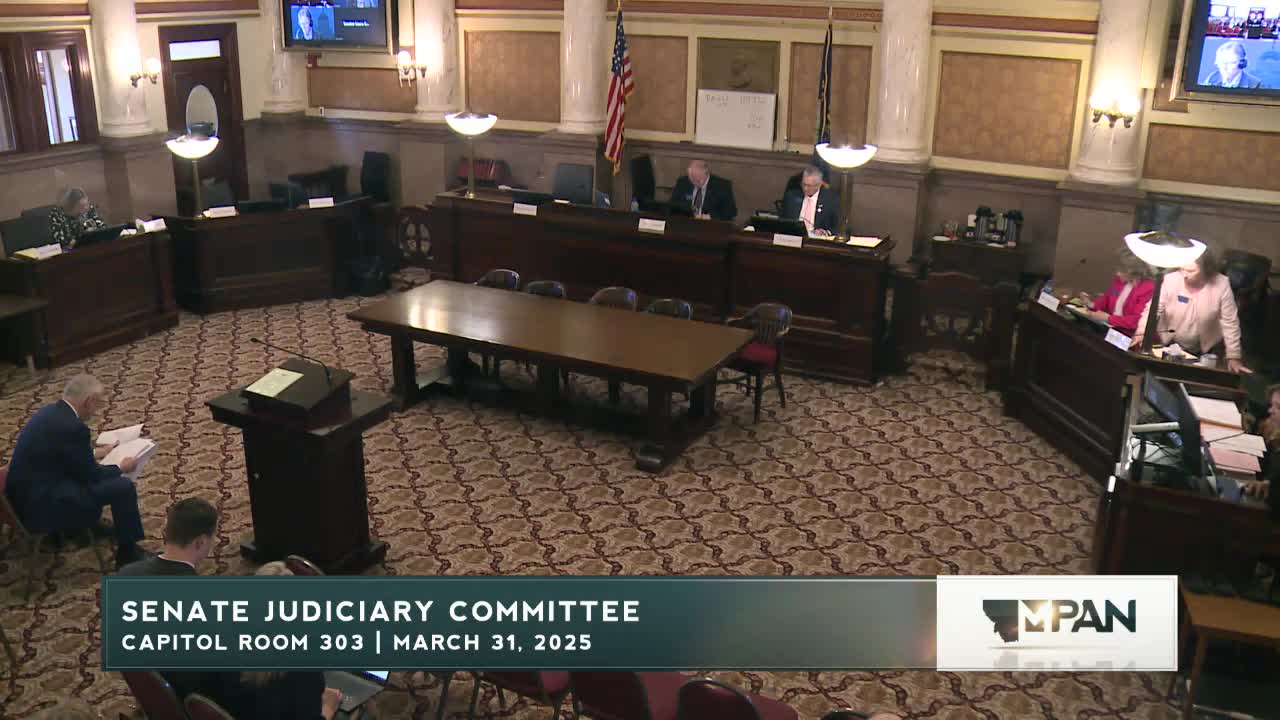
Representative Bill Mercer told the Senate Judiciary Committee that House Bill 332 is intended to modernize Montana's Youth Court Act, adding and removing specific offenses from the list that may be transferred to adult court and clarifying detention and transfer procedures.
Representative Bill Mercer opened the Senate Judiciary Committee hearing on House Bill 332 as an effort to "update the Youth Court Act" and to bring statutory transfer provisions into line with crimes the Legislature has created since the statute's language was last revised.
Mercer said HB 332 would add certain crimes to the list of offenses that may be transferred from youth court to district court, change which offenses are transferable for 16- and 17-year-olds, and clarify procedures for hearings and detention. "This is merely trying to update the Youth Court Act to bring it into conformity with things that we have done legislatively," Mercer said.
Supporters included representatives of county attorneys and local business groups. Nanette Gilbertson of the Montana County Attorneys Association said elected county attorneys need the discretion to pursue adult prosecution in appropriate cases. Dan Brooks of the Billings Chamber of Commerce told the committee that public safety remains a top concern for businesses and the Billings Police Department has reported a rise in violent youth crime.
Yellowstone County deputy chief and lead juvenile prosecutor Hallie Bishop described the bill as a "cleanup bill," adding that it brings Montana law into compliance with federal requirements by clarifying that a detained youth must be kept in an area providing "sight and sound separation from adults accused or convicted." Bishop also said the bill clarifies informal disposition procedures and seeks to limit transfer authority to violent crimes added to statute since the Youth Court Act was drafted.
Opponents included the ACLU of Montana and national youth-defense organizations. Henry Seaton of the ACLU argued the proposal is "not an evidence based approach to reducing youth recidivism" and warned that expanding transfers to adult court risks greater victimization and long-term harm for youth. Amy Boro of a national nonprofit that represents youth defenders told the committee, "Prosecuting children in adult court ... harms public safety," saying research shows transfer laws have little deterrent effect and can increase recidivism.
Public defender Michelle Lyday emphasized procedural concerns, citing data from a 2023 Youth Court report: of 4,028 youth who passed through youth court, 3,730 cases were handled informally. Lyday said the bill raises questions about counsel, the use of informal consent adjustments that were made without attorneys present, and the role of consent decrees that could shift youth adjudication toward adult-style deferred imposition models.
Committee members asked sponsors and witnesses to clarify specific points: whether mere presence at a crime would result in adult charges (Bishop said Montana law requires active participation or another culpable act), and whether protections for counsel were adequate (sponsors pointed to added notice requirements in section 3). Mercer and proponents stressed multiple safeguards in the transfer statute and that district courts retain review authority.
No committee action was taken during the hearing. Testimony reflected a clear divide: prosecutors and some local officials urged expanded transfer authority and updated language to reflect modern offenses and federal detention standards, while civil-rights and defense witnesses urged caution, pointing to research, developmental concerns for youth, and procedural protections for informal processes.
The committee also discussed technical cleanups in sections dealing with detention, supervision, and the interplay between informal and formal dispositions; sponsors said they would supply staff and stakeholders with additional drafting clarifications before any executive action.