Get Full Government Meeting Transcripts, Videos, & Alerts Forever!
Get email alerts on the Child Protection Warrants topic
No spam. Unsubscribe anytime.
Committee weighs bill requiring warrant before child removal except in emergencies; department says emergencies covered
Summary
Senate Bill 50 would require Child Protective Services to obtain a court warrant before removing a child from a home except when the child faces imminent and apparent danger that cannot be averted while obtaining a warrant, the sponsor told the House Judiciary Committee.
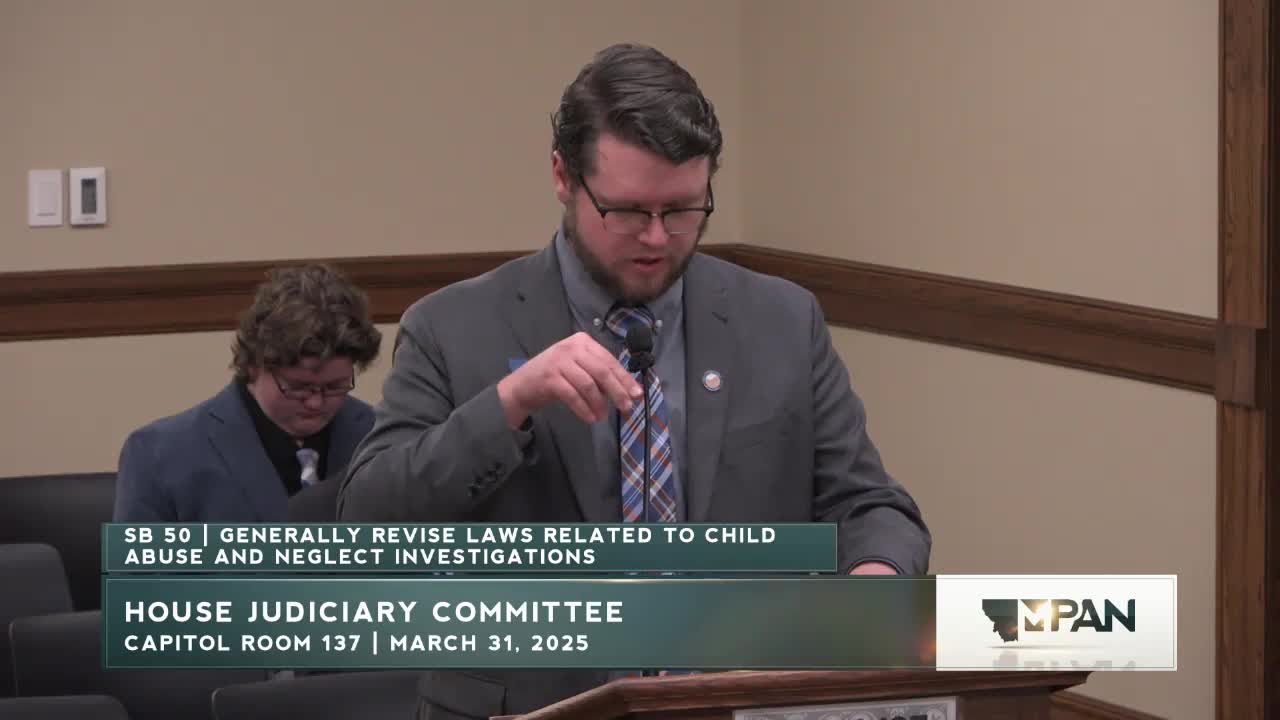
Sen. Daniel Emmerich, R‑Great Falls, opened the House Judiciary hearing on Senate Bill 50, a bill that would require child‑protective services to obtain a court warrant before removing a child from a home except in exigent circumstances and would require an abuse and neglect petition to be filed within a specified timeframe.
The sponsor said the bill, as amended in the Senate, defines “imminent and apparent danger” as “immediately observable and about to happen” and codifies that CPS may not remove a child without a warrant unless the child is likely to experience that danger in the time required to obtain a warrant. Emmerich said he worked with the department on the definition so the department retained latitude to protect children in emergency situations.
Proponents included Sen. Dennis Lenz, who described the concept as longstanding from an interim committee and said a separate, larger child‑protection bill was vetoed in the prior session. Denise Johnson of the Montana Child Protection Alliance testified that Montana removes children at a higher rate than the national average and argued a warrant requirement would protect children’s constitutional due process and reduce trauma from unnecessary removals. “Removing a child from their home and family is horrific and terrifying, traumatizing children,” Johnson said. She cited national statistics and said Montana’s removal rate is 7.2 per 1,000 compared with a national rate of 2.8 per 1,000.
Informational testimony from Grussberg, a division administrator for Child and Family Services, and from the department said the bill preserves the ability to remove in emergency situations and would not make it harder to remove children when imminent danger exists. Grussberg said the bill aligns with the department’s safety model for emergency situations; she said the main change is requiring a warrant for non‑emergency removals and that the department supports a delayed effective date to allow implementation.
Members pressed the sponsor and department on implementation details. Representatives asked how the bill would interact with the Indian Child Welfare Act (ICWA) on reservations, whether judges would be available 24/7 in rural counties, and whether requiring a warrant would create redundancies because county attorneys already review emergency protective services petitions within five days. The sponsor said some of those cross‑jurisdictional questions would need further study and noted the bill includes a delayed effective date (July 2026) and implementation period to work with courts and counties.
Several members raised concerns about the bill’s definitions and the availability of judges in rural counties. The sponsor and department said they expect to work with counties and courts during the implementation period, and stated the department had asked for a year to implement and training language was included.
The committee did not vote on the bill at the hearing. The sponsor said the bill includes a delayed effective date to allow a year of implementation and expressed confidence the bill could be implemented in conjunction with courts.