Get Full Government Meeting Transcripts, Videos, & Alerts Forever!
Get email alerts on the Legal Standing topic
No spam. Unsubscribe anytime.
Senator proposes tighter standing rules in Senate Bill 395; trial lawyers and others warn it could bar public‑interest suits
Summary
Senate Bill 395 would revise Montana law on standing to require individualized injury and limit claims based on public importance or speculative future harm. Opponents, including the Montana Trial Lawyers Association, said the bill risks removing important checks on government actions and could block suits where harm is likely to recur.
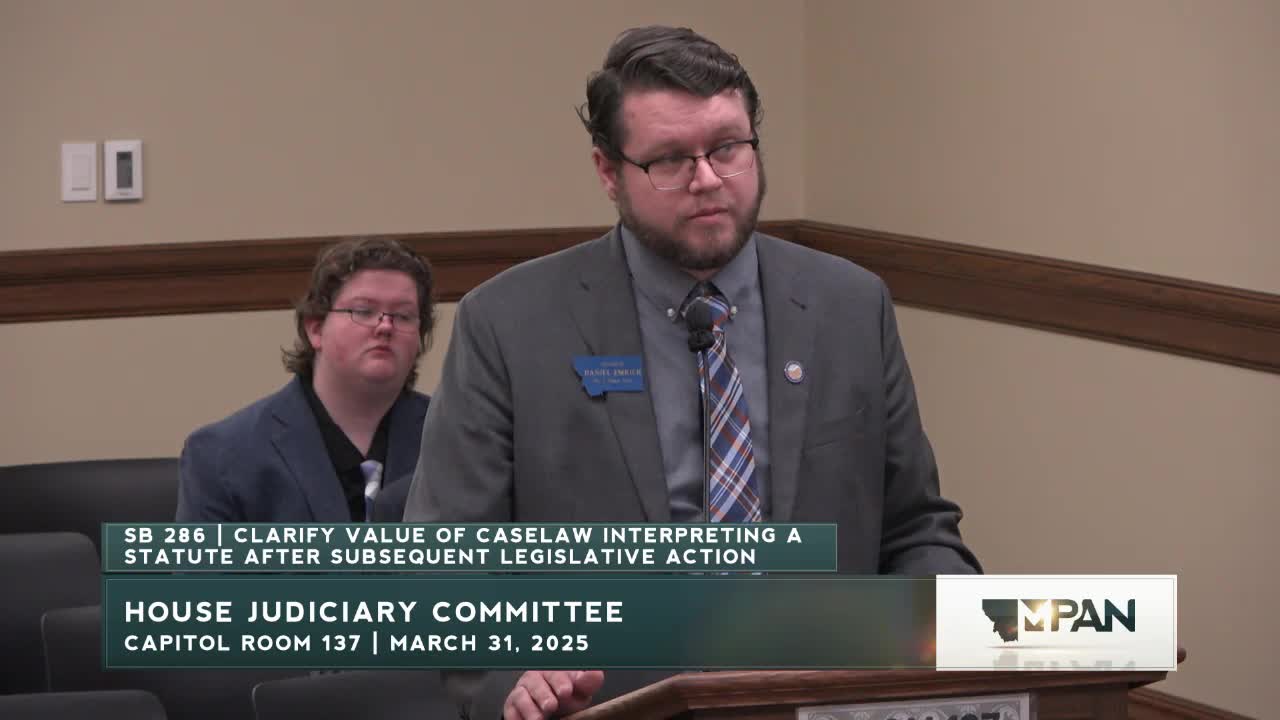
Sen. Daniel Emmerich, R‑Great Falls, told the House Judiciary Committee that Senate Bill 395 would revise Montana legal standards for standing to maintain a lawsuit. Emmerich said the bill would require a claimant to allege an injury or a likelihood of injury caused by the defendant and would prevent maintaining standing solely on the basis of public importance or speculative harms.
“Standing is essentially the reason why the court should hear your case,” Emmerich told members. He said the proposal tracks the state constitution’s requirement that a plaintiff demonstrate an injury and that the bill does not prevent courts from granting standing but “prevents the court from allowing a plaintiff to maintain standing in contravention to the constitution rules of standing.”
Opponents argued the draft is too restrictive. Al Smith, testifying for the Montana Trial Lawyers Association, said federal and state courts already use doctrines that allow preventive or recurring‑harm suits in some circumstances, and he warned the bill’s provisions (cited in testimony as affecting Article VII, Section 2 and Article II, Section 16 of the Montana Constitution) would narrow Montana citizens’ ability to challenge unlawful government action. “This prevents citizens and organizations from challenging unlawful government actions because of how extremely narrow the scope of injury can be,” Smith said.
Members pressed for specifics and examples. Several representatives asked the sponsor and opponents whether the bill would have altered recent high‑profile cases (members referenced the Held climate case during questioning). Emmerich and witnesses debated whether the bill would merely restate constitutional injury requirements or would make it harder to pursue cases that raise matters of public importance when individual injury is difficult to prove. The sponsor said the bill would curb what he characterized as an “elastic” expansion of standing that could invite litigation without demonstrated injury.
The committee took testimony but did not take final action on the bill at the hearing.