Get Full Government Meeting Transcripts, Videos, & Alerts Forever!
Get email alerts on the Statutory Interpretation topic
No spam. Unsubscribe anytime.
Montana senator proposes bill to clarify courts should treat legislative changes as controlling over prior case law
Summary
Sen. Daniel Emmerich told the House Judiciary Committee that Senate Bill 286 would instruct courts to give effect to subsequent legislative changes when litigating statutes previously interpreted by case law. Opponents raised separation-of-powers concerns and asked for citations showing the problem the bill would address.
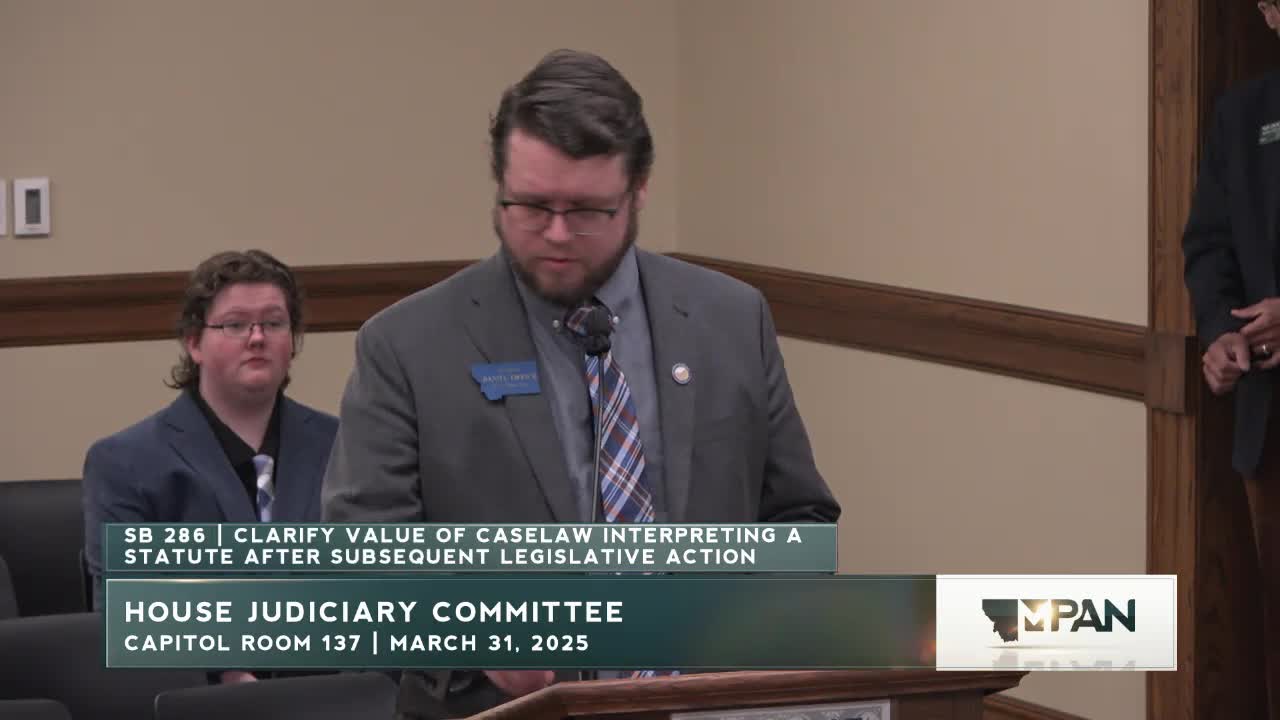
Sen. Daniel Emmerich, R-Great Falls, told the House Judiciary Committee that Senate Bill 286 would clarify that when the Legislature later amends an interpreted statutory provision, courts should treat that legislative change as controlling for purposes of litigation over the statute.
The measure, Emmerich said, adds a new section on “case law applicability” instructing courts that the “precedential value of court decisions interpreting a statute yield to the subsequent legislative action on the interpreted statutory provisions.” He said the aim is to make clear that courts should relitigate the statute as written after a legislative change rather than relying primarily on earlier precedents when resolving later motions for summary judgment.
The bill’s sponsor framed the proposal as an instruction to courts about statutory construction. “When we have a statute and the courts interpret it in a way that we did not intend, and the Legislature goes back and changes the statute, the court should first consider that change in law,” Emmerich said. He cited Montana’s rules of statutory construction in Title 1 and gave examples where he said courts had “inserted” their own views beyond legislative intent.
Opponents urged caution. A witness identified as Al Smith, representing a bridal association, told the committee he opposed the bill because it was unclear and could be read to intrude on the judiciary’s role. “A lot of times the court, when the court finds a statute unconstitutional, a lot of times it’ll actually say it’s up to the legislature to correct these constitutional deficiencies,” Smith said. He warned that language in the bill could be read to prevent courts from relying on prior precedent and that would “invade the province” of the judiciary.
Committee members pressed the sponsor for citations and examples. Representative Staffman asked whether a prior case that declared a statute unconstitutional would be usable as precedent after the Legislature reenacted substantially the same language; Emmerich answered that the prior case could be considered but that the new statute should be litigated on its merits rather than the court deciding by summary judgment that an earlier case controls. Representative Griffith and others asked whether the bill tracked existing appellate standards or whether more precise language or examples would be needed; Emmerich said he was open to friendly amendments but believed the draft was adequate to restate long‑standing construction rules.
No formal action or vote was taken in the hearing. Committee members suggested potential drafting improvements and asked the sponsor to provide case citations where the sponsor believed the courts had failed to consider subsequent statutory changes. Emmerich said he would provide case references to the committee.