Get Full Government Meeting Transcripts, Videos, & Alerts Forever!
Get email alerts on the Tax Pass Through Deduction topic
No spam. Unsubscribe anytime.
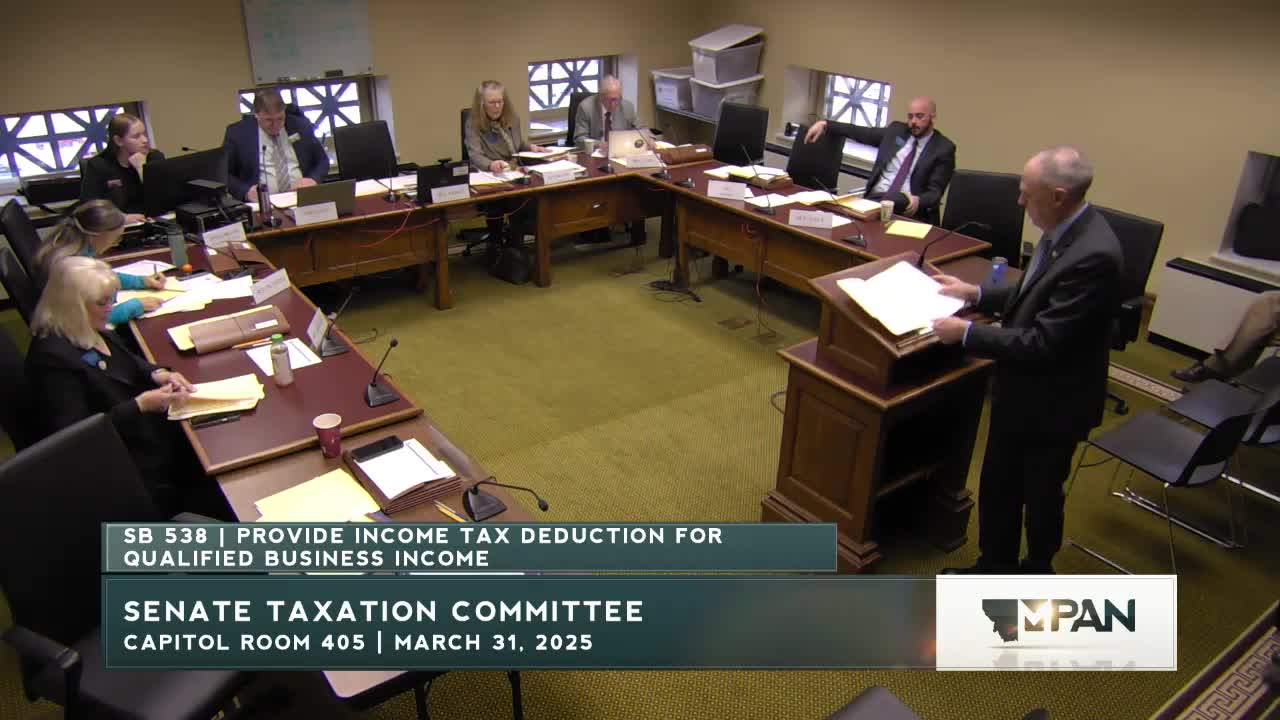
Committee hears SB 538 to allow federal 199A pass‑through deduction on state returns
Summary
Sen. Greg Hertz said SB 538 would conform Montana law to the federal 20% pass‑through deduction (Section 199A); proponents said it levels the playing field for small businesses, opponents warned the break skews to high‑income taxpayers and would cost the state tens of millions annually.
Senator Greg Hertz opened the SB 538 hearing by describing the federal Section 199A pass‑through deduction, which allows certain sole proprietors, partnerships and S corporations to exclude up to 20% of qualified business income for federal tax purposes. Hertz said SB 538 would add the deduction back on Montana returns to reduce complexity and better align state and federal treatment.
Sheridan Hoyer of the Montana Chamber of Commerce and Rhonda Wiggers of the National Federation of Independent Business testified in support, saying Montana small businesses pay higher effective state taxes than large corporations because the state has not historically conformed to 199A. Opponents included Rose Bender of Montana Budget and Policy Center, who argued the deduction disproportionately benefits high‑income households and has cost the federal government significant revenues without delivering measurable benefits to workers.
Department of Revenue witnesses Aaron McNay and Brian Olsen were on hand to answer questions about the fiscal note and implementation. McNay said the department’s reports can break down affected taxpayers by industry and size but did not provide an estimate of the distribution by business size during the hearing. Opponents cited research that a majority of the federal deduction’s benefits flow to households with more than $1 million in income and warned of a likely annual state revenue loss exceeding $60 million if Montana adopted the deduction permanently.
Hertz closed by arguing the deduction mainly helps small Montana pass‑through businesses and could reduce costs for consumers; opponents and informational witnesses highlighted long‑term fiscal risks. No formal committee vote on SB 538 was recorded in the transcript.