Get Full Government Meeting Transcripts, Videos, & Alerts Forever!
Get email alerts on the Public Safety Budget topic
No spam. Unsubscribe anytime.
Executive Office of Public Safety outlines FY26 priorities, warns of federal uncertainties
Summary
Secretary Terence Reedy told the Joint Committee on Ways and Means that the Executive Office of Public Safety and Security’s H1 request for FY26 is $1.7 billion, with the Executive Office itself recommended at $56 million — a $9.7 million reduction versus FY25 GAA driven by staff and grant cuts — and he warned that federal shifts could quickly force further changes.
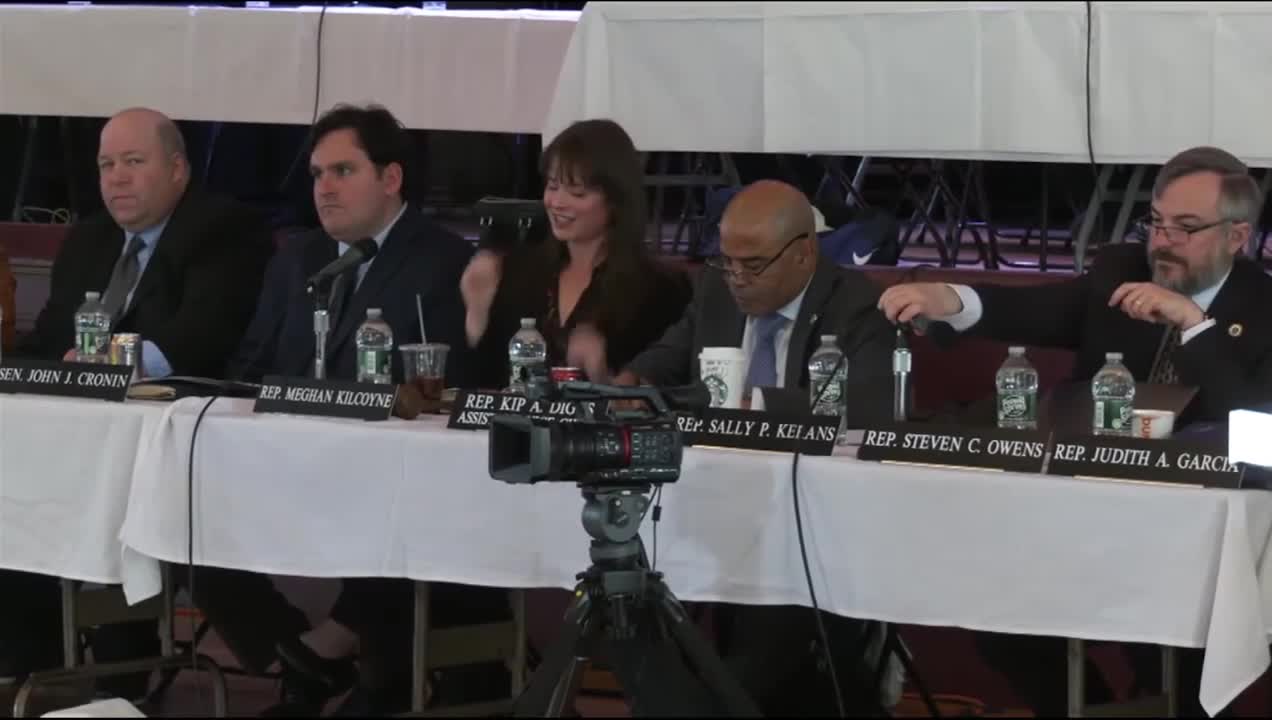
Secretary Terence Reedy told the Joint Committee on Ways and Means in Clinton that the Healy–Driscoll administration’s H1 proposal for the Executive Office of Public Safety and Security (EOPS) totals $1.7 billion and includes a recommendation of $56 million for the Executive Office itself, down $9.7 million from FY25 GAA.
Reedy and his executive team described the H1 package as focused on sustaining core public-safety functions while prioritizing technology, training and reentry supports. He said the $1.7 billion request represents a year‑over‑year increase driven in part by collective bargaining costs, a new DOC health‑care contract and other non‑discretionary increases, but warned the Secretariat faces “uncertain waters” if large federal shifts occur.
The secretary listed programs and initiatives EOPS has run or launched in 2024 and 2025: an Emerging Adult Leadership Academy and summit, a civil‑rights symposium for law‑enforcement, an election‑security summit, a campus‑safety summit, a narcotics symposium on emerging threats, and new reentry tools such as tablet‑based parole orientation and coding/mentoring pilots inside facilities. Reedy emphasized investment in telepathology at the Office of the Chief Medical Examiner and modernized data systems (including a cross‑tracking criminal‑justice data tool), and said EOPS received national recognition for its technology efforts.
Reedy told members that H1 contains reductions to some grant programs (nonprofit security, Shannon grants, human‑trafficking prevention) and administrative staffing cuts that account for the Executive Office decline versus FY25. He and CFO Emmy Joy Maffeo said the request attempts to balance sustaining core functions with fiscal constraints, and that they will follow up to answer detailed budget questions from legislators.
On immigration enforcement, Reedy told the committee federal activities involving ICE are a federal matter and that state law precludes Massachusetts law enforcement from acting in a civil immigration capacity; he pointed to the SJC “Lund” decision as part of why federal‑state practices are under discussion.
Reedy and members repeatedly flagged the need for federal support for large events (notably the 2026 FIFA World Cup matches hosted in Massachusetts), saying planning assumes federal funding for large public‑safety costs and that shortfalls would create major challenges.
The secretary brought a large team of agency heads to answer members’ questions during an extended Q&A: topics included the Department of Correction’s staffing and wellness problems, corrections health‑care costs, training and MPTC tuition increases, and programs to address K2/synthetic cannabinoid incidents.
Looking ahead, Reedy asked legislators to consider the systemic fiscal pressures nationwide and the importance of cross‑branch cooperation if federal shifts affect state revenue or create new demands.
Why it matters: EOPS is the state’s coordinating office for dozens of public‑safety functions. The secretariat’s budget choices directly affect law enforcement training, corrections health care and emergency planning; members said they will weigh the Secretariat’s maintenance requests against rising contract and collective‑bargaining obligations.