Get Full Government Meeting Transcripts, Videos, & Alerts Forever!
Get email alerts on the Tax Data Centers topic
No spam. Unsubscribe anytime.
Senate committee hears bill to clarify tax treatment for data‑center communications infrastructure
Summary
Sen. Becky Beard told the Senate Tax Committee that SB 540 would clarify how property used by qualified data centers is assessed, especially local dedicated communications infrastructure; proponents said the change would boost certainty for investors, opponents warned of local tax shifts.
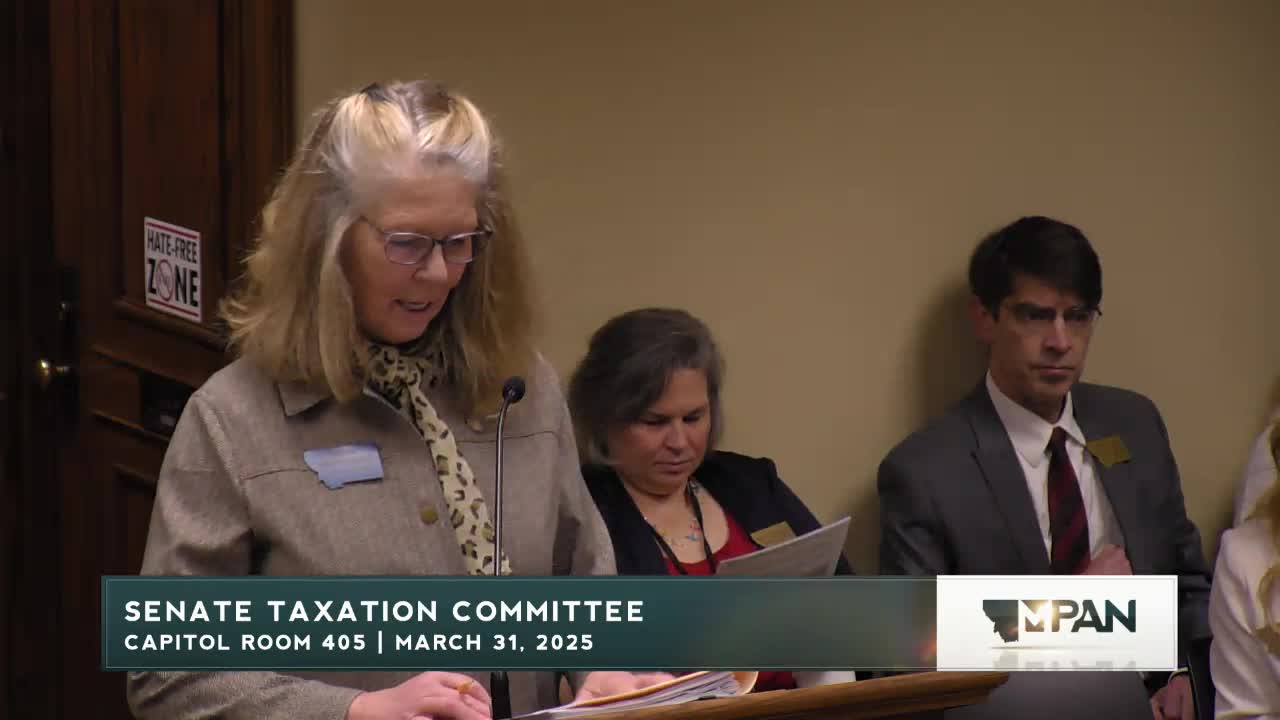
Senator Becky Beard, sponsor of Senate Bill 540, told the Senate Tax Committee the bill clarifies how property used by qualified data centers is classified for property tax purposes and aims to make Montana more competitive in attracting data‑center investment.
The bill draws a line around “locally dedicated communications infrastructure” — copper, fiber, microwave and satellite links — and says that such infrastructure that lies entirely within a single county and within the external boundaries of a data center should be locally assessed as part of the qualified data center. Beard said the change removes uncertainty that can deter potential projects.
Proponents at the hearing included representatives of R Plus Energies, a renewable energy and storage developer; the Montana Chamber of Commerce; and the Montana Taxpayers Association. Jonathan Forrester of R Plus told the committee his company has developed large renewable projects in the Intermountain West and supports SB 540 because clarified tax treatment will help data‑center investors align energy projects with facilities.
Rose Bender of the Montana Budget and Policy Center spoke in opposition, urging attention to local budget effects. Committee members pressed Department of Revenue staff on implementation details; Jill Gallagher, Industrial Unit Manager at the Department of Revenue, told senators the department will need reporting language and that current law already treats some infrastructure as locally assessed but the bill removes ambiguity. Gallagher said the in‑service date that can trigger coverage was revised to Dec. 31, 2024, and that, as she understands it, “there isn't any of that right now.”
Beard and proponents cited neighboring states’ data‑center incentives and the current Class 17 rate of 0.9% versus Class 13 at 6% if certain infrastructure converts after 15 years. R Plus representatives asked the committee to remove a 15‑year “trigger” that would move some communications property into a higher class; the amendment before the panel clarifies definitions, adds a Department of Revenue reporting requirement, and extends the external‑boundary treatment through 2037 for communications infrastructure that crosses county lines.
Senators asked whether energy generation sited at or adjacent to a data center would be covered; committee members flagged House Bill 424 (energy inclusion) as a related measure legislators may need to coordinate with SB 540 if both pass.
After the hearing the committee took executive action; the committee adopted an amendment that reorganized and clarified definitions and added a reporting requirement, then moved SB 540 as amended out of committee by voice vote (committee record: 6‑2, senators Heyman and Dunwell recorded as opposed).