Get Full Government Meeting Transcripts, Videos, & Alerts Forever!
Get email alerts on the Behavioral Health Sobering Center topic
No spam. Unsubscribe anytime.
Presbyterian Medical Services reports rising sobering-center use; council hears calls to increase funding
Summary
Presbyterian Medical Services updated the Farmington City Council on operations at its Total campus, reporting a jump in sobering-center admissions and steady growth in the Joint Intervention Program. Presenters and two program participants described services, gaps and a need for additional funding and a crisis triage center.
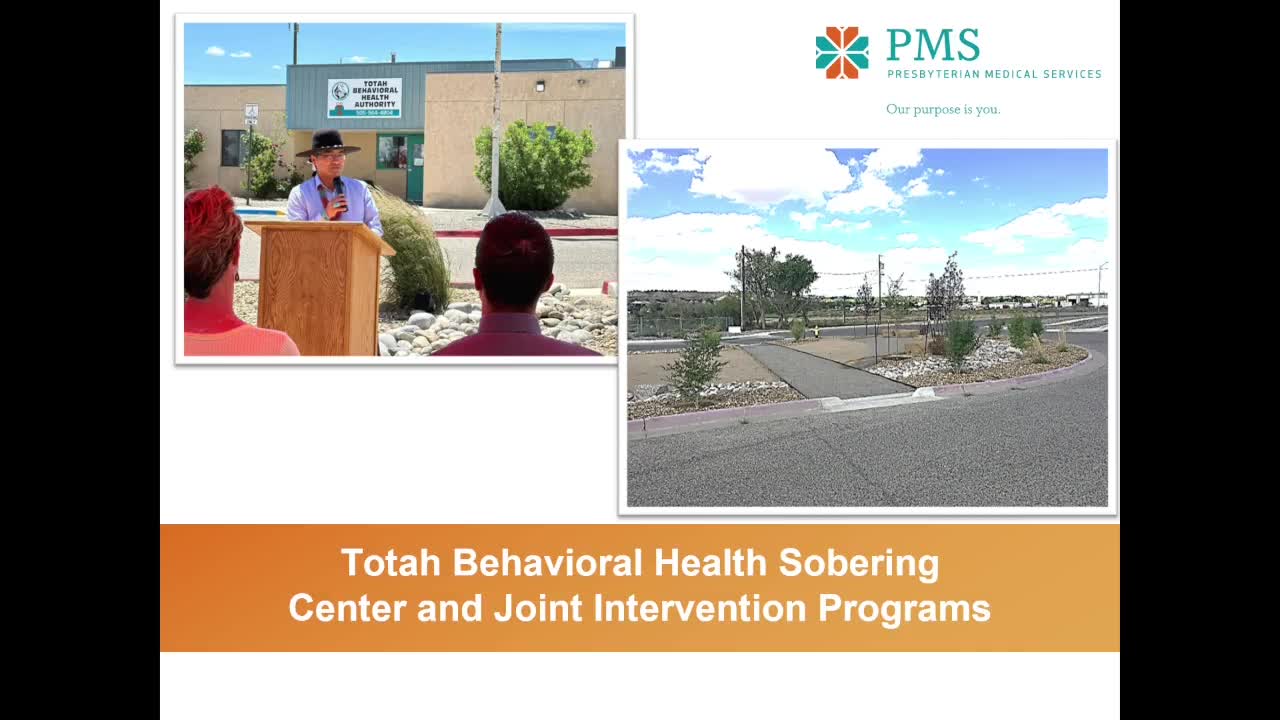
Presbyterian Medical Services’ representatives told the Farmington City Council on a recent evening that the nonprofit’s Total campus — which includes a 24/7 sobering center, a crisis-expansion shelter and the Joint Intervention Program (JIP) dormitory called Paul’s Place — has seen a substantial increase in use and is seeking additional local funding to keep pace.
Jill Adair, Northwest Region Director for Presbyterian Medical Services, said the sobering center logged 9,472 admissions in 2023 and 12,271 in 2024, with the single highest month last December at 1,286 admissions. “Our greatest month, our most admissions per month was last December with 1,286 admissions during that month,” Adair said. She added the center now averages roughly 37 people on site at a time and has expanded intake hours in a short pilot to open at 5 a.m.
The nut graf: Councilors questioned whether the jump in admissions reflects unmet local need or regional shifts in how other cities handle homelessness and intoxication. City staff and PMS representatives urged the council to consider a roughly $300,000 annual increase to sustain current services and discussed an additional $200,000 to expand an allied mobile crisis team (the ARU) that has been supported by now-expired grant funding.
Christine Carlson and Esteban, program staff at the Total campus, described services on the site that combine medical oversight, mental-health assistance, case management, cultural healing and transitional housing. Esteban, identified as the JIP administrator, said Paul’s Place can house roughly 36 people (about 30 men and six women) and currently had 32 residents, with two clients living off campus while participating. Carlson said the campus has been operating in Farmington since 2001 and that programming is built on kinship and relationship models tailored to the area’s largely Native clientele.
Two people in the JIP — Preston Bridal and Cassandra Harrison — addressed the council during the presentation. Bridal, who said a judge had offered the program as an alternative to a jail term, described reobtaining identification and preparing for work: “This program has really helped me become better to be back in society,” he said. Harrison, who said she had been in the program since September 2024, said she had nearly nine months sober and planned to pursue classes at San Juan College.
Councilors asked about drivers of higher admission counts. Adair and Carlson said several factors likely contributed: word-of-mouth referrals (now the program’s top referral source), voluntary self-referrals that have grown to 60–70 percent of admissions, and regional shifts in how neighboring cities route people experiencing homelessness. Adair also told the council the center accepts people with high blood-alcohol content and will accept clients with drug intoxication; the expansion provides a sober overnight option for people who need a place to sleep after sobering.
Council discussion touched on operational limits and gaps. PMS staff said contraband — particularly cannabis products since legalization — complicates residential rules at Paul’s Place and can trigger relapses. Carlson said many program participants have co-occurring mental-health conditions and that a proposed crisis triage center (a separate facility from the navigation center) would help people who present primarily with acute mental-health crises. Councilors and staff flagged workforce shortages for clinical providers and EMTs as ongoing constraints.
City Manager Robert Mace briefed the council on finances tied to the campus: current local partners share roughly $1.5 million annually for the JIP, sobering center and expansion after grant offsets. Mace said staff will include a roughly $300,000 funding increase request in the upcoming budget cycle and that the city is discussing cost-sharing with San Juan County, San Juan Regional Medical Center and Presbyterian Medical Services. He also said the ARU’s grant-funded pilot has ended; continuing and expanding that mobile response could raise annual local costs to about $685,000, depending on staffing models.
The presentation closed with council members thanking presenters and the two program participants. Several councilors said the campus and services provide a regional hub for treatment and crisis care and urged continued coordination on funding, outreach and potential triage-center planning.
Ending: Council members said they plan to keep the item under consideration during the budget process and to continue discussions with PMS and county partners about funding and program expansion.