Get Full Government Meeting Transcripts, Videos, & Alerts Forever!
Get email alerts on the City Finance Budget topic
No spam. Unsubscribe anytime.
Quincy staff present conservative revenue forecast for fiscal 2026; grocery tax cited as buffer
Summary
City staff outlined a $50.73 million budget projection for fiscal 2026 on March 3, 2025, stressing reliance on sales and home rule taxes and flagging declines in state-shared revenues; grocery tax was estimated at $1 million–$1.2 million and noted as a budget pressure reliever if retained.
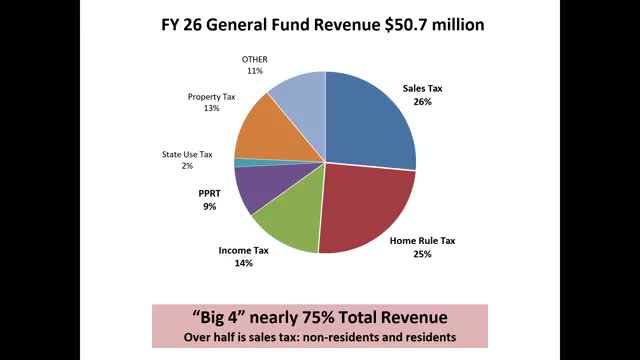
City staff presented the city’s revenue projections for fiscal year 2026, which begins May 1, 2025, telling the Quincy City Council the administration expects roughly $50,732,000 in general fund revenue.
The presentation, delivered by Sherry (staff member), said more than half of the city’s general fund revenue comes from sales tax and the local home-rule (purchase) tax, with income tax and the Local Government Distributive Fund (PPRT) comprising the other major pieces. Sherry said the city is using conservative growth assumptions: 2.5% growth for sales tax and home-rule receipts and cautious estimates for state-shared sources.
Sherry said the Illinois Municipal League (IML) projections informed income-tax and PPRT forecasts, but noted those state-shared formulas are population-based and Quincy’s population declined 2.88% between the 2010 and 2020 censuses. She said IML projected a 3.2% increase in income tax per capita and a roughly 6.7% decrease in PPRT next year, and the city adjusted PPRT assumptions downward based on timing differences between state and city fiscal years.
On the grocery tax, Sherry told the council the tax is already being collected and estimated it would generate approximately $1 million to $1.2 million annually for the city. She said keeping the grocery tax in place would reduce pressure on property taxes and help offset declines in other revenues, while acknowledging the decision on the tax could be made later in the year and would largely affect a single month of the coming fiscal year if not extended.
Sherry emphasized lag effects in sales-tax reporting — March receipts reflect December activity — and reminded the council that local sales and home-rule projections rely on historical trends going back to 1998 and on statewide inputs such as IML and Illinois Department of Revenue analyses.
Council members asked for an updated packet version; Sherry agreed to redistribute the updated presentation to members after the meeting.
Sherry concluded the review noting the general fund budget baseline is about $49.7 million for the current year and staff’s projection for FY26 is $50.73 million, with notable downside risk in PPRT and use tax and upside potential in sales and home-rule receipts if local trends improve.