Get Full Government Meeting Transcripts, Videos, & Alerts Forever!
Get email alerts on the Housing Needs Analysis topic
No spam. Unsubscribe anytime.
Champaign council directs staff to seek consultant for housing needs analysis and strategy
Summary
Council authorized staff to prepare a request for qualifications for a consultant to conduct a housing needs analysis and strategy expected to take 12–15 months. Staff cited sharp rent increases, low single-family permitting and rising homelessness as drivers of the study.
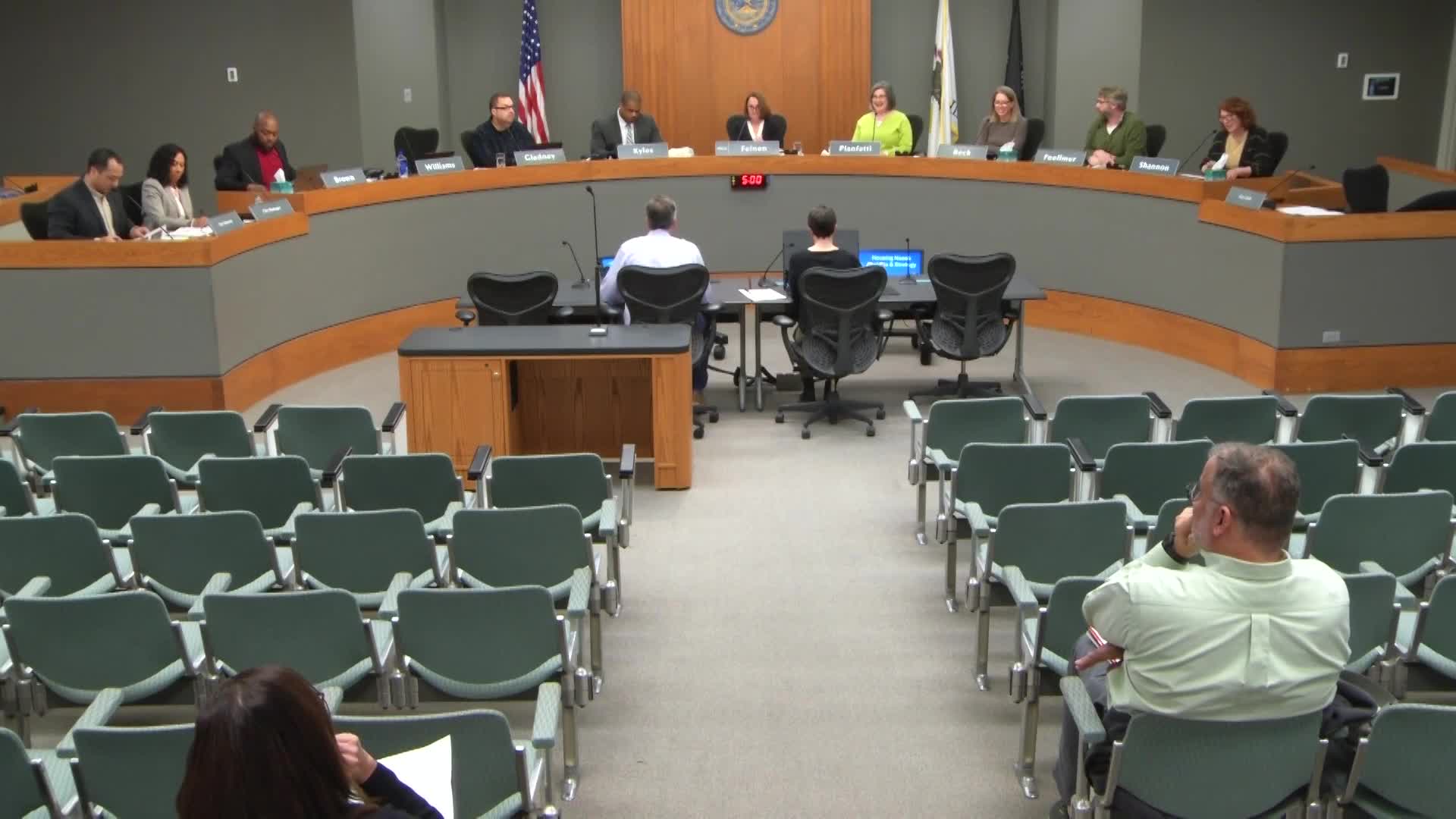
City staff presented a proposal Tuesday for a comprehensive housing needs analysis and strategy and council directed staff to prepare a request for qualifications for consultant services. Neighborhood Services Director Rob Kowalski and Community Development Specialist Lauren Weber told the council the study will analyze the city’s housing stock, resident demographics and demand; include community engagement, developer interviews and roundtables; and produce a prioritized strategy for policy and program actions.
Why it matters: Staff said the study will give Champaign-specific data and recommended strategies to address gaps in supply and affordability that staff and council members described as limiting economic growth and making housing less attainable for residents.
Kowalski opened the presentation by framing the national supply shortage and by asking what the local shortfall is: “What is Champaign short of? How many units? What kinds? Who can afford housing here and who cannot?” He and Weber said publicly available county- and city-level data show substantial renter cost burden and falling for-sale inventory. Weber said city-level data indicate about 55% of renters spend 30% or more of their income on housing and that single-family building permits were at a record low in 2024 (23 permits). She also noted a pattern in recent multifamily construction: most new multifamily units served the student market rather than the nonstudent community.
Weber described the study scope in three parts: an existing-conditions housing needs analysis (inventory, age, types and geography of housing; price-to-rent trends); a resident-demographics analysis (household size, income, employment access and special needs); and a demand analysis that links units needed by type and income level. Staff said they will supplement national and ACS datasets with additional local sources and with consultant analysis (for example, price-per-square-foot and vacancy data) and will pursue targeted community outreach, provider roundtables and interviews with regional developers.
Kowalski and Weber said the work will ask practical questions — for example, how student and community housing markets overlap and how to count per-bedroom pricing in student-oriented units — and will make recommendations on policy changes, programs and implementation partners. They proposed a 12–15 month timetable, with initial housing needs analysis results available in about six to eight months, a strategy by spring 2026 and implementation starting in summer 2026.
Council members asked detailed questions about study methods and uses. Council Member McGladden asked why single-family supply has lagged despite high prices; staff said construction costs, financing risk and possible local land or policy constraints will be examined. Council Member Rebec and others asked staff to ensure student housing is parsed from the community market and to measure per-bedroom rent and price-per-square-foot when feasible. Council Member Beck said staff’s plan to "socialize" results and validate them with residents is essential. Several council members urged targeted outreach to historically underserved neighborhoods and to include other governments and service providers in roundtables.
After discussion, council approved direction for staff to proceed with the housing needs analysis and strategy and to prepare a request for qualifications seeking consultants with experience in university towns and local-market analysis. Staff said consultants will be asked to provide a clear affordability-gaps analysis and a prioritized toolkit of policy options and programs. The study will be funded from city resources and is expected to require consultant contracting; staff said a contract will be presented to council for approval once a consultant is selected.