Get Full Government Meeting Transcripts, Videos, & Alerts Forever!
Get email alerts on the Subdivision Regulations topic
No spam. Unsubscribe anytime.
Taylor County officials, fire chiefs and insurers press for review of subdivision rules after insurer pullouts
Summary
At a commissioners court hearing, fire chiefs, insurance agents and water suppliers urged the county to review subdivision rules to improve emergency access, hydrant availability and water-storage options after insurers scaled back coverage in rural areas.
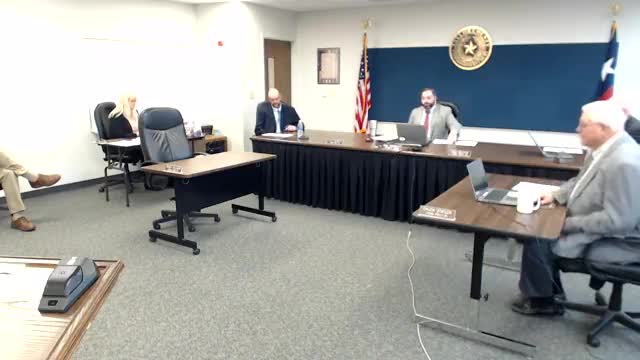
Taylor County commissioners heard an extended discussion on subdivision regulations, firefighting access and homeowner insurance during the commissioners court meeting. Fire chiefs, local insurance agents and water-supply managers told the court that private subdivisions with narrow roads, single ingress/egress and no hydrants are increasing fire risk and contributing to an insurer exodus from some rural areas.
The discussion, held during item 7b of the agenda, brought together Echo Fire Chief Derek Young, Chief Sal (emergency management), insurance agents Mike Bristow and Dan Presto, Mike Wiley, water suppliers including Stephanie Honey (manager, Yukas Water Supply) and representatives of Steamboat Long Water. County legal staff and emergency management staff also participated.
Why it matters: multiple speakers said insurance companies have recently declined new policies in parts of the county because of fire-protection ratings and prior claims, raising the cost or availability of coverage for new and existing homeowners. County leaders said addressing road widths, multiple access points, perimeter fuel breaks, and water-supply design (hydrants, larger mains or local storage tanks) could reduce insurance risk and improve firefighter access.
Speakers described a consistent set of concerns and potential remedies. Insurance agent Mike Bristow said the immediate need is water infrastructure: “The biggest thing we could do to help … is to get those fire hydrants in those subdivisions.” Bristow told the court that several underwriters have stopped writing new rural policies in areas rated poorly by the public-protection classification system, and that adding hydrants can materially reduce a homeowner’s premium.
Fire officials described problems that complicate response. Chief Young urged the court to look ahead and “bring awareness to the future and what all of us together can do that will benefit everybody in the county,” citing narrow private roads, cul-de-sacs too small for apparatus, dead-end streets and vegetation encroaching on roadways. Sheriff Bishop and other chiefs described incidents where crews had to haul water miles because hydrants or storage were not available.
Water suppliers and engineers explained technical and regulatory constraints. Stephanie Honey (Yukas Water Supply) said some systems must increase main sizes, pump capacity or storage to support hydrants; where those upgrades are not hydraulically feasible, she suggested subdivision-level storage tanks dedicated to fire suppression as an alternative. A representative of Steamboat Long Water noted elevation differences and system pressure limits could make hydrants or 6-inch mains costly or impractical in some locations.
County counsel summarized legal limits and the likely next steps. County attorney Mr. Staney told the court the county’s subdivision authority is grounded in Texas Local Government Code Chapter 232 and cautioned that the county may not be able to impose retroactive requirements on existing subdivisions. He recommended further research and interagency discussions with water providers, the Texas Commission on Environmental Quality (TCEQ) and the Texas Department of Insurance to clarify what the county can legally require going forward.
Emergency management noted mitigation funding and planning processes can help address specific high-risk locations, but that mitigation programs typically require site-specific documentation and a clear set of problems to justify grant-funded or regulatory interventions.
Court reaction and next steps: commissioners and staff did not adopt an ordinance or immediate rule change at the meeting. Several commissioners described individual roads in their precincts where access problems already exist and asked staff to bring back options. County staff said they will continue research, meet with water suppliers and regulators, and return with proposals for the court to consider, including nonretroactive requirements for new subdivisions and possible incentives or standards for developers to install 6-inch mains, hydrants or on-site storage.
The discussion closed without formal action; commissioners said the topic requires additional study and coordination with water suppliers and state regulators before any change in county policy.
Ending: Commissioners asked staff to pursue interagency meetings with water suppliers, TCEQ and insurance stakeholders and to return with draft options and cost estimates. No regulatory changes were adopted at this session.