Summerville budget presentation shows projected FY25 deficit, $4.5M in new requests and staff proposes cuts and phased positions
Loading...
Summary
Town staff presented a FY25 draft showing roughly $56 million in requested expenditures, capital asks and new positions that create a deficit; staff identified $4.5 million in new-personnel/capital requests and proposed timing and targeted reductions to close the gap ahead of next workshops.
Town of Summerville staff presented a detailed FY25 budget summary to council showing higher projected revenues than last year but a sizable gap between requests and available resources.
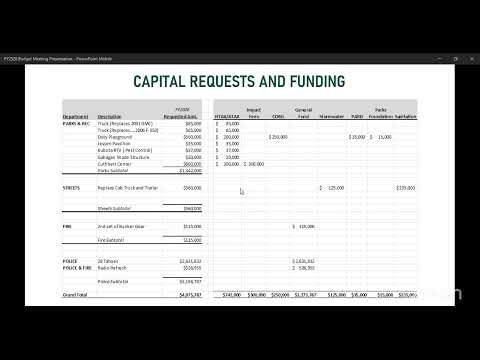
Finance staff said projected revenues increased roughly 10% year over year but total requested expenditures approached $56 million, producing a deficit once capital and new positions are included. Staff listed capital requests of about $3.2 million and new-position salary requests of roughly $900,000 (with fringe at about 35 percent) and noted those totals push the general-fund gap to an amount staff described as significant.
Key figures staff used in the presentation included an illustrative $2.6 million local-option sales-tax total (discussed separately) and aggregated departmental requests. The presenter said staff had identified approximately $4.5 million in new-personnel and program costs (all departments combined) and that eliminating or timing some of those additions would be necessary to balance the budget. Staff proposed options including phasing hires into January, shifting some capital to a capital fund rather than the operating budget, and transferring hospitality and other special revenues where legally permitted.
Staff also highlighted grants and restricted funds: hospitality-tax (ATAX) receipts and local accommodations were shown as potential funding sources for certain park and events projects; staff emphasized the distinction between local ATAX and state ATAX and said state ATAX rules limit allowable uses. The crisis-intervention (CIT) grant was presented as federally funded with a person tied to the award; staff cautioned that if federal funding were not renewed, the town would need to absorb or remove those personnel actions.
Several department heads detailed specific priorities and trade-offs. Maintenance and streets staff described limited capacity to expand sidewalk work without additional personnel or outsourcing; building-inspection staff said the town would focus on cross-training and internal certification rather than funding a new concierge position. IT and permitting staff outlined a plan to consolidate citizen-permitting software training and workflows to speed permitting and reduce handoffs.
Staff said they would return with specific options at the next budget workshop and listed an April session date for continued review; council members asked staff to present scenarios for closing the gap and to estimate the timing effect of delaying hires until January. No formal budget vote occurred during the meeting.