Get Full Government Meeting Transcripts, Videos, & Alerts Forever!
Get email alerts on the Municipal Budget topic
No spam. Unsubscribe anytime.
Ossipee voters approve operating budget after line-item fights over legal fees, welfare and outside agencies
Summary
After more than five hours of line-by-line debate, Ossipee voters approved the town's operating budget, $7,912,516, including several floor amendments: the town's legal services line was raised to $100,000, the Freedom Food Pantry/Waystation grant was increased, welfare funding was cut, and the town's tax-anticipation line was reduced.
Moderator opened Article 14, the town's operating budget, reading the warrant: "To see if the town will vote to raise and appropriate the sum of $7,907,516 for general municipal operations." The assembly then debated the budget line by line.
The discussion focused on a handful of contested lines that drew the most sustained comment: the legal-services budget, the line funding the Waystation (a homeless-services nonprofit), the welfare (general assistance) appropriation, and the town's tax anticipation line (line of credit). Speakers pressed the moderator and department leaders for details about prior-year spending and the anticipated impacts of increases or cuts.
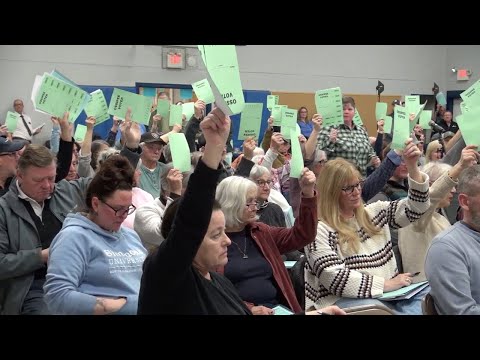
The largest single amendment that carried was to the legal line. Selectman Jonathan Smith, citing recent building and zoning enforcement cases and recovery of funds through liens and sheriff's sales, moved to increase the legal-services line from the budget committee's recommendation of $75,000 to $100,000. Smith said the town had spent about $110,000 to $115,000 the prior year and that enforcement activity often requires upfront legal money that is later recovered: "We currently have recovered $20,000 back paid directly back to the town for actions taken in both building code and zoning enforcement," he said. The amendment passed by counted ballot (results read aloud: 97 yes, 77 no), and the legal line was set at $100,000.
A separate, hotly debated amendment increased the town's appropriation for the Waystation (listed in the warrant as the weigh station) from $2,000 to $10,000. Supporters described the group's case work and winter shelter costs, citing the Waystation's recent expansion of a client coordinator position and hotel-room placements. Selectmen and the budget committee opposed the increase on grounds that welfare funds exist for many emergency needs and that handing out items such as tents or sleeping bags raises accountability concerns. After floor discussion and a counted vote, the amendment passed 87—34 (87 yes, 74 no) and the line became $10,000.
On general assistance (welfare), the budget committee moved an amendment to reduce the line from $32,450 to $24,450 (a reduction of $8,000). The motion's proponents said the town's welfare office historically under-spends its allocation and that some services to residents are handled by outside agencies; opponents warned that welfare is a state-mandated service and that cutting the line would leave the town to find emergency funding elsewhere. The amendment passed and the welfare line was reduced to $24,450.
Voters also approved an amendment to lower the town's line-of-credit appropriation (tax anticipation note) from $30,000 to $10,000 on a counted vote (83 yes, 80 no). Selectmen and the town's administration had argued the line-of-credit amount is prudent as short-term cash access to preserve town operations if tax revenues are delayed.
Highway and paving funding drew questions but no final amendment remained: a floor amendment to cut the paving warrant article from $600,000 to $300,000 failed; the separate paving warrant (Article 18) later passed as printed.
After all line-item votes and the carried amendments, the moderator announced a new bottom line for Article 14 that accounted for the adopted floor changes: $7,912,516. Voters approved the article as amended by voice/placard vote. The moderator then asked that the vote not be reconsidered.
Ending: The operating budget debate accounted for the bulk of the evening's time and reflected divided views about how to balance immediate service needs, legal enforcement costs that can later be recovered, and the town's appetite for adding recurring expenses.