Get Full Government Meeting Transcripts, Videos, & Alerts Forever!
Get email alerts on the Wastewater topic
No spam. Unsubscribe anytime.
Kalamazoo holds public hearing on proposed $196.8 million Clean Water SRF project plan including biosolids thermal system and two sewer repairs
Summary
Kalamazoo City staff held a public hearing to present the city’s fiscal year 2026 Clean Water State Revolving Fund project plan and invited public comment on a package of projects that would be submitted for competitive SRF financing.
Kalamazoo City staff held a public hearing to present the city’s fiscal year 2026 Clean Water State Revolving Fund project plan and invited public comment on a package of projects that would be submitted for competitive SRF financing. The plan’s main elements are a thermal biosolids treatment system with energy recovery, the replacement of a failing 6-inch sanitary sewer on Farmers Alley with an 8-inch line, and rehabilitation of a deteriorated sewer at Kleinstuck Preserve.
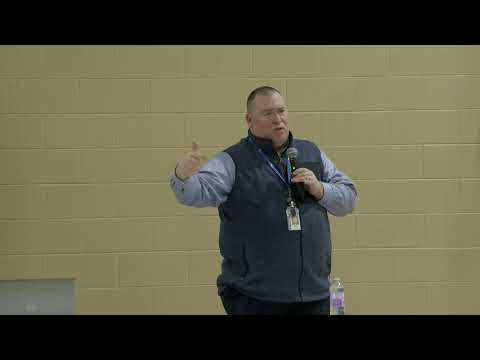
The projects together represent the city’s recommended investments to reduce long-term disposal costs, reduce sewer overflows and improve system reliability. “This unit’s ability to destroy PFAS. So that’s something that’s, you know, really, novel in terms of, processes for wastewater across the state of Michigan,” city presenter James Baker said during the hearing, describing the proposed biosolids thermal oxidation and energy-recovery system.
Why this matters: city staff said the package would address recurring sanitary-sewer overflows downtown and in the Kleinstuck Preserve, reduce reliance on external biosolids disposal contracts and lower long-term disposal costs that the city said have increased markedly since 2019. Staff estimated construction costs at about $194,000,000 for the dryer and energy recovery system (ERS), $337,000 to replace the Farmers Alley sewer, and $2,100,000 to rehabilitate the Kleinstuck Preserve sewer, for an approximate total of $196,800,000. Staff estimated the combined projects would raise a typical residential equivalent unit (REU) bill by about $12.66 per month.
Project descriptions and rationale - Biosolids thermal system and ERS: Staff described a system to dry biosolids, then thermally oxidize residual material and capture heat for reuse on site. The proposal would reduce biosolids mass (improving handling and lowering disposal volumes), recover heat for site uses and, staff said, enable the plant to accept material from other utilities that face issues with PFAS or other contaminants. Baker said the technology would operate at higher combustion temperatures than older incinerators and include modern emissions controls; he noted the city must apply for and receive a state air “permit to install,” which will trigger a separate public comment and permitting process.
- Farmers Alley sewer replacement: Staff said an existing 6-inch sanitary line in a downtown alley has a history of failures, structural deterioration and capacity shortcomings that have caused backups and public-health risks. The recommended work is replacement of roughly 70 linear feet of 6-inch pipe with an 8-inch sewer, plus new manholes and service laterals to restore capacity and reliability.
- Kleinstuck Preserve sewer rehabilitation and access improvements: The Kleinstuck Preserve sewer dates to 1929 and, staff said, suffers localized structural defects (drop pipes, improper slopes, root intrusion and vandalism) that have caused sanitary sewer overflows (SSOs). The plan calls for pipe repairs and replacements where needed and a new roughly 12-foot maintenance access path from Stearns (staff noted the plan online currently shows Chevy Chase as the access route but said Stearns is being considered to allow maintenance vehicles to enter and exit without turning around).
Alternatives and environmental considerations Staff described alternatives (no action, dryer-only, optimization, and regionalization) and said a dryer-only approach would cut disposal mass but not eliminate disposal costs and would have different emissions outcomes compared with the proposed ERS. Staff also summarized environmental review topics that will require further study—archaeological and historical resources, endangered species (staff said five federally threatened species are identified in Kalamazoo County and that protections will guide work in preserve areas), air quality, stormwater and construction impacts—and said consultants will carry out the detailed analyses.
Public comment and concerns Several residents and stakeholders spoke. One commenter asked whether the Kleinstuck access would come off Stearns rather than Chevy Chase; staff said Stearns is an option because it provides a route that allows vehicles to enter and exit and that the plan online is not finalized. Another resident urged the city to seek funding to help homeowners who must replace service lines from the sidewalk to their homes; a commenter representing the Stewards of Kleinstuck, Erin Fuller, offered the nonprofit’s willingness to work with the city on access and preservation while enabling necessary maintenance.
Air-permitting and PFAS Staff emphasized that the biosolids thermal system would require a state air permit to install and that the permit process includes its own public comment period and public hearing. Baker told the hearing the proposed thermal oxidation would operate at higher temperatures with modern emissions controls, including selective catalytic reduction, and that the city would follow federal, state and local permitting requirements. He also said the system’s ability to destroy PFAS could make Kalamazoo a regional option if other plants face limits on land application.
Procedural next steps City staff said written comments received by the city clerk will be included in the project plan record. The presentation concluded with staff stating the city will continue environmental reviews, engineering refinements and the air-permit process; staff did not propose a vote at the hearing. The project plan remains on file at the city clerk’s office and as an online link for public review, and further permitting and funding steps will follow.
Ending Staff closed the public hearing after receiving oral and two written comments and said further engineering, permitting and public-notice steps will occur before final design and construction.