Get Full Government Meeting Transcripts, Videos, & Alerts Forever!
Get email alerts on the Signs And Ordinance topic
No spam. Unsubscribe anytime.
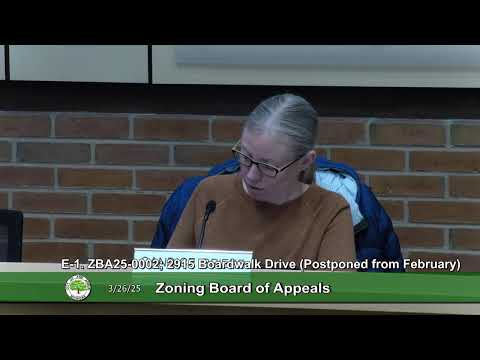
Zoning board debates sign‑height variances for Arborland and Boardwalk properties; members split on visibility versus ordinance compliance
Summary
The Ann Arbor City Zoning Board of Appeals on March 26 considered two variance requests to install wall signs above the city’s 20‑foot placement limit and recorded a split board on how to weigh visibility and maintenance against the 2019 ordinance.
The Ann Arbor City Zoning Board of Appeals on March 26 considered two variance requests to install wall signs above the 20‑foot height limit set by the city’s 2019 sign ordinance.
Petitions reviewed: a request by a tenant at 3755 Washtenaw Avenue (Arborland shopping center, tenant: Skechers) for a 7‑foot variance to install a new wall sign at a maximum 27 feet, and a request at 2915 Boardwalk Drive (tenant: Granger) for a 9‑foot variance to install two wall signs at a maximum 29 feet. Planning staff described both properties as located in the TC‑1 Transit Corridor District and said the buildings were under the 45‑foot threshold that triggers the ordinance’s wall‑sign placement rule.
Why it matters: The sign ordinance adopted in 2019 requires wall signs on buildings under 45 feet tall to be located in the lowest 20 feet of façade. Applicants said the existing signs are nonconforming and that corporate rebranding or visibility from Washtenaw/Eisenhower and vegetation along the corridor justify replacement at the same, higher locations.
Discussion and applicant arguments Will Johnson of Johnson Sign Company, representing the Granger property at Boardwalk Drive, said the company was updating corporate branding and sought to maintain the signs “in the same place” and to preserve visibility over vegetation. He said the new signs would reuse existing electrical connections.
Jim Fields and the Skechers representative (3755 Washtenaw) argued the storefront sits back from the roadway and placing the sign lower would reduce visibility; the petitioner said locating the sign below the architectural band would expose mounting and electrical penetrations in customer‑facing areas. Fields said, “Staying below that threshold really puts that down to where the visibility is so much lower.”
Board deliberation and key concerns Board members split in their evaluations. Several members said the existing sign locations and maintenance concerns (rust and exposed mountings) provided a practical difficulty supporting a variance. One board member said, “Because I think sign maintenance is important, you don't want things to rust. On balance, I would approve this at a higher [level] because of the maintenance issues.”
Opponents and consistency concerns Other members argued the businesses already had working signs and corporate rebranding does not override the city’s ordinance. One member noted past denials of corporate rebrands elsewhere and said the ordinance should be enforced consistently: “When people are updating their signage is the time for that signage to comply with our updated sign ordinance.” Another member noted several stores in Arborland have signage at lower heights and questioned whether the applicants had shown the minimum relief necessary.
Votes and dissent Board members recorded support and opposition during roll calls and discussion; the transcript shows members both voting in favor and opposing the petitions. Several supporters emphasized existing electrical connections, the site’s vegetation and the setback from the roadway as reasons to allow replacement at the existing heights; opponents emphasized ordinance compliance and consistency with previous denials of corporate rebrands.
Outcome noted in the record The transcript captures the board reading motions that would grant the requested variances and records members’ yes and no remarks during roll calls. The record also shows dissenting votes and explicit opposition. Because the meeting transcript contains overlapping statements and some compound roll‑call language, the final, formal dispositions are recorded in the meeting minutes and in the municipal filing for each petition; the discussion in the transcript shows the split nature of the board’s vote and the arguments for and against granting variances at both sites.
What applicants said next Applicants were told they could revise and resubmit if they wished to lower sign heights; staff noted that replacement signs reusing existing mounting and electrical connections were part of the presentations. The board reminded applicants that appeals of ZBA decisions may be filed to the Washtenaw County Circuit Court.