Get Full Government Meeting Transcripts, Videos, & Alerts Forever!
Get email alerts on the Traffic Stops And Equity topic
No spam. Unsubscribe anytime.
Commission weighs follow-up study on Driving Equality Ordinance as two-year mark approaches
Summary
Members discussed the availability of traffic-stop data and possibilities for a follow-up study of Ann Arbor's Driving Equality Ordinance. Researchers and the police chief said data exist but that technical, time and funding constraints will shape any new analysis.
Commissioners discussed commissioning a follow-up analysis of Ann Arbor’s Driving Equality Ordinance as the city approaches the ordinance’s two‑year mark. Dr. Karpiak, who worked on the original study, told the commission the data used in the first analysis remain available and that a repeat study is technically feasible if there have been enough traffic stops during the interim.
Dr. Karpiak said the initial analysis used three years of data to obtain the statistical specificity needed to break down stops by race and gender; he cautioned that similar statistical power will depend on how many stops have occurred since the ordinance took effect. He also said the earlier grant that supported part of the prior work was $25,000 and was used mainly to fund a graduate student role; larger funding would be needed to replicate a fuller study.
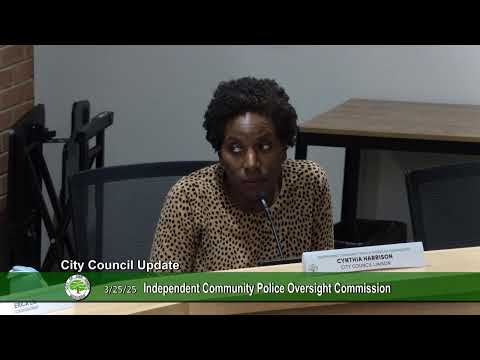
Councilmember Harrison reminded commissioners that the Driving Equality Ordinance was passed in July 2023. Chief Anderson said the department is reviewing available data despite challenges with some records systems and that policy and training reviews are underway; he indicated the department would provide information to the commission about data availability.
Commissioners discussed funding options. Dr. Karpiak and others noted past small grants had helped but that a comprehensive follow-up could require larger support or a multi‑year approach. Commissioners also mentioned that the U.S. Department of Justice had offered research grants in the recent past to analyze traffic-stop data in municipalities that adopted similar laws; availability of those programs now is unclear.
No formal action was taken. Commissioners asked staff to explore whether commission budget funds could be earmarked or combined across fiscal years to support a study, and to follow up with the city attorney and potential academic partners about feasibility and timelines.