Get Full Government Meeting Transcripts, Videos, & Alerts Forever!
Get email alerts on the Mill Levy Broadwater Sheriff topic
No spam. Unsubscribe anytime.
Broadwater County sheriff outlines plan to continue five‑year mill levy, details staffing and jail costs
Summary
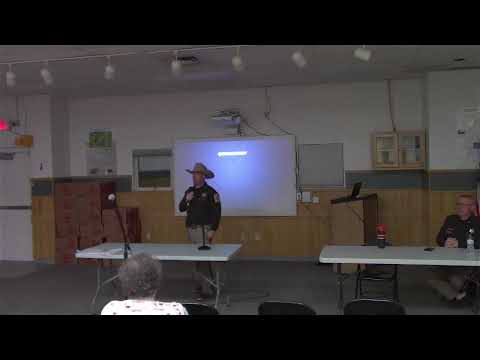
Sheriff Nick Grauser held a public briefing in Townsend to explain a proposed continuation of the county's five-year mill levy and to show how levy revenue supports dispatch, deputies and the detention center.
Sheriff Nick Grauser of Broadwater County outlined plans to continue the county's five-year mill levy and described how the revenue pays for dispatch, deputies, detention operations and other law-enforcement expenses during a public meeting and video presentation.
Grauser said the levy was approved five years earlier and described the current proposal as a continuation rather than an increase. "This mill levy was voted in 5 years ago, and the biggest thing I want to emphasize is essentially just a continuation of the mill levy 5 years ago. There's no more mills, so I'm not gonna ask for any more mills," Grauser said. He said the office intends to mill about 31.95 mills next year, down roughly 20 percent from a recent level and below the statutory cap he cited of 39.93 mills.
The meeting was intended to show residents what the sheriff's office does daily and why Grauser and staff say the levy is needed. Grauser walked through the office's four operational divisions—dispatch (the dispatch control room), deputies, the detention center, and the coroner function—and played a 35-minute video containing incident footage to illustrate typical calls for service.
Why it matters: Grauser said personnel costs account for the majority of the sheriff's office budget, and that mill-levy revenue makes up about one-third of the office's overall funding. Without the levy, he said, difficult choices would be required about cuts to staff and services.
Budget and operations details provided at the meeting - Calls for service: Grauser said dispatch handled about 17,000 calls for service in the prior year. - Detention: Grauser said the detention center handles both local inmates and inmates booked from other counties and the Department of Corrections; he estimated the jail typically holds about 31 inmates but noted daily fluctuation. He compared the cost of housing inmates out of county (citing Lewis and Clark County and Gallatin County rates of roughly $120 per inmate per day) to maintaining the county's own facility. - Staffing and pay: Grauser said personnel make up about 77% of the office budget. He listed law-enforcement wages at about $1,400,000; detention wages at about $586,000; dispatch at about $411,000; and a total office budget of about $3.2 million, with wages of about $2.5 million and roughly $748,000 remaining for vehicles, equipment, training and contracts. - Revenue: Grauser identified several revenue sources: the county's allocation of property-tax mills (which he said the county commissioners assign at 34.4% to the sheriff's office), contracted services to the city of Townsend, inmate housing reimbursements and the mill levy. He said the Department of Corrections per-diem for inmates is set by statute at $82 per day.
Grauser described specific, day-to-day pressures on staff: he said dispatchers commonly operate alone on a 12-hour shift and that a single multi-agency emergency can require multiple simultaneous pages and contacts. He described the detention environment as volatile and said deputies respond to a wide range of cases, including DUI and child-related offenses that require extensive investigative work.
On inmate housing, Grauser said housing other counties' inmates is a revenue source that helps offset costs. "Most of our inmates we get are from the Department of Corrections. State law, they set that cost. It's $82," he said. He added that inmate counts and the county's own inmate population affect capacity and revenue planning.
Public engagement and next steps Grauser said the office has been holding a series of public meetings and has sent a survey to residents with three response options: support the levy, oppose it, or request more information about services. He said "yes" was the top selection, with requests for more information the second-most common response. He invited residents to take tours of the dispatch center, detention area and other facilities and announced an upcoming meeting on the south end of Broadwater County the following Wednesday at 6 p.m. at Headwaters. The briefing was livestreamed to the county YouTube channel, and Grauser asked attendees to share that link.
No formal vote or ordinance was taken at the meeting; Grauser's remarks described the office's intended levy level and its use of levy revenue rather than recording a board decision or ballot outcome.
Grauser closed by asking residents to consider how levy revenue supports 911 dispatch, detention staff and deputies who respond to emergencies. "When people ask me where does the money for the mill levy go, this is where it goes," he said, listing dispatch, detention and patrol as principal uses.
The sheriff's office materials and the video shown at the meeting contain additional incident-level footage and operational detail that Grauser said he is willing to review on facility tours.