Get Full Government Meeting Transcripts, Videos, & Alerts Forever!
Get email alerts on the Oversight Budgeting topic
No spam. Unsubscribe anytime.
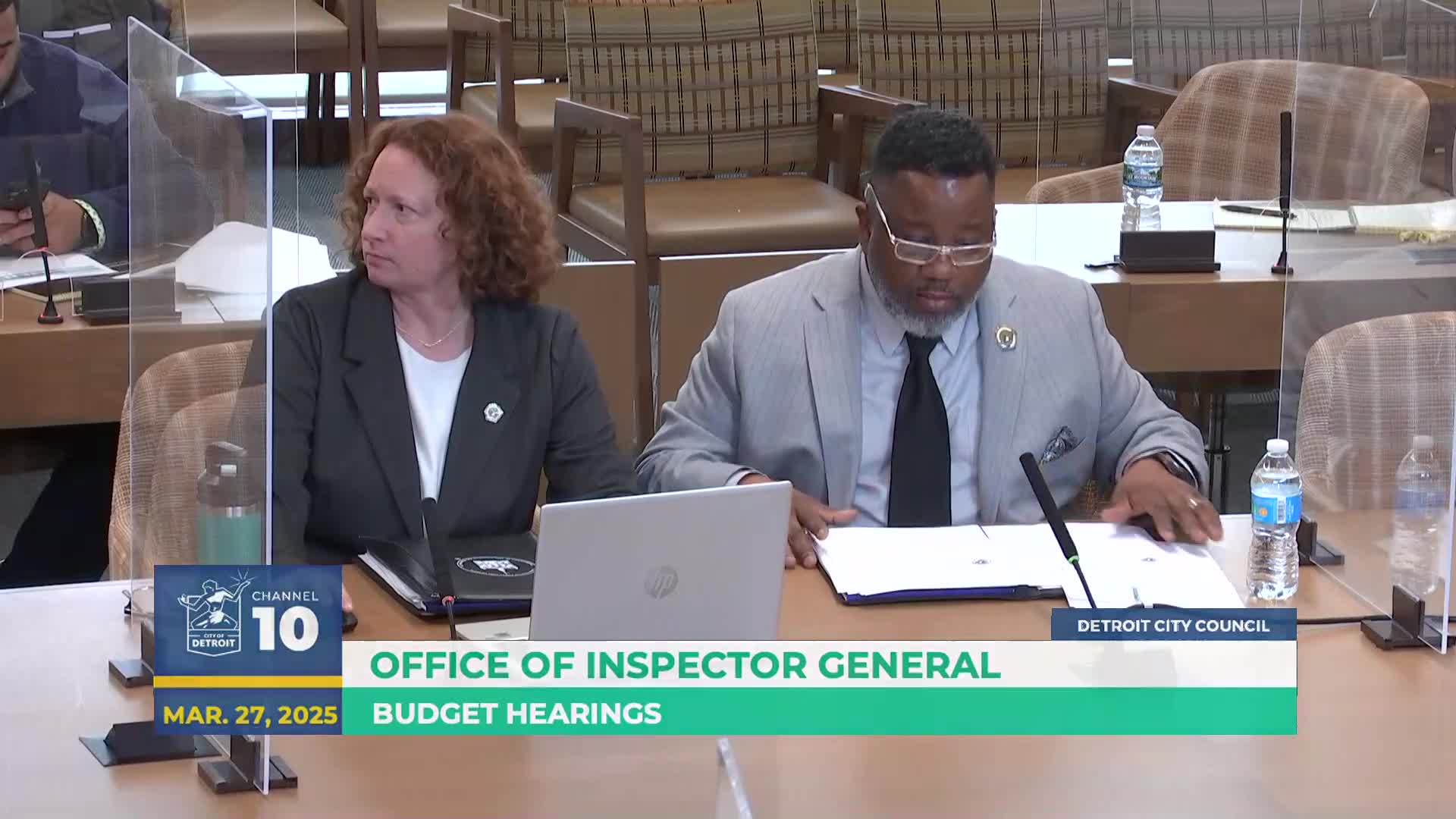
Detroit Inspector General asks council to fund manager position, details investigations and new oversight tools
Summary
Inspector General Bridal Maribel outlined 2024 casework, new oversight initiatives and asked the Detroit City Council to move $171,379 into the OIG budget to fund a manager position; council approved the request by voice vote with no objections.
Inspector General Bridal Maribel told the Detroit City Council during a budget hearing that the Office of Inspector General is seeking $171,379 to fund a manager of investigations and audit position and described office activity and new oversight tools the office plans to use.
Maribel said the office’s purpose is “to detect and root out fraud, abuse, waste, and corruption in city government and contracting.” She gave a summary of the OIG’s 2024 caseload and recent activity, saying, “We received and or reviewed 263 complaints in that time. We closed 250 complaints. We initiated 38 investigations. And we completed and closed 21 investigations.”
The OIG’s presentation explained that the office also issued 10 debarments and two interim suspensions in 2024, and that joint work with state and federal partners produced criminal charges in a multi-year case in which Maribel said $1,250,000 was returned to the city before sentencing and total restitution was $4,720,000.
Nut graf: The funding request would cover a new manager position and several operating items the OIG says are needed to meet charter responsibilities and expand proactive oversight. Maribel said proportional funding enacted last year creates a pathway for the OIG to grow to a 15-person office; the presentation tied that growth to improved preventive work on waste, fraud and abuse.
Maribel described changes already under way in the office. She said the OIG has created a manager of investigations and audit role to reduce bottlenecks in workflow and align the office with OIG best practices, and that an information analyst position (hired in November and identified in the presentation as Srinivas Gamba) is helping to modernize the office’s IT and data work. “We created this position,” Maribel said of the manager role, and later described the new workflow as routing drafts through the manager to the deputy and then to the inspector general for final approval.
The IG also outlined new offerings: inspections and evaluations to review policies and programs for compliance and vulnerabilities; an OIG advisory memorandum service departments may request for confidential evaluations; and expanded community engagement and social media outreach, including a Social Media Action Committee (SMAC). Maribel said the office published 11 memorandums and official reports, issued four quarterly OIG reports, produced three editions of a Good Government newsletter and issued seven press releases in 2024.
Maribel described recent statistics for early 2025 as well: “to date, we’ve received 89 complaints. We’ve closed 92. 10 are pending,” and she explained that some pending items carried over from the prior year. The presentation also noted that the office conducted two administrative hearings in 2024 and said the new manager role had been filled on a working-title basis by a long-standing auditor in the office.
On proportional funding, Maribel said the 2012 city charter created the OIG and that proportional funding—approved in 2024—would, in her presentation, let the office expand to the 15 staffers she described. During the presentation she cited proportional funding figures in several ways: she said a fully staffed OIG would represent “2.2% of the city’s budget,” then said “point 2% of the city budget,” and added that “the entire proportional funding resolution would be less than 1% of the city budget.” (Those three statements were presented consecutively in the hearing.)
After the presentation Council President asked for a motion to move $171,379 into the OIG budget for the requested items. The motion was placed on the floor and, according to the record, “Any objection? Seeing none, then action shall be taken.” The council approved the budget move by voice vote; no roll-call tally was recorded in the hearing transcript.
Councilmembers asked questions after the presentation. Member Durhall thanked the IG for work on the procurement ordinance and said a fiscal impact study on the proportional funding resolution is in committee. Member Johnson asked whether the office had been “fully funded” before the city entered emergency management; Maribel replied that the OIG was created in the 2012 charter and was stood up during the city’s emergency management period, and that the office never had an opportunity to be “fully funded” or benchmarked in earlier years. Member Santiago Romero asked about the difference between work the OIG would do proactively and the auditor general; Maribel said the OIG focuses on vulnerabilities to “fraud, abuse, waste and corruption,” and that proactive inspections and evaluations would be targeted through that lens.
The presentation closed with Maribel inviting councilmembers and the public to refer complaints and to request outreach or advisory services. Councilmembers and the IG discussed measuring outcomes if additional positions are approved.
Ending: The council approved the requested $171,379 allocation by voice vote during the hearing; Maribel and Deputy Inspector General Jennifer Bentley said the office will continue to publish findings and expand community engagement as it implements the new positions and programs.