Get Full Government Meeting Transcripts, Videos, & Alerts Forever!
Get email alerts on the Government Transparency topic
No spam. Unsubscribe anytime.
Commission rejects social media policy; commissioners debate scope for elected officials
Summary
Muskegon commissioners declined to adopt a proposed social media use policy after members expressed concern the draft could be read to regulate elected officials' personal accounts. The motion failed on a roll call vote after extended discussion of FOIA, a Supreme Court ruling and definitions of "official" pages.
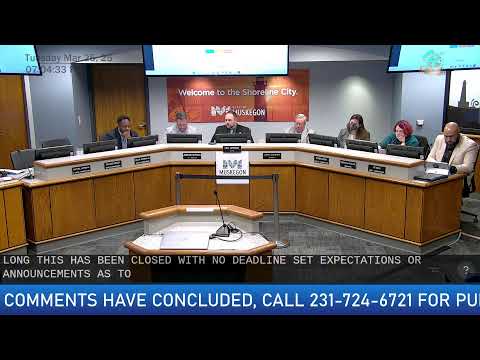
The Muskegon City Commission on March 25 did not adopt a proposed Social Media Use Policy and Guidelines after commissioners raised concerns about wording they said could treat elected officials’ personal social media accounts as official city channels.
Deborah Sweet, the city’s community engagement manager, reviewed changes made after a work session, saying staff added a disclaimer to explain that comments on official city posts may be turned off and that the policy covers official city accounts. Sweet told the commission the policy is intended to define which accounts the city operates and therefore must be archived and governed.
Commissioners discussed a single sentence in the policy’s scope that refers to “public officials.” Commissioner Kilgo said he objected to public officials being included in the scope because elected officials are accountable to voters and should not be regulated in the same way as city staff. Vice Mayor Sinclair and others pressed for clarity about whether the policy would apply to personal accounts, commission pages run personally by officials, or only to city‑managed accounts that use city credentials.
Commissioners and staff repeatedly cited a recent U.S. Supreme Court ruling and Michigan’s Freedom of Information Act as reasons to be explicit about what qualifies as an official city account and what remains a private page. Sweet and city staff said the policy aims to draw that line so the city can point to what it controls in the event of legal questions about deletion or moderation of comments.
Commissioner Jeremy and others said the text still left ambiguity about the phrase “public officials” and how it could sweep in personal pages; several commissioners suggested revising the language to say “elected officials” if the intent is to limit scope. The manager and staff noted the language in the draft was crafted with legal counsel in response to court guidance.
After discussion the commission took a roll call on the motion to approve the policy as presented. Vice Mayor Sinclair and Mayor Johnson voted “yes”; Commissioner Kilgo voted “no”; other commissioners who voted were recorded as supportive in the transcript, but the chair declared the motion did not proceed. No revised version was adopted; staff may return with modified language for future consideration.
The exchange highlighted an ongoing local tension: commissioners said they want to protect elected officials’ First Amendment rights on personal networks while also ensuring the city complies with record‑keeping and public‑records obligations for official channels.