Get Full Government Meeting Transcripts, Videos, & Alerts Forever!
Get email alerts on the Economic Development topic
No spam. Unsubscribe anytime.
Powell council hears plan to reorganize Powell Development Corporation into broader public‑private economic development board
Summary
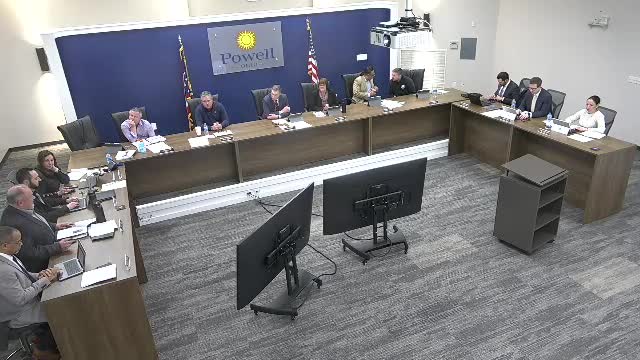
Sean Hughes, the city’s economic development administrator, presented a plan to restructure the Powell Development Corporation (PDC) into an expanded Community Improvement Corporation (CIC) during the Powell City Council meeting on Tuesday, Feb. 4.
Sean Hughes, the city’s economic development administrator, presented a plan to restructure the Powell Development Corporation (PDC) into an expanded Community Improvement Corporation (CIC) during the Powell City Council meeting on Tuesday, Feb. 4. Hughes described a nine‑member board with four council appointees and five seats filled by representatives of new advisory committees for business retention and expansion, tourism, entrepreneurship, downtown merchants and real estate.
The plan, Hughes said, is intended to increase capacity and create a closer public‑private partnership to carry out goals from the city’s recent economic development study. "This is an evolution of our PDC," Hughes said. "What you're creating is [a] living, breathing mechanism that can adapt and grow as the community adapts and grows." He described the structure as a way to align land use, support growing industries, enhance downtown vibrancy and expand the PDC's staffing and volunteer base.
City Manager Andy White, who introduced the proposal, told council the PDC is a separate entity from the city but a useful vehicle for economic development. White said next steps would include discussions with the existing PDC board and modification of the PDC's articles of incorporation. "We're on the right track," White said, adding that no council action was needed immediately.
Key elements Hughes outlined include four council appointees (typically the mayor or designee, the city manager or designee, a school district representative and one at‑large appointee) and five private‑side seats representing the proposed committees. Hughes proposed committee leads or designees from VisitPal (downtown merchants), Destination Delaware (tourism), the Delaware Entrepreneurial Center and a Real Estate Committee of property owners and developers. He said the PDC currently has five board members and the reorganization would expand that to nine.
Hughes identified two budget items discussed during the presentation: the PDC currently provides $35,000 annually to VisitPal to support downtown marketing and events, and the PDC budget includes $25,000 to support the entrepreneurship effort with the Delaware Entrepreneurial Center. He said some committee work could be carried out under subsidiary or management agreements, and that city staff would continue to perform much of the PDC’s financial recordkeeping and legal oversight.
Council members pressed on governance and representation. Councilmember Tyler Herman and others asked whether the school district would reliably supply a high‑level representative; Hughes said he had spoken with Ryan Jenkins, the school district’s CFO, who he expects to be engaged. Multiple council members raised concern that with only four council appointees on a nine‑member board, a private‑majority board could direct policy contrary to council preference. One council member pointed out the need to vet and approve private‑side board members and to protect the city’s subsidy and oversight role when redrafting the articles of incorporation.
Questions also covered downtown participation and membership in VisitPal. Hughes said VisitPal is currently open to all downtown businesses, with meeting attendance varying from about five to 25 people, and that restaurants are harder to engage because of meal‑service schedules. He said VisitPal’s boundaries follow the city’s current downtown boundaries and could change as those boundaries change.
Speakers emphasized that the proposed structure intends to increase capacity for projects now in progress. Council members noted the proposal represents a substantial step up from current operations and will require initial intensive staff work. White and Hughes explained that because the PDC is a component unit of the city, its finances are tied to the city’s financial reporting and the city would retain oversight of budgetary intent and reporting.
Hughes described statutory limits he believed applied to CICs, noting a typical public/private composition rule often cited as a 40% public/60% private split for boards of this type; he said he would double‑check the exact statutory language. White and others said modifications to the PDC articles and additional board vetting would be part of implementation if council supports the concept.
The presentation concluded with staff requesting feedback rather than immediate action. White noted that, if council gives consent to proceed, the next work items would be board conversations and formal amendments to the PDC incorporation documents and governance rules.
Votes at a glance: the meeting approved the prior meeting minutes and adopted the consent agenda (which included multiple facade grants) by voice vote; council later approved a motion to convene an executive session under Ohio law (Ohio Revised Code Section 121.22) by roll‑call vote. The PDC reorganization itself was presented for feedback and no formal council vote on the reorganization occurred during the meeting.
Ending: Staff indicated they will follow up with the existing PDC board, draft changes to the articles of incorporation and return to council for additional review. Council members asked staff to ensure the redrafted governance documents protect the city’s oversight role and clarify membership selection and financial reporting before any formal changes become effective.