Get Full Government Meeting Transcripts, Videos, & Alerts Forever!
Get email alerts on the Transportation Active Transportation topic
No spam. Unsubscribe anytime.
Powell reviews shared‑use path master plan; consultants recommend 41 projects, prioritized for grants
Summary
City staff and consultants presented a draft shared‑use path master plan that inventories Powell’s network, scores corridors by safety and access, and recommends 41 projects with cost ranges and prioritization intended to help the city pursue grants and CIP funding.
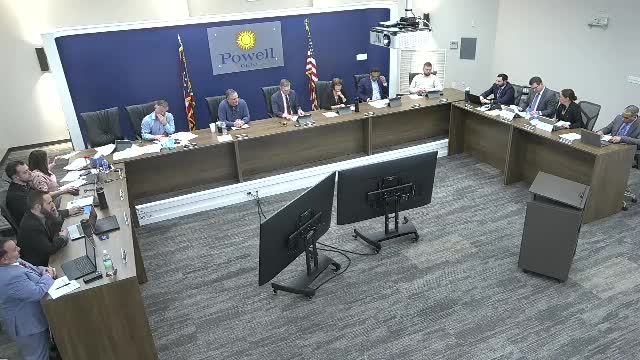
Council members on March 4 heard a formal presentation of a draft Shared Use Path Master Plan that inventories Powell’s existing network, identifies gaps and safety hot spots, and recommends 41 projects prioritized for construction and grant pursuit.
The plan, presented by planners Shannon Fergus and Ella Donnelly and consultant partners, combines crash data, pavement ratings, population and destination mapping, and extensive public engagement: the team reported about 14 in‑person engagement sessions plus six staff sessions and an online survey that had delivered roughly 480 responses as of late February. “We looked at the existing network, and then looked at gaps within the over a hundred miles of pathways in Powell,” Fergus said. The plan also includes a database tying each path to recorded plat language about maintenance responsibility.
City staff and consultants said the plan’s prioritization criteria weight connectivity to regional trails, access for higher‑need populations (using ODOT’s Active Transportation Need Index), proximity to schools and parks, population within a quarter‑mile, and public input. “We developed a prioritization criteria, and the steering committee … helped us do some iterations,” Donnelly said, describing how the team mapped higher‑priority projects in green on the plan’s maps. Recommended improvements include widenings (with an example Sawmill widening), crossings such as railroad improvements and RRFBs (rapid flashing beacons), and repairs or replacements where pavement condition is poor.
Cost estimates vary widely: consultants said individual projects range from about $120,000 to $5,000,000 depending on length, right‑of‑way needs, drainage, and other engineering factors. The team said cost estimates break down by categories (construction, right‑of‑way, drainage, design and incidental costs) so staff can see acquisition versus construction components for each project.
Council members pressed on feasibility and priorities: several members said they favored completing missing links and connecting existing segments before building entirely new long corridors. Councilmember comments also questioned whether an 11‑foot width (the ODOT minimum recommended) is realistic citywide; the consultants said they recommend 11–13 feet where feasible but acknowledged tradeoffs with cost and right‑of‑way. Staff noted the plan is a 15–20 year document intended to produce shovel‑ready projects for grant applications and for the CIP process.
The council and staff discussed funding: staff said the CIP currently contains design dollars for path additions this year and roughly $750,000 for construction next year, plus a separate $845,000 allocation for a “rewrote” (?) path project that council can reassign. Councilmembers and staff emphasized that identified projects will strengthen competitive grant applications and that joint jurisdictional projects with Liberty Township or other partners often score higher for some federal and state grants.
The presentation included an inventory task consultants described as especially useful: a parcel‑by‑parcel review of subdivision plats to find any recorded maintenance responsibility for paths, saved as a dataset that will accompany the plan and a trail maintenance memo. The team also proposed a maintenance plan template detailing routine repairs and seasonal needs.
Council took the presentation as an informational briefing; no adoption was requested that evening. Staff said materials and detailed tables of project IDs, lengths and priority scores will be posted and that the plan will be used to inform upcoming CIP conversations and grant pursuit.
The plan’s authors recommended council consider the plan’s prioritized list during CIP development and to identify which projects staff should program for design and construction funding or for grant applications. The consultants and staff said they will integrate council feedback and return to council with next steps.