Get Full Government Meeting Transcripts, Videos, & Alerts Forever!
Get email alerts on the Utilities Water topic
No spam. Unsubscribe anytime.
Council leans toward larger water treatment build; staff to seek contractor cost estimate and continue design
Summary
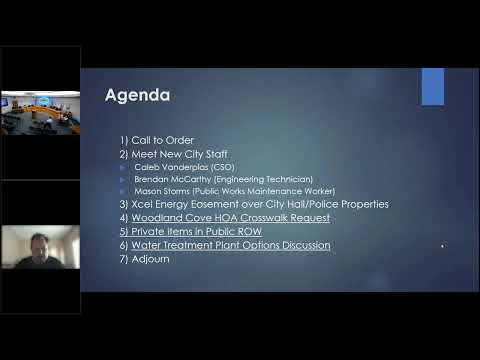
Minnetrista city staff and the water-system consultant presented planning options for a new south-system water treatment plant, including treatment capacity, storage and cost trade-offs tied to demand assumptions.
Minnetrista city staff and the water-system consultant presented updated planning options for a new south-system water treatment plant, including projected demand, peaking-factor assumptions, filter and storage configurations and preliminary cost estimates.
Staff said the system's historical peak-day factor (the ratio of max-day to average-day demand) has averaged about 3.6 for the south zone between 2019 and 2023. The Minnesota Department of Natural Resources (DNR) typically recommends a design peaking factor of about 2.6; using 2.6 would reduce near-term capacity needs, staff said. Using the city's current 3.6 peak factor leads to a larger recommended treatment capacity and storage.
Staff presented options that bracket capacity and storage: a smaller expansion scenario that would add roughly 1,000 gallons per minute (gpm) of treatment capacity (if the peaking factor is reduced toward 2.6) and a larger scenario that would add about 1,700 gpm (or to 2,100 gpm plant capacity when combined with existing capacity). Storage options discussed included a 200,000-gallon pumping chamber with an add-on 400,000-gallon clear well (600,000 total), a 600,000-gallon clear well, and a larger 750,000-gallon clear well. Staff provided preliminary project-cost ranges: early schematic estimates shown in the packet included figures in the roughly $21.8 million to $23.2 million range depending on filter and clear-well choices; staff said removing certain items (for example, a gas-scrubber for a large chlorine system) could reduce the estimate by about $1.4 million.
Council and staff discussed trade-offs: a larger plant and larger clear well extend the time before the city must build additional storage or treatment capacity but raise near-term borrowing and rate impacts; a smaller plant reduces upfront cost but could trigger earlier future construction and higher cumulative cost. Staff noted some design choices (filter type: concrete vs steel) had limited lifecycle cost benefit given current steel prices.
Council gave staff direction to continue design work leaning toward the larger storage/treatment configuration that would push major capacity needs out toward about 2040 if the city retains higher peaking behavior, and to pursue a pre-bid contractor estimate (a CMAR or similar contractor-provided opinion of probable cost) to reduce the risk of unexpectedly high bid results. Staff said it could include bid alternates for the clear well and other elements so the city can stage construction. Council members asked staff to circulate the demand/sensitivity spreadsheet so councilmembers can review peaking-factor scenarios and asked staff to pursue contractor estimates; council did not take a final formal vote at the work session.
Staff emphasized that outcomes depend heavily on the peaking factor (irrigation and seasonal use); they noted that increased onsite stormwater reuse in newer development and lower irrigation demand as landscaping matures could reduce peak-day demand over time. Council directed staff to continue design work, to obtain contractor cost input and to prepare bid documents that include alternates to allow flexibility at bidding.