Get Full Government Meeting Transcripts, Videos, & Alerts Forever!
Get email alerts on the Police Station Financing topic
No spam. Unsubscribe anytime.
New Prague council gives preliminary approval to police-station CIP, tables bond sale resolution
Summary
The City Council approved a capital-improvement plan (CIP) authorizing up to $13 million for a new police station and directed staff to return with financing options; a separate resolution to issue bonds for about $12.84 million was tabled for more analysis of term, cash contribution and tax impact.
The New Prague City Council gave preliminary approval on March 17 to a Capital Improvement Plan (CIP) that sets a not-to-exceed amount of $13,000,000 for a proposed new police facility, but tabled a second resolution that would have authorized the immediate issuance and sale of general obligation bonds to finance the project.
Rebecca Kurtz, municipal finance adviser with Ehlers, told the council the presale report proposes “a bond issue in the amount of $12,840,000” and described how the city could structure debt. She said the proposal assumes a 25-year term, a true interest cost assumption of about 4.5 percent and an underwriter’s fee that could be up to 1.1 percent, and noted the underwriting and closing schedule would put proceeds in hand in May if the council moves forward.
The CIP matters because Minnesota law limits how much a city may issue in debt paid solely by property taxes and also limits annual principal-and-interest payments as a share of market value. Kurtz said the CIP package is written to meet those statutory tests and to provide flexibility for final structure.
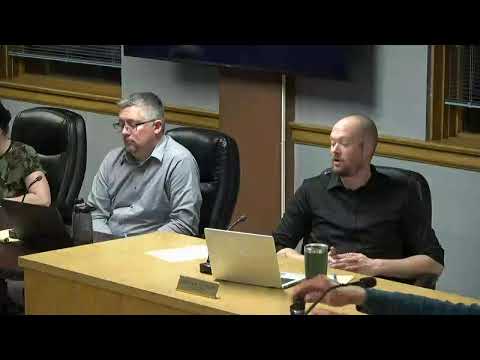
Council debate focused on timing, cost and taxpayer impact. Councilmember Sean questioned advancing the financing ahead of bids for the building, asking, “Why wouldn't we wait until we actually got the bids for the building itself before we move forward? It seems like we're putting this step ahead of it.” Other council members asked staff and the financial adviser to prepare alternative scenarios — including the recommended 25-year term, a 30-year term, and versions with additional cash applied at closing to reduce borrowed principal or capitalized interest.
Kurtz said the presale report as presented capitalizes the first interest payment (due Feb. 1, 2026) into the bond issue and estimated that capitalized interest at roughly $400,000; she noted the city has “a little over $400,000” in cash on hand that could be used instead to remove that charge from the bond if the council chooses. She also said bids for the building were expected March 26 and that staff planned to return April 21 with results of a bond sale if directed to proceed.
Kurtz gave two example structures and their rough tax impacts based on current assumptions: a 25-year term with an average annual debt service around $860,000 and total estimated interest costs “just over $9,000,000,” and a 30-year term with annual debt service about $810,000 but higher total interest “just over $11,000,000.” Using those assumptions, she estimated an annual levy impact on a $350,000 house at roughly $255 for a 25-year structure and about $240 for a 30-year structure.
After prolonged discussion about trade-offs between higher long-term interest costs and lower annual levies, and about whether to use some cash on hand to reduce borrowing, the council approved the CIP/resolution that gives preliminary approval to issue CIP bonds up to the $13 million cap. The council then tabled the companion resolution that would have authorized the formal issuance and sale of the series 2025A bonds in a maximum aggregate principal amount of $12,840,000 and directed staff and Ehlers to return with revised presale schedules showing 25- and 30-year alternatives and scenarios with different cash contributions and “step-up” payment options.
Council members who asked for follow-up — including requests to show both 25- and 30-year amortizations with and without cash applied at closing, and to model a “step-up” (lower initial payments that increase later) — said they wanted the additional detail before committing to a bond sale. Kurtz said that if the presale resolution is approved later she would take bids in the morning and return the results the same evening (April 21) so the council could accept or reject the sale.
Votes at a glance - Resolution 25-03-17-02 (preliminary approval of the Capital Improvement Plan and CIP bonds, not-to-exceed $13,000,000): approved (motion carried by voice vote). No individual roll-call tallies were recorded in the transcript. - Resolution 25-03-17-03 (providing for issuance and sale of general obligation capital improvement bonds, series 2025A, max aggregate principal $12,840,000): tabled on council motion (motion by Councilmember Sean; seconded by Councilmember Rick). Motion carried.
Context and next steps Kurtz said approving the CIP now starts a 30-day statutory period for CIP authority; the presale report and bond documents can be adjusted after bids arrive. Councilmembers asked staff to present detailed debt-service schedules showing 25- and 30-year terms, versions with roughly $400,000 (and larger) cash contributions to reduce capitalized interest or principal, and alternative repayment profiles that ease the levy impact early in the term. Staff and Ehlers plan to return with revised scenarios at the next council meeting, and council members said they would use that information to decide whether to call the bond sale.