Get Full Government Meeting Transcripts, Videos, & Alerts Forever!
Get email alerts on the Transportation topic
No spam. Unsubscribe anytime.
Committee advances bill to add two appointed members to Ada County Highway District commission
Summary
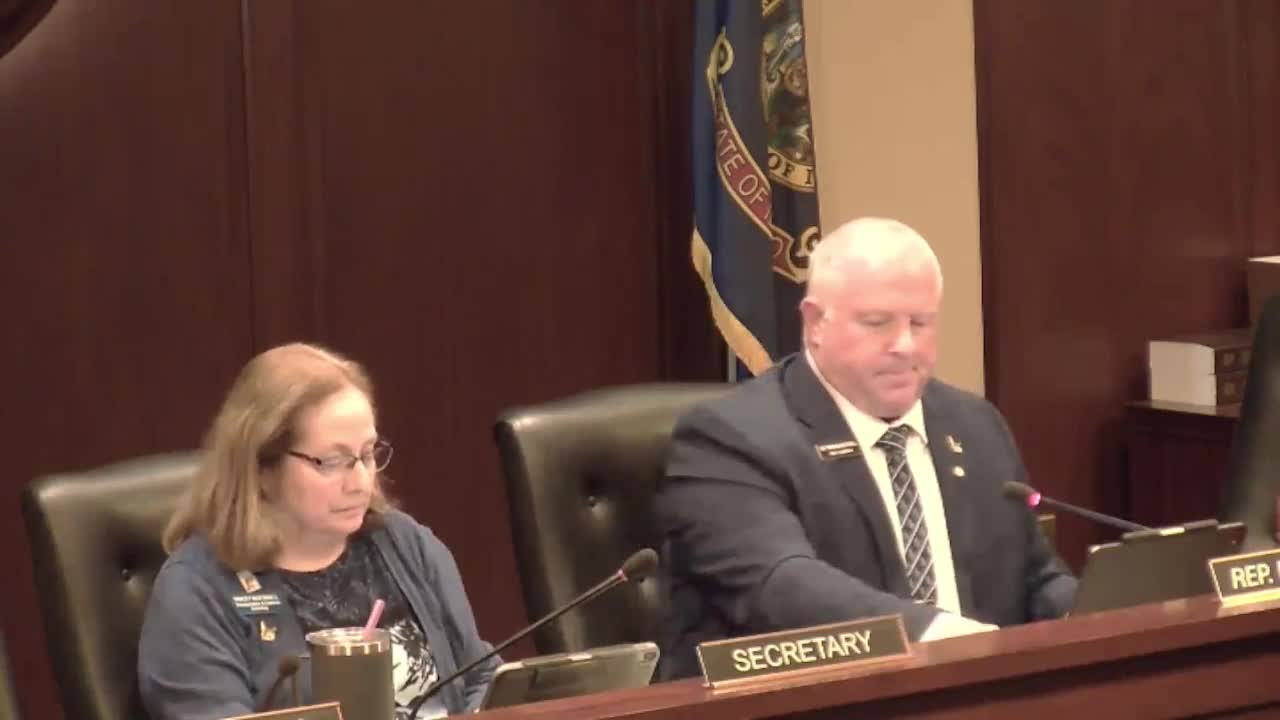
The House Transportation and Defense Committee voted to send House Bill 326 to the House floor with a "do pass" recommendation after more than an hour of testimony on whether to add two appointed members to the Ada County Highway District commission.
BOISE — The House Transportation and Defense Committee voted to send House Bill 326 to the House floor with a "do pass" recommendation after more than an hour of testimony on whether to add two appointed members to the Ada County Highway District commission.
The bill, sponsored by Rep. Joe Palmer (R-Meridian), would increase the ACHD commission from five elected members to seven by adding one member appointed by the governor and one appointed by the county commissioners. "Basically, in a county wide highway district, there will be 2 added commissioners that are appointed," Palmer told the committee.
Supporters of the bill, including Palmer, framed the measure as a way to improve coordination between state and local road systems and to introduce appointed members with transportation experience. Palmer said he would like to "move towards a more professional commission" with criteria for commissioners and argued state and county highways intersecting in Ada County make coordination important.
The bill encountered broad opposition from residents, local officials and transportation advocates who testified that the change would dilute voter control and reduce accountability. "It is a conservative and wise principle that decision making should be made as locally as possible," said Lisa Hecht, who identified herself as an Ada County resident. "This move to seat outsiders who may not understand Ada County's specific needs and not elected primarily by Ada County voters amounts to a loss of representation and overreach."
Other residents made similar points. "Only 4 months ago, voters showed up at the polls and elected officials they want to represent them," Jolene Evans said in testimony opposing the bill. "Political appointees will not be accountable to the people who would be impacted by any decisions this political appointee could make."
Local officials also spoke. John Evans, mayor of Garden City, said cities and the county already need better input and coordination with the highway district but suggested structural changes to governance — for example, a joint powers agreement under the county umbrella — rather than adding appointed members. "We've got a whole layer of government that's unique in the United States, that cogs the wheel sometimes, creates extra public hearings and dilutes the direct contact and challenges the aggregate connection between land use and transportation," Evans said.
Ryan Head, director of the Ada County Highway District, told the committee the district sees no clear problem that the bill would fix and said the measure was the fourth in recent years seeking to change ACHD governance. Head also disputed the fiscal note presented with the bill and gave a cost estimate: "The fiscal note is not exactly accurate. It's about $150,000 so about 10 times what was listed, that it would cost to fully fund 2 additional commissioners, including benefits and PERSI." He also described a recent coordination example: when a local bridge inspection showed a safety issue, ACHD closed the bridge and, together with ITD and Ada County,secured funding through the Local Highway Technical Assistance Council to repair it.
Committee members pressed on details that speakers raised. Representative Gannon asked whether appointees would be required to reside in the Ada County Highway District; Palmer and other speakers stated that the intent is for appointees to live inside the district, though several lawmakers noted the bill's text could be tightened to remove ambiguity about residency. Representative Cloud (Representative Clow in the transcript) noted language in the draft that he said appeared to require subdistrict residency for elected commissioners but not explicitly for appointees; sponsors said that could be clarified in amendment or a trailer bill.
Public testimony emphasized the outcome of recent ACHD elections as evidence of local support for the existing model: witnesses cited recent vote margins for commissioner seats and urged the committee to respect voters' choices. Bicycle and pedestrian advocates argued decisions about local streets are "hyper local" and made the case that commissioners who live in the neighborhoods they represent are more accountable and better informed. "These people have very real concerns that they transmit by talking with their neighbors," said Devin McComas, executive director of the Boise Bicycle Project.
Committee action: members debated two procedural motions. Representative Gannon moved to send the bill to general orders; that substitute motion failed. The committee then voted to advance HB 326 to the House floor with a "do pass" recommendation. The committee did not record a roll-call vote tally in the transcript; the chair announced the motion carried and noted members had their votes recorded.
Why it matters: Ada County administers one of the state's largest, most complex highway districts, receiving state and local transportation funds and overseeing projects that affect pedestrians, bicyclists, commuters and freight. Supporters say appointed members would ease coordination where state highways enter Boise and Ada County; opponents say the change would dilute local accountability and weaken voter control.
What's next: HB 326 will be considered on the House floor. Committee members indicated the bill could be amended to clarify residency requirements for appointees and to address fiscal-note language before floor consideration.