Get Full Government Meeting Transcripts, Videos, & Alerts Forever!
Get email alerts on the Mobile Driver License Mdl topic
No spam. Unsubscribe anytime.
Committee advances mobile driver’s license bill after debate on security and voting use
Summary
The committee advanced House Bill 78 to general orders with an amendment to prevent electronic driver’s licenses from being used at polling places; members debated security, interoperability, law enforcement use, and implementation timelines.
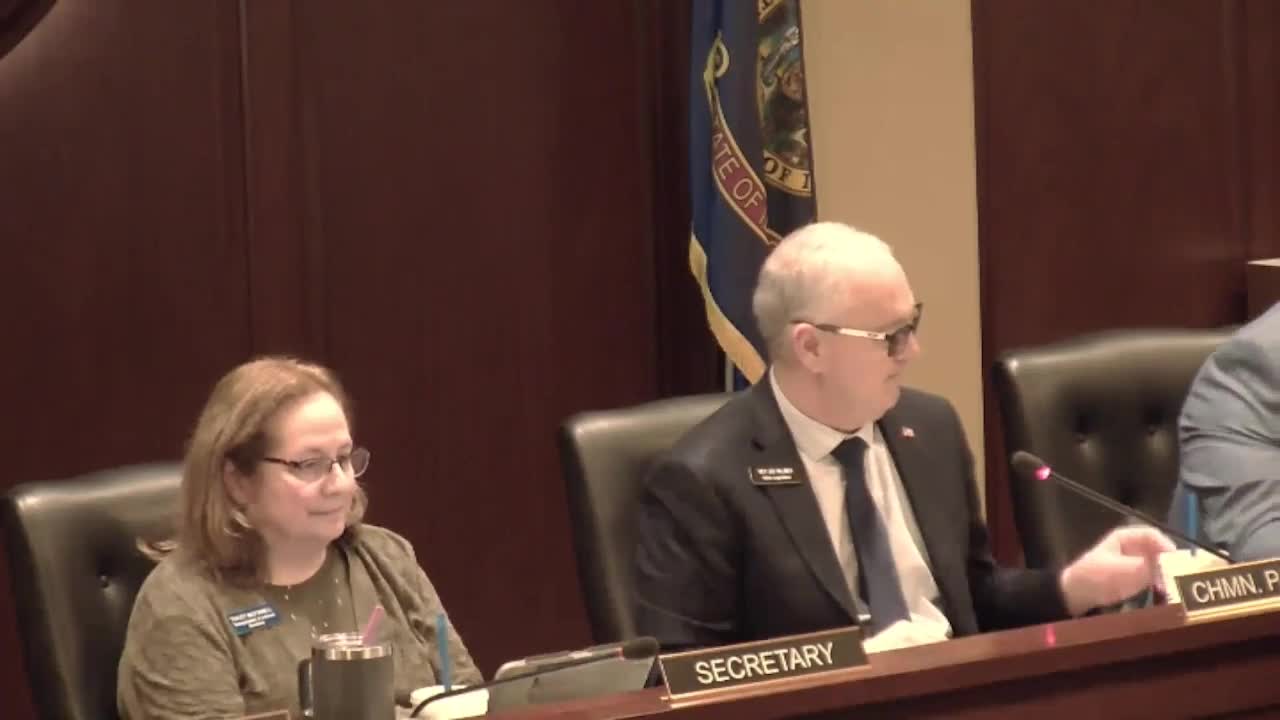
The House Transportation and Defense Committee voted to send House Bill 78 to general orders with a committee amendment prohibiting the use of an electronic driver’s license for identification at polling places. Representative Jim Petzke offered the substitute motion that the bill be sent to general orders with a specific committee amendment to add language to the Idaho Code excluding an electronic driver’s license or identification card issued under the bill from being used for voting identification; the motion carried on a roll-call vote.
Sponsor Representative Stephanie Mickelson (Legislative District 32) told the committee the bill authorizes an optional mobile driver’s license (MDL) but preserves the requirement that citizens carry their physical plastic card when stopped by law enforcement. Mickelson said MDL adoption nationwide has accelerated and that online transactions through the Idaho Transportation Department rose from roughly 250,000 in 2020 to about 1,700,000 in 2024, arguing customers want easier, digital options.
Lisa McClellan, DMV administrator at the Idaho Transportation Department, described technical safeguards and issuance controls. She said states that join the AAMVA (American Association of Motor Vehicle Administrators) Digital Trust Service must meet ISO and NIST standards, including provisioning requirements such as a selfie-based “liveliness” check during issuance and audits of issuing agencies. McClellan said apps that rely on the Digital Trust Service are free for reliant parties and that MDL provisioning requires controls intended to reduce fraud.
Several members raised security and operational concerns. Representative Mitchell and Representative Hill cited published security research and private-sector vulnerability findings in other jurisdictions; Mitchell said some independent security researchers reported that earlier MDL implementations (prior to ISO/NIST/AAMVA trust standards) were subject to forgery. Representative Harris and others questioned whether businesses or law enforcement would have to install new software or hardware to read MDLs; McClellan said reliant-party reader apps are free and that some verification steps require trusted apps to fully validate credentials.
Committee members also asked about data residency and cross-border use; Mickelson and McClellan said the MDL framework uses existing international standards similar to passport and payment-card systems and that states place public keys in the AAMVA Digital Trust Service to achieve interoperability. McClellan said DMV provisioning includes checks intended to prevent issuance to impersonators.
Industry testimony: Stacy Satterly of the Idaho Bankers Association testified in support of the bill’s due pass to general orders, saying secure real-time identification could reduce identity fraud for banks but that banks would need time and investment to adopt the hardware and software to accept MDLs.
Procedure and vote: Representative Handy initially moved to send the bill to amending order with a do-pass recommendation; Representative Petzke offered a substitute motion to send H78 to general orders with a committee amendment excluding MDLs for voting identification. The substitute passed on roll call; recorded votes in the transcript showed 8 ayes and 6 nays and the motion carried. The committee chair announced the bill will be sent to the floor for amendments.