Get Full Government Meeting Transcripts, Videos, & Alerts Forever!
Get email alerts on the Public Homelessness Policy topic
No spam. Unsubscribe anytime.
Committee advances bill to ban prolonged public camping in large Idaho cities; vote 13-2
Summary
The Idaho House State Affairs Committee voted 13-2 to send Senate Bill 1141 to the floor with a "do pass" recommendation after two hours of testimony that split nonprofit providers, city officials and law enforcement over enforcement, definitions and shelter capacity.
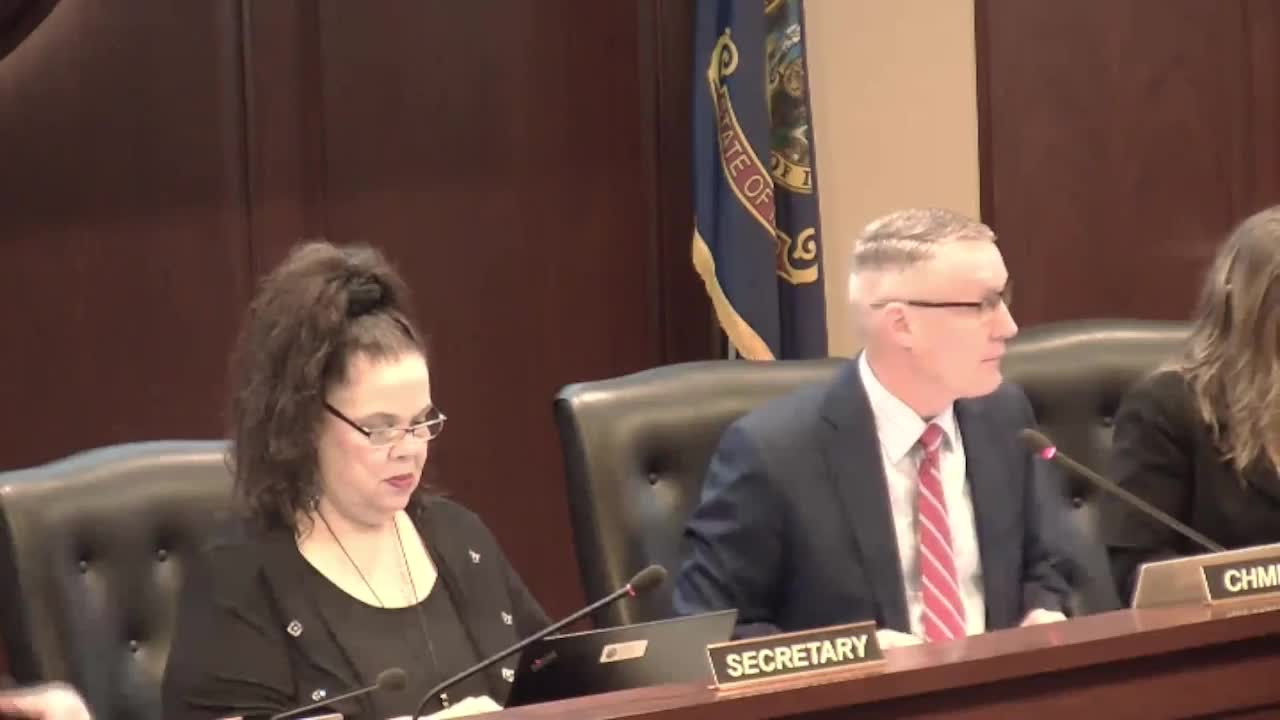
The Idaho House State Affairs Committee voted to send Senate Bill 1141, as amended, to the full House with a "do pass" recommendation after a committee vote of 13-2 following public testimony and member questions.
Senator Cody Galloway, sponsor of the measure, said the bill would make "public camping or sleeping ... unlawful" in cities with populations greater than 100,000 and give state officials tools to press cities that do not manage encampments. "Public camping is dirty, dangerous, and even deadly," Galloway told the committee as she described photos in the members' packets and cited recent deaths tied to people sleeping in vehicles.
Committee members heard competing views from city officials, police and shelter providers on whether the bill solves public-safety and health problems or creates new legal and operational burdens. Kathy Grismeyer, director of policy and government affairs for the City of Boise, opposed the bill and warned it could create "a pretty large legal liability" for cities that already face federal court limits on camping enforcement. She told the committee the City of Boise has had an anti-camping ordinance since 1993 and was sued in 2018; that litigation led to a stipulated agreement restricting ticketing when shelter space is available.
Christopher Dennison, chief of the Boise Police Department, said his officers made 28 camping-related arrests in 2024 and stressed concerns about the bill's scope. "Because of the expansive definition, in order for the city to avoid legal liability, it may require me to dedicate significant public safety resources to patrol every street in Boise day and night," Dennison said, and he urged the committee not to approve the bill.
Nonprofit providers and neighborhood representatives also split. Jodi Peterson Steigers, executive director of Interfaith Sanctuary, said the bill is "punitive" and would increase taxpayer costs for enforcement and jailing. "Why should we spend public money on jailing the unhoused when we could invest in solutions that actually work?" she asked, noting Interfaith Sanctuary plans a privately funded 24/7 shelter for roughly 205 guests opening in October 2025.
By contrast, Reverend Bill Roscoe and Lucy Willets, a Boise City Council member speaking for herself, supported the measure and said it would set standards and push cities to act before encampments grow. Roscoe said he supports the bill "for the health and safety of people who choose to sleep outside" and described shelters his organizations operate; he said his mission provides roughly 475 shelter beds nightly across several facilities.
Members raised repeated questions about the bill's wording. Several committee members and witnesses pressed for an objective definition of "prolonged" in the bill's definition of public camping and asked whether the measure would criminalize people who sleep in recreational vehicles or cars. Senator Galloway and supporters said the measure is not intended to criminalize people seeking shelter and that cities could adopt different approaches to comply; opponents said the statutory standard, combined with an attorney-general oversight mechanism, would force cities into costly enforcement actions or legal exposure.
The bill as drafted restricts its application to cities with populations greater than 100,000 but includes language saying nothing prohibits other cities or districts from enforcing similar rules. Committee Chair Representative Crane moved to send the bill to the floor with a due-pass recommendation; the motion passed 13-2 (two members opposed).
Committee discussion and testimony highlighted three persistent fault lines: whether the state should set a uniform standard for public camping or leave enforcement to local ordinances; how to define and prove "prolonged" camping without sweeping in short daytime rest or parked lawful RV use; and whether the shelter system has capacity to receive people who would be removed from public spaces. Several witnesses said beds are limited even when providers prioritize families and medically vulnerable people.
The committee took formal action to advance the bill; committee members did not adopt additional amendments in the hearing. Because the measure carries a "do pass" committee recommendation, it moves to the full House for further floor debate and potential amendment.
Less-critical procedural items discussed before the SB 1141 hearing included approval of minutes and a temporary hold placed on another RS item; those items did not alter the committee's action on SB 1141.