Get Full Government Meeting Transcripts, Videos, & Alerts Forever!
Get email alerts on the Long Term Care Oversight topic
No spam. Unsubscribe anytime.
Maine bill would create commission to review long-term care oversight; DHHS raises concerns
Summary
Sen. Denise Tepler introduced LD 980 to create a Commission to Improve Oversight of the Long-Term Care System; supporters urged stronger standards and staff training for memory care while DHHS questioned the bill's scope and internal consistency. Sponsor will submit amendments before work session.
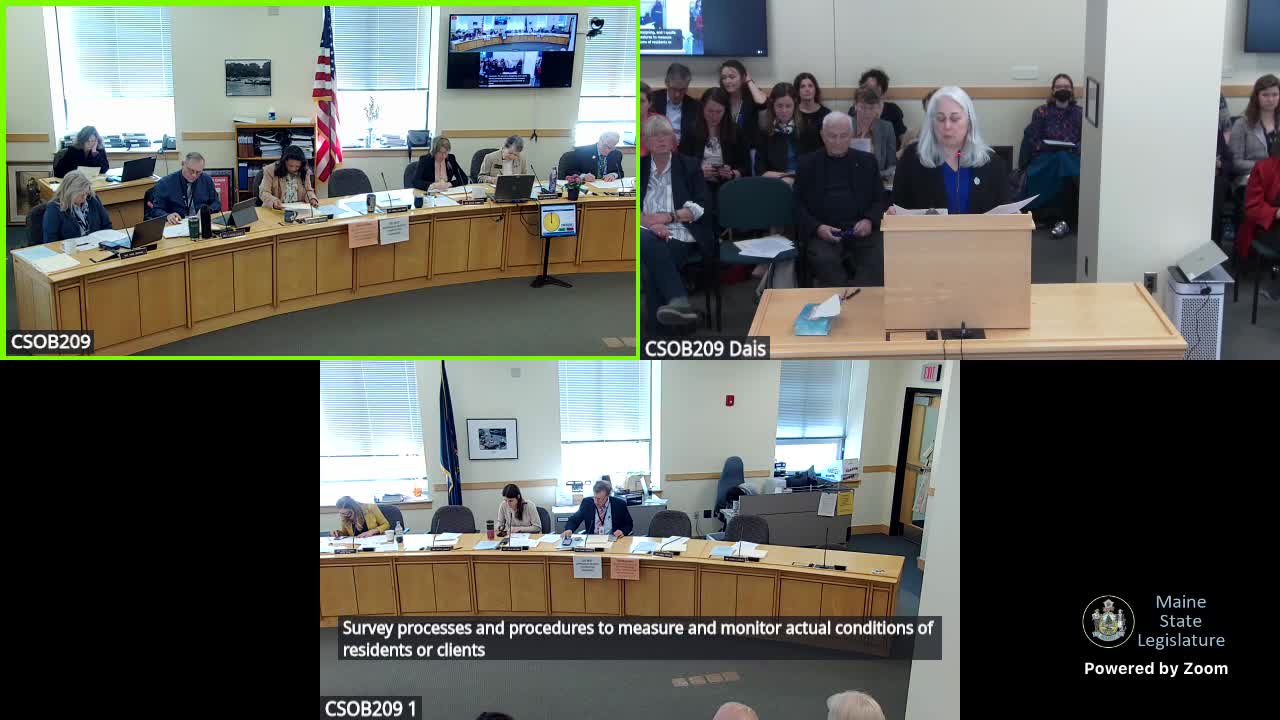
Sen. Denise Tepler, who represents Senate District 24, introduced LD 980 on Oct. 12 to create a Commission to Improve Oversight of the Long-Term Care System and asked the Joint Standing Committee on Health and Human Services to report the bill ought to pass.
Tepler said the commission would aim to clarify oversight across facility types and adopt an outcome-based approach, telling the committee, “Like taxes, it is inevitable,” when noting Maine’s aging population and the need to improve care for older Mainers. She described oversight now as a “hodgepodge of laws and regulations” and said the commission should help set standards, design survey processes and recommend penalties for noncompliance.
The bill drew support from a testifier who said memory care raises distinct medical and training needs. The commenter told the committee that he reviewed state indexes and “could not find any currently active status statutes specifically to memory care facilities,” and asked, “Even for CNAs, is 8 hours a year of training really enough to take care of patients with dementia and Alzheimer's disease?” He urged the commission to evaluate staff training, certification evaluation independence, and staff retention.
Paul Saucier, director of the Office of Aging and Disability Services at the Maine Department of Health and Human Services, testified in opposition. Saucier told the committee, “The intent and focus of the proposed Commission are not clear,” and pointed to internal inconsistencies in the draft resolve: some sections appear to call for stronger facility inspections while others seek simplification of rules, and one section would direct attention to the workforce across the whole aging and disability continuum.
Representative Lucian Daigle asked whether a fiscal note had been prepared; committee staff replied that a fiscal note was not yet available. Tepler told members she expects to submit an amendment before the work session to adjust membership and some details without changing the bill’s substance. The committee did not take a vote during the hearing; the bill will be considered further at work session in the coming weeks.
Supporters emphasized gaps in memory-care-specific statutes, variable staff training and high turnover. Opponents from DHHS said the resolve’s scope and directives need clarification so the commission’s charge would not duplicate or conflict with existing functions. Tepler said she is open to amendments including adding hospital and Office of Aging and Disability Services representation on the commission.
The committee accepted additional written testimony and reminded members that today’s hearing was to collect public input; formal deliberation and any vote were deferred to the scheduled work sessions.