Get Full Government Meeting Transcripts, Videos, & Alerts Forever!
Get email alerts on the Department Of Agriculture Sb128 topic
No spam. Unsubscribe anytime.
Committee hears presentation on SB 128 to create a Department of Agriculture; Farm Bureau urges new agency
Summary
The Senate Resources Committee heard an overview and stakeholder presentation on SB 128 on Feb. 28, a bill that would create a standalone Department of Agriculture by elevating the Division of Agriculture.
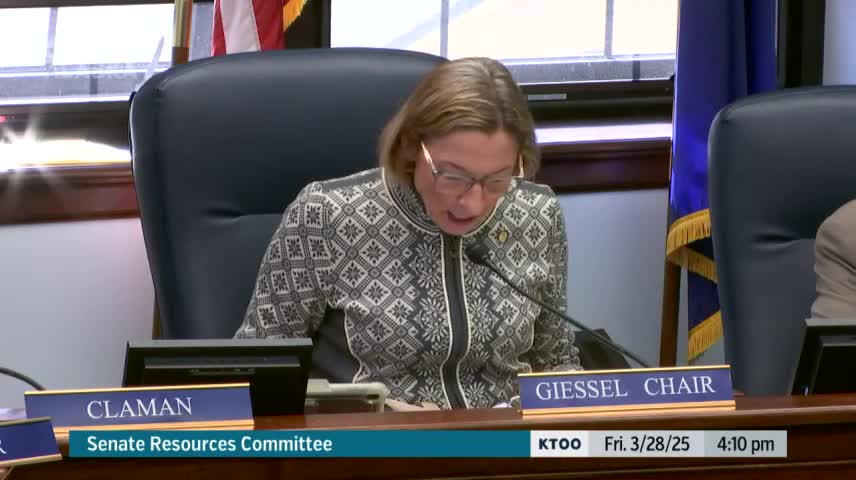
The Senate Resources Committee on Feb. 28 heard an overview of Senate Bill 128, legislation to create a standalone Department of Agriculture by elevating the existing Division of Agriculture. Senator Colleen Giesel opened the item; Senator Willikowski and staff presented the bill overview and Hunter Lotzfeld and Amy Seitz of the Alaska Farm Bureau explained policy goals and operational ideas.
Why it matters: supporters said a department with a commissioner would give agriculture a higher-level advocate in state government, help build markets and technical capacity, and accelerate recent growth in Alaska farm enterprises. Critics and some senators questioned whether changing the organizational chart would meaningfully change outcomes without sustained funding, and whether the proposed scope should include fisheries, mariculture or broader “food security” responsibilities.
Presentation and key points
Hunter Lotzfeld, staff to Senator Willikowski, said the draft largely follows the governor’s executive order (EO 136) that previously attempted to create a department by administrative action and that legislative counsel recommended nine drafting changes. Lotzfeld said many changes are conforming edits and that the bill would clarify the commissioner’s role as primary point of contact between state agencies and external partners.
Amy Seitz, policy director for the Alaska Farm Bureau, told the committee the measure reflects extensive feedback from farmers and task forces and would provide an executive-level champion for agriculture. “The mission and vision that is on this page is essentially what the division of agriculture has right now,” Seitz said, adding that the division lacks capacity and that “we do not need another task force.” She urged the committee to consider a phased approach emphasizing development programs and market expansion.
Budget, scope and structure questions
Committee members repeatedly asked whether simply renaming or reorganizing would help without additional funding. Seitz said the Division of Agriculture currently receives about $5 million in general-fund support; she listed possible program expansions discussed in a Department of Agriculture white paper, including roughly $1 million for program building and $3 million for a forgivable-loan program for agricultural development in earlier planning documents. She argued a commissioner would be better positioned to negotiate cross-agency issues (for example, laboratory access with the Department of Environmental Conservation, or state procurement for local products) and to pursue federal and private grant funds.
Members asked whether fisheries or food-security functions should be included. Seitz said agriculture and mariculture (shellfish and seaweed cultivation) are natural fits for a department focused on production; she cautioned that moving commercial fisheries into a new department could risk agriculture losing priority because fisheries already receive significant state attention.
Supporters’ arguments
Seitz and others on the call cited Census of Agriculture figures showing recent growth in the number of farms in Alaska, especially in the past decade. Testimony emphasized opportunities in seed potatoes, peony exports, canola seed and poultry/egg production and said a department could help scale production, market access and value-added processing. Senator Shelley Hughes and others said state-level coordination is necessary for market development, crop insurance assistance and technical extension services.
Opposition and caution
Some senators expressed skepticism that creating a department would itself create markets or funding. Senator Clayman and others said if the legislature cannot secure additional recurring funding for agriculture programs, reorganizing might not materially increase capacity. Senator Willikowski framed the measure as a legislative check on the governor’s earlier executive order and said the bill gives the Legislature an opportunity to debate mission and scope.
Next steps and closing
No vote was taken on SB 128 during this hearing. Committee members agreed to continue the conversation and directed staff to provide detailed sectional text and budget estimates at a later hearing. The committee closed the meeting and scheduled further agenda items for the next session.