Get Full Government Meeting Transcripts, Videos, & Alerts Forever!
Get email alerts on the Corporate Income Tax Sb92 topic
No spam. Unsubscribe anytime.
Senate committee adopts substitute for SB 92 to tax oil-and-gas-related S corporations; questions remain
Summary
The Senate Resources Committee adopted a committee substitute for SB 92, which would impose a corporate-style income tax on certain oil and gas entities, close an S-corporation tax loophole, and route revenue to the general fund. Staff and the Department of Revenue explained changes; public testimony showed strong support and opposition.
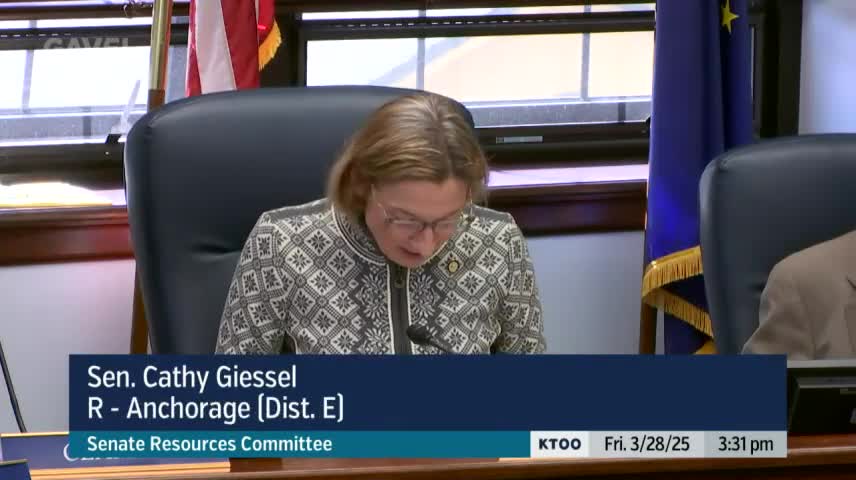
The Senate Resources Committee on Feb. 28 adopted a committee substitute (version l) for Senate Bill 92, which would extend a corporate-style tax to entities that operate like oil-and-gas corporations, including certain S corporations and limited liability companies. Chair Senator Colleen Giesel presided; Senator Willikowski moved to adopt the substitute and the committee removed an initial objection and proceeded with the measure.
The substitute makes multiple technical and substantive changes to the bill as introduced, said Sonia Kawasaki, Senate majority legal counsel, during the committee discussion. “The deletion of the energy and electrical grid projects upgrade fund…would mean the funds that are generated from the new tax under the bill would automatically flow into the general fund rather than be obligated to a designated fund,” Kawasaki said. She also described changes to how taxable income would be calculated and the insertion of language to avoid double taxation of corporate entities with unitary business structures.
Why it matters: supporters argued the bill closes a long-standing Alaska tax treatment that allows many S corporations tied to oil-and-gas assets to avoid state corporate income tax; opponents warned the change would act like a de facto personal income tax and could harm investment. Public testimony ranged from residents urging the committee to “close the S‑corp loophole” and use revenue for infrastructure, to national advocacy groups warning the change would raise business costs.
Committee discussion and changes
Kawasaki said staff added language that (1) clarifies aggregation rules and taxable-income calculation consistent with existing corporate income tax methods, (2) explicitly includes limited liability companies in the list of entities subject to the tax, and (3) removes a provision that would have directed revenue to a newly created “energy and electrical grid projects upgrade fund.” Kawasaki told the committee the bill now prevents an unintended state application of the 20% federal qualified business income deduction enacted in the Tax Cuts and Jobs Act of 2017: "We eliminated that altogether…" she said.
Kawasaki also described a provision intended to prevent double taxation: where an entity is part of a unitary business with a corporation that already pays under existing oil-and-gas corporate provisions (AS 43.20.xxxx), income would be allocated to the entity that is already taxed, she said. Committee staff noted the textual explanation of changes would be corrected to match the final working version (work order 34-LS0540\l).
Department of Revenue estimate
Michael Williams, corporate tax manager for the Department of Revenue, told the committee the agency’s revenue estimate was prepared to reflect the policy intent of the bill and would not change between versions: “Our estimate…does not change between versions because we always produce the estimate under the assumption that we were going to treat these entities as if they were corporations,” he said.
Public testimony
The committee heard roughly a dozen public comments. William Herman of Anchorage said he favored taxing S corporations and cited a $200 million–per‑year estimate he had heard. Philip White of Fairbanks quoted Bob Bartlett’s 1955 constitutional-era warnings about outside exploitation of Alaska resources and urged passage. Aurora Ruff of Anchorage supported using the revenue for energy infrastructure and told the committee, “Closing the S‑corp loophole is a no brainer.”
Opponents included Dennis Hall, state affairs manager for Americans for Tax Reform, who disputed claims that every state taxes S corporations as corporations and warned that Alaska’s 9.4% corporate rate is already high by national comparison. Other testifiers argued the tax would be borne by consumers and could reduce private investment.
Committee action and next steps
Senator Willikowski moved to adopt the committee substitute; Chair Giesel removed an initial objection for purposes of discussion and, after staff explanation, the committee proceeded. With no further objection, the substitute (version l) was placed before the committee. The committee left public testimony open in writing and scheduled additional hearings on the bill next week.
Votes at a glance
- Motion: Adopt committee substitute for SB 92 (work order 34-LS0540\l). Mover: Senator Willikowski. Objection for discussion raised and later removed by Chair Giesel. Outcome: adopted by the committee (voice; roll-call not recorded). Notes: public testimony taken; bill scheduled for further hearing.
Ending
Committee members requested follow-up from Department of Revenue and staff to confirm the draft language functions as intended for unitary businesses and taxable-income calculation. The committee accepted written testimony through the Senate Resources email and will revisit SB 92 at a future hearing.