Committee hears bill to ease return-to-work rules for recently retired teachers
March 29, 2025 | 2025 Legislature NE, Nebraska
This article was created by AI summarizing key points discussed. AI makes mistakes, so for full details and context, please refer to the video of the full meeting. Please report any errors so we can fix them. Report an error »
Why it matters: Committee members and witnesses said the change aims to ease substitute shortages, especially in rural districts, but representatives of the Nebraska Public Employees Retirement Systems (NPERS) and other opponents said removing the bright-line rule risks the tax-qualified status of the retirement plan under Internal Revenue Service (IRS) rules and would increase administrative burdens.
Senator Dan Linowski, the bill’s introducer, said the amendment “limits retired teachers who participate in the state employee retirement plan to provide no more than 40 days of intermittent service or substitute teaching during that semester while inside of their hundred and 80 day separation period.” He said the goal is to let qualified recent retirees fill longer substitute assignments without authorizing unlimited work.
Supporters told the committee LB 689 would let districts use experienced recent retirees when a single consecutive assignment exceeds the existing eight-day consecutive limit. David Kramer, testifying on behalf of Omaha Public Schools, said current Nebraska statute defines a bona fide separation as 180 days and that LB 1 98 (2024) had adopted the eight-day intermittent rule; he said LB 689 would remove the 8-day-per-month reference so retirees could serve more than eight days per month while preserving a bona fide separation under federal tax law. Kramer said districts and stakeholders have discussed potential NPERS administrative needs and welcomed working with NPERS on implementation.
Opponents said the change raises legal and operational risks. Tag Herbeck, legal counsel for the Nebraska Public Employees Retirement Board and NPERS, told the committee NPERS is “statutorily mandated under 84 15 o 3 to maintain a qualified status of retirement plans in accordance with IRS instructions,” and warned removal of the bright-line eight-day standard could force NPERS to evaluate substitution on a facts-and-circumstances basis and possibly limit or forbid substitute service to protect plan qualification. Herbeck also said AM 7 34 lacks an existing IRS statute, regulation or ruling expressly authorizing 40 days during the required bona fide separation period and suggested obtaining a private letter ruling before adopting such a change; he estimated NPERS would need roughly $12,500 to $25,000 to pursue a letter ruling.
Tyler Cummings, interim director of NPERS, testified in opposition and outlined the historical evolution of return-to-work rules: earlier rules forbade return to the same plan year or within 180 days, intermittent service was later permitted, and in 2021 the eight-day-per-calendar-month safe harbor was adopted. Cummings said frequent statutory changes create administrative burdens for members, employers and staff and that the eight-day rule adopted in 2021 and the changes in 2024 have largely achieved the desired balance.
Jason Hayes, representing a coalition that includes the Nebraska State Education Association, the Nebraska Association of School Boards and the Nebraska Council of School Administrators, also urged preserving the eight-day safe harbor and warned that removing it would create uncertainty for retirees and districts and could invite IRS audit risk. Hayes acknowledged the teacher shortage and the value of experienced substitutes but said the eight-day approach is predictable for retirees and employers.
Committee members pressed technical questions about why the eight-day rule was adopted, the difference between consecutive-day limits and monthly totals, and how IRS guidance applies. Several senators expressed sympathy with the desire to help districts find qualified long-term substitutes in rural areas; Senator Margo Juarez and others noted teacher shortages and supported further study. Senator Linowski said he had consulted informally with IRS attorneys but that the IRS had not supplied an official position; he asked the committee to conduct an interim study rather than advance the bill immediately.
No committee vote or formal action on LB 689 was recorded at the hearing. Several witnesses and senators recommended an interim study to examine alternative separation-period lengths in other states, the IRS compliance risks, and administrative impacts on NPERS before a statutory change is adopted.
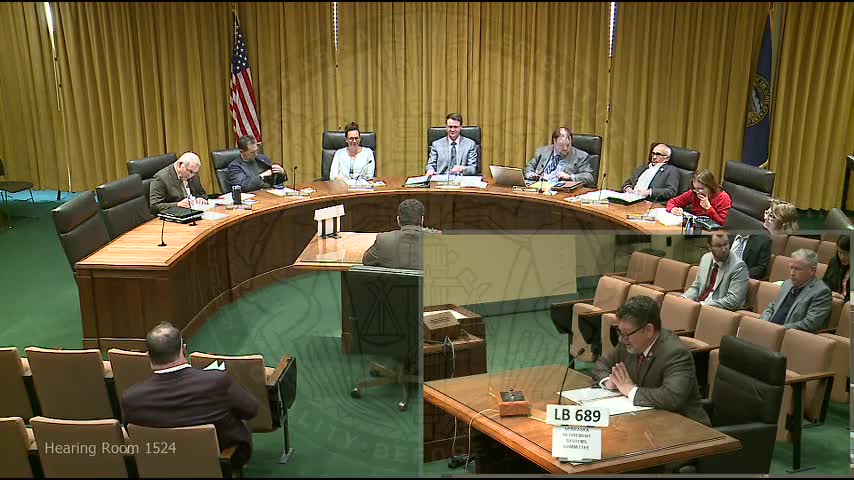
The committee closed the LB 689 hearing after hearing two proponents and two opponents on the record and no neutral testifiers, and the sponsor reiterated his request for an interim study.
Don't Miss a Word: See the Full Meeting!
Go beyond summaries. Unlock every video, transcript, and key insight with a Founder Membership.
30-day money-back guarantee
Sponsors
Proudly supported by sponsors who keep Nebraska articles free in 2026

