Orange County Schools outlines three bond‑funded options for school replacements; board raises traffic, capacity and community‑engagement questions
Loading...
Summary
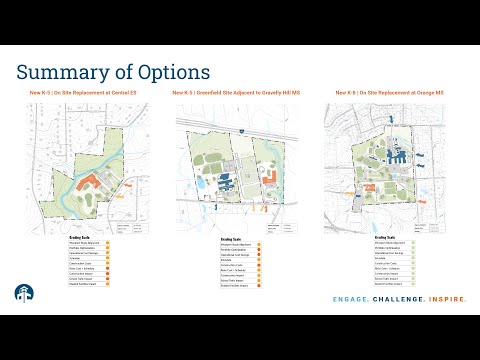
District staff presented options tied to a voter‑approved bond (total $300 million, $125 million for schools) including on‑site replacement of Central Elementary, a Greenfield K‑5, and a K‑8 at the Orange Middle site; staff outlined schedule for community engagement and a target decision on April 15 for the first prioritized project.
Orange County Schools staff updated the board on planning for the district’s voter‑approved bond program at the March 24 meeting and presented three refined options for phase‑one school projects, staff said.
Staff told the board voters approved a $300 million county bond package and that roughly $125 million of that package is allocated for school projects in the district’s ten‑year plan. District planning staff and retained architects and program managers presented feasibility findings and three refined options intended to address facility condition, utilization and long‑term program needs.
The three options presented were: (1) an on‑site replacement of Central Elementary (demolish and rebuild on the existing footprint), (2) a new Greenfield K‑5 on vacant or adjacent property and a renovation of Central, and (3) a K‑8 replacement built at or adjacent to the existing Orange Middle School site that would allow the district to consolidate and, in staff scenarios, remove up to two existing elementary buildings from the active portfolio. Presenters said the phase‑one work under consideration would touch roughly 1,700 students and about 250,000 square feet of building area (about 21% of the district’s facilities portfolio in their analysis).
Presenters described tradeoffs for each option: new construction reduces the risk of unknown conditions and can deliver modern circulation and athletic fields but has a higher up‑front cost; renovation options can be less expensive initially but carry contingency and schedule risk when unforeseen conditions appear. Staff identified wetlands and limited buildable acreage at the Central Elementary site as constraints and flagged traffic and parking as recurring community concerns for the K‑8 option at the Orange Middle site.
Financial staff reported cost‑per‑student estimates that varied by option (presenters cited figures in the approximately $80,000–$91,000 per‑student range for different options) and estimated the district could realize operational savings from portfolio consolidation over ten years; one presenter said a scenario could save about $10.6 million in operating costs over a decade, depending on which options were selected and timing of work.
Staff proposed a community engagement schedule with in‑person and online opportunities April 7–9 (including sessions aimed at parents and staff) and said the board would consider final project selection for the first prioritized bond project at the board meeting on April 15. The planning team includes district planning staff, an architecture firm (presenters named Marcos Thomas and his firm), Donna Francis (consultant from the firm listed in the presentation), and a program manager with experience in K‑12 projects.
Board members asked detailed follow‑up questions about projected enrollment trends, the effect on primary‑school capacity if two elementary buildings were consolidated, how a K‑8 scale would affect school intimacy and discipline patterns, traffic and transportation impacts, and whether hazardous‑materials or other unknowns could delay schedules. Several board members requested more neighborhood‑level community meetings in the specific schools and areas that would be most affected rather than only central or neutral sites.
No formal vote was taken on capital projects at the meeting. Staff said they will hold the April engagement sessions, collect public feedback, refine cost and schedule assumptions and return to the board for a decision on April 15.