Get Full Government Meeting Transcripts, Videos, & Alerts Forever!
Get email alerts on the Trees And Landscaping topic
No spam. Unsubscribe anytime.
Rowlett commissioners require replacement trees after Cornerstone Church removes protected specimens
Summary
The Planning and Zoning Commission recommended that Cornerstone Assembly of God mitigate removal of three protected pecan trees by planting replacement trees on-site rather than waiving the mitigation fee. The trees were removed during construction after staff approved emergency removal on safety grounds.
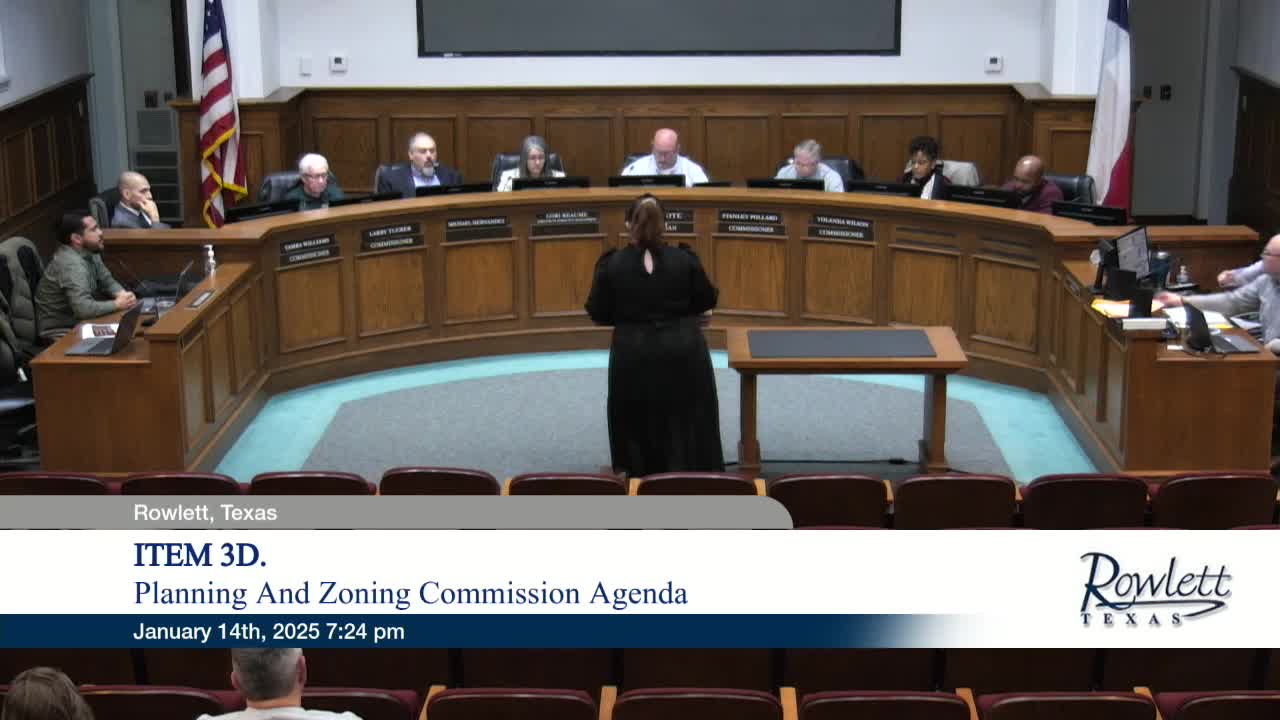
Rowlett Planning and Zoning Commission members on Tuesday recommended that Cornerstone Assembly of God mitigate the loss of three protected trees removed during construction at 4000 Dalrock Road by planting replacement trees on-site rather than waiving the mitigation fee.
The recommendation, made to the City Council, follows staff testimony that three trees marked for protection were damaged during site work, determined to be a safety hazard and removed with staff approval. Britney Musser, senior planner, told commissioners that the three removed trees totaled 63 caliper inches and that the code allows mitigation either by planting or by paying a fee; the fee assessed for the 63 inches was $7,665.21.
Why it matters: the commission’s decision signals that Rowlett will hold property owners accountable for tree-protection requirements even when damage occurs during construction, and it instructs City Council that staff and the commission expect mitigation by planting unless council decides otherwise.
Musser told the panel that Section 77-504 of the city’s development code permits staff to authorize removal when a tree is damaged beyond recovery or poses a health/safety risk, but a separate subsection requires replacement or mitigation when trees originally marked for protection are later removed. "If trees are marked for protection during a tree permit and then are damaged in construction, they are required to be replaced in the form of plantings," Musser said.
Brian Hyatt, pastor and registered agent for Cornerstone Church, described efforts by the church to protect the trees and said the damage occurred as grading exposed large root systems. "We were adamant about that from day one... but it just was impossible once the grading was done," Hyatt said. He asked the commission to consider tree credits already saved elsewhere on the property and to waive the mitigation fee because the church is a nonprofit and the project budget is thin.
Commissioners expressed concern that waiving mitigation would set a precedent that could encourage contractors or developers to accept post‑hoc penalties rather than take care to protect trees. Commissioner Pollard and Commissioner White both argued the contractor and project team bear responsibility for the damage and that the city should not effectively reward inadequate protection measures.
A motion to recommend approval of the tree removal permit with mitigation required as trees planted on-site and with no waiver of mitigation passed unanimously, 7–0. The commission’s recommendation will be forwarded to City Council, together with the meeting record and the staff report. Staff also noted the Board of Adjustment will separately consider variances on the site related to parking-lot landscaping and other requirements; the tree mitigation decision is distinct from those variance requests.
Details left for council/staff follow-up: staff said the reforestation fund contains roughly $420,000 (staff estimate), that the applicant has discussed the incident with the contractor and engineer but had not confirmed contractor payment or insurance coverage for the damages, and that the applicant may pursue coordination with the contractor or insurance to cover mitigation costs. Commissioners asked staff to include the discussion in the council report so council members see the commission’s position that waivers are not recommended in this case.
The commission’s action was limited to mitigation method; it did not alter or adjudicate the separate variances pending before the Board of Adjustment.