Get Full Government Meeting Transcripts, Videos, & Alerts Forever!
Get email alerts on the Zoning Recode topic
No spam. Unsubscribe anytime.
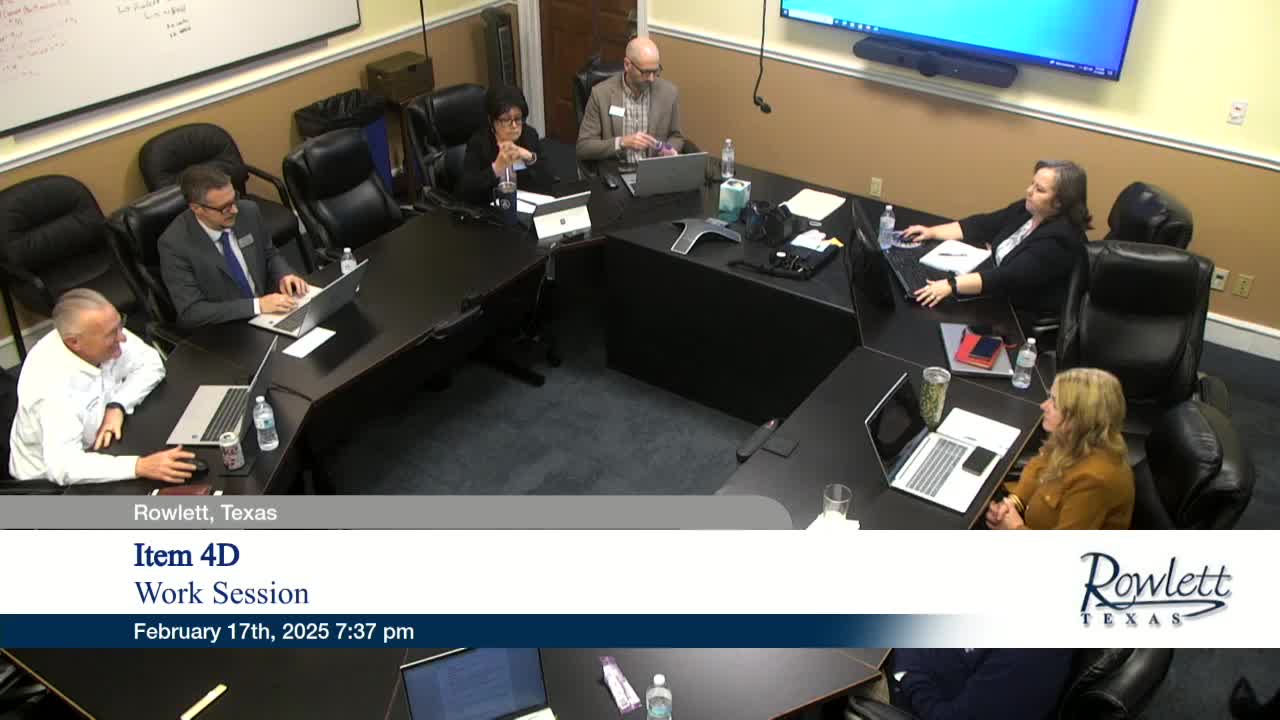
Council favors density‑based direction for zoning rewrite, asks staff to reconstitute committee
Summary
Council discussion on revising Rowlett’s zoning and development code leaned toward a density‑based (units‑per‑acre) approach over strictly lot‑based Euclidean zoning. Staff will reconstitute a Recode Rowlett committee, develop draft language and maps, and return with proposed policy choices and rezoning steps.
Rowlett City Council directed staff to pursue a density‑based approach (often described as units‑per‑acre) for an update to the city’s zoning and development code, signaling a preference for greater flexibility bounded by clear controls. Staff said a density‑based method could reduce repetitive planned‑development requests and clarify expectations for prospective developers, though it would be more complex to draft and would require a larger public engagement and rezoning effort.
Deputy City Manager Christophe Bauer and Manager David Hall framed the choice as two high‑level methodologies: a traditional lot‑based (Euclidean) zoning system that defines uses and lot dimensions for zones, and a density‑based system that limits units per acre and uses incentives and transitional standards to achieve compatible development. Bauer said the draft presented to council reduced the number of zoning districts from 29 to 15 under a lot‑based approach as an initial attempt to simplify the code.
Why it matters: The city’s zoning framework shapes what development is permitted, how projects are designed, and how predictable the approval process is for developers. Staff said the current mix of form‑based code districts, planned developments and many zone categories has contributed to frequent negotiated PDs and inconsistent outcomes.
Council discussion points Supporters of the density approach said it provides predictable bound‑aries (units per acre) while allowing design flexibility that better accommodates Rowlett’s varied topography and mature trees. Proponents said clearer upfront rules increase developer certainty, reduce repeated variance/PD cycles and make Rowlett more competitive for investment.
Concerns raised included the administrative complexity of drafting incentives and transitional standards, the need for clear front‑end controls so developers know expectations, and the need to follow up with a comprehensive plan update. Several council members said they favored eliminating form‑based code districts. Staff recommended reconstituting the Recode Rowlett committee, conducting a series of public meetings and returning with more refined draft language and mapped rezoning proposals.
Process and timetable Staff proposed a fast schedule of committee meetings and public engagement: reconstitute the Recode Rowlett committee, hold roughly 4–6 meetings under the lot‑based draft or a longer sequence for a density approach, then hold joint meetings with Planning & Zoning and proceed through formal notification and rezoning. Council members asked staff to bring policy options and check‑in points during the drafting process.
Outcome and next steps Council voiced a general preference for pursuing the density‑based (Plan B) direction with controls; members emphasized that the council would retain policy control over zoning allocations (for example, deciding where higher density is permitted, required setbacks/transitions and whether special use permits are needed for particular uses). Staff will reconstitute the Recode Rowlett committee, prepare detailed draft code options for the two methodologies, and return for policy guidance and mapped rezoning recommendations.