Get Full Government Meeting Transcripts, Videos, & Alerts Forever!
Seattle committee hears briefing on multi‑decade cleanup, funding plan for Lower Duwamish Superfund site
Summary
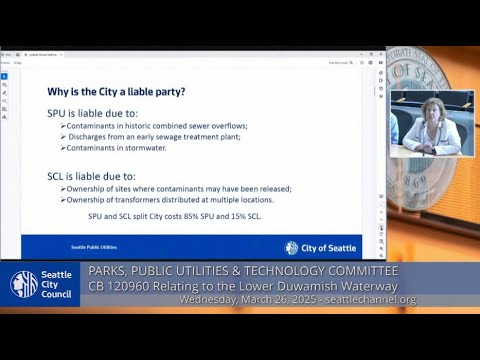
Seattle Public Utilities and Seattle City Light briefed the City Council’s Parks, Public Utilities and Technology Committee on March 26 on proposed authority to spend beyond current budget cycles to participate in investigation and cleanup of the Lower Duwamish Waterway Superfund site.
Seattle Public Utilities and Seattle City Light briefed the City Council’s Parks, Public Utilities and Technology Committee on March 26 on proposed authority to spend beyond current budget cycles to participate in investigation and cleanup of the Lower Duwamish Waterway Superfund site.
The briefing said the cleanup is a multi‑decade effort that will be carried out under a consent decree and funded by a mix of settlements, potential state matching funds and utility rate revenue. Andrew Lee, general manager and CEO of Seattle Public Utilities (SPU), said residents who experienced flooding in December 2022 asked whether their homes should be tested for contamination and asked, “Is my family now at risk for exposure to PCBs, a known carcinogen?”
The committee heard technical background and funding details. Ellen Stewart, deputy director of SPU’s drainage and wastewater line of business, described the Lower Duwamish Waterway as a roughly five‑mile industrial corridor between Harbor Island and the Turning Basin and said EPA is leading cleanup under federal Superfund law. Stewart said cleaning will typically involve dredging of contaminated sediments, capping in some areas and long‑term monitoring; the upper reach design completed in 2023 and full‑scale work on that reach began in November 2024.
Stewart and presenters detailed schedule and scope: cleanup work is phased from upstream to downstream to avoid recontamination; the upper reach cleanup will take about three years because in‑water work is limited to an October–February fish window; engineering design for the…
Already have an account? Log in
Subscribe to keep reading
Unlock the rest of this article — and every article on Citizen Portal.
- Unlimited articles
- AI-powered breakdowns of topics, speakers, decisions, and budgets
- Instant alerts when your location has a new meeting
- Follow topics and more locations
- 1,000 AI Insights / month, plus AI Chat