Get Full Government Meeting Transcripts, Videos, & Alerts Forever!
Montgomery County committees back tax-abatement pilot to convert vacant commercial properties to housing with amended affordability and term
Summary
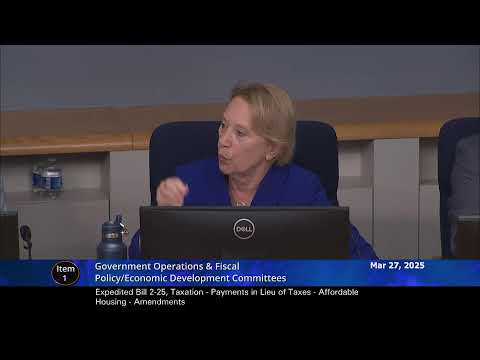
The joint Government Operations & Fiscal Policy and Economic Development committees on Monday recommended to the full Montgomery County Council an amended Bill 2-25E to create a payment-in-lieu-of-taxes pilot incentivizing conversions of high-vacancy commercial buildings to rental housing.
The joint Government Operations & Fiscal Policy and Economic Development committees on Monday recommended to the full Montgomery County Council an amended version of Bill 2-25E, a pilot program offering a full real-property tax exemption to encourage conversions of high-vacancy commercial buildings to rental housing.
Council President Stewart opened the session by saying, “This bill establishes a pilot for certain conversions of high vacancy commercial properties to residential use,” and staff outlined the bill’s core terms as introduced: eligibility for properties that were at least 50% vacant at the time of application, a requirement that at least 15% of units be maintained as Moderately Priced Dwelling Units (MPDUs) for households at 60% of area median income (AMI) for 25 years, and a 100% real-property tax exemption for that same term.
The committees amended the proposal during the work session. Council Member Friedson moved — and the joint committee approved — increasing the minimum MPDU requirement from 15% to 17.5%. The committees also shortened the pilot’s full tax-exemption term from 25 years to 20 years and approved a separate 10-year sunset review so the county can re-evaluate the program’s effectiveness. Those changes passed on joint-committee votes. Council Member Sales abstained from the final committee recommendation to the full council.
Why it matters: committee members said the pilot is intended to move underused commercial properties back into productive use and add housing supply during a difficult multifamily construction market. Supporters said the program is modeled on similar regional efforts and, despite the temporary property-tax foregone revenue, can increase other revenues (income taxes, impact…
Already have an account? Log in
Subscribe to keep reading
Unlock the rest of this article — and every article on Citizen Portal.
- Unlimited articles
- AI-powered breakdowns of topics, speakers, decisions, and budgets
- Instant alerts when your location has a new meeting
- Follow topics and more locations
- 1,000 AI Insights / month, plus AI Chat