Get Full Government Meeting Transcripts, Videos, & Alerts Forever!
Get email alerts on the Housing Tax Abatement Pilot topic
No spam. Unsubscribe anytime.
Montgomery County committees back tax-abatement pilot to convert vacant commercial properties to housing with amended affordability and term
Summary
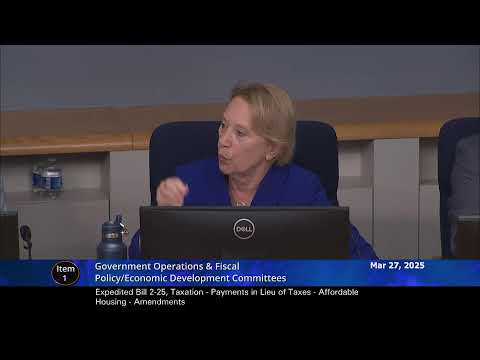
The joint Government Operations & Fiscal Policy and Economic Development committees on Monday recommended to the full Montgomery County Council an amended Bill 2-25E to create a payment-in-lieu-of-taxes pilot incentivizing conversions of high-vacancy commercial buildings to rental housing.
The joint Government Operations & Fiscal Policy and Economic Development committees on Monday recommended to the full Montgomery County Council an amended version of Bill 2-25E, a pilot program offering a full real-property tax exemption to encourage conversions of high-vacancy commercial buildings to rental housing.
Council President Stewart opened the session by saying, “This bill establishes a pilot for certain conversions of high vacancy commercial properties to residential use,” and staff outlined the bill’s core terms as introduced: eligibility for properties that were at least 50% vacant at the time of application, a requirement that at least 15% of units be maintained as Moderately Priced Dwelling Units (MPDUs) for households at 60% of area median income (AMI) for 25 years, and a 100% real-property tax exemption for that same term.
The committees amended the proposal during the work session. Council Member Friedson moved — and the joint committee approved — increasing the minimum MPDU requirement from 15% to 17.5%. The committees also shortened the pilot’s full tax-exemption term from 25 years to 20 years and approved a separate 10-year sunset review so the county can re-evaluate the program’s effectiveness. Those changes passed on joint-committee votes. Council Member Sales abstained from the final committee recommendation to the full council.
Why it matters: committee members said the pilot is intended to move underused commercial properties back into productive use and add housing supply during a difficult multifamily construction market. Supporters said the program is modeled on similar regional efforts and, despite the temporary property-tax foregone revenue, can increase other revenues (income taxes, impact taxes, fees) once properties are occupied.
Key discussion points and staff clarifications - Eligibility and linkage to zoning: County staff explained the pilot is tied to companion zoning text amendments (ZTA 2503 in the “More Housing Now” package) that create an expedited approval path for conversions; the pilot applies only where that expedited process is available. Staff said the ZTA and the tax pilot can differ in some details, but were drafted to align. The pilot’s vacancy threshold is 50% at the time of the applicable application (planning or permitting) and generally applies to office and retail commercial uses, subject to zone-specific exclusions adopted in the ZTA process.
- Retail and neighborhood-serving storefronts: Council Member Sales proposed excluding neighborhood retail zones from the pilot to avoid displacing small businesses; that motion was discussed but not seconded and did not advance. Staff and committee members clarified that the PHP (Planning, Housing and Parks) committee had removed retail from eligibility in certain zones (for example, GR and NR) and asked staff to craft language to protect small, neighborhood-serving storefronts while still allowing conversions of buildings where ancillary retail only served a significantly vacant building.
- Affordability mix and depth: Public testimony and members pushed to increase affordability; the committee approved 17.5% MPDUs at 60% AMI (up from the introduced 15%). Council Member Sales urged a deeper split with more deeply affordable units and proposed a 30% MPDU alternative and a separate structure splitting levels of AMI; that motion lacked a second and did not advance. Members discussed examples, including Strathmore Square, and noted that financing mixes (tax credits, housing initiative fund, private equity) can affect achievable affordability.
- Term, sunset and timelines: The committee shortened the abatement from 25 to 20 years (approved) and separately approved a 10-year sunset/review requirement so the county can assess the pilot’s return on investment and housing outcomes.
- Transition/retroactivity: The committee unanimously approved transition language allowing properties that already have planning-board site-plan approval to qualify without reapplying to planning, provided the developer meets strict timing conditions: submit a building-permit application to the Department of Permitting Services (DPS) that includes the core and shell within two years of the planning-board resolution or the act’s effective date, and obtain the building permit within two years of DPS’s acceptance of that application. Staff said the transition was intended to avoid penalizing projects already in process.
- For-sale units: Staff advised the committee that the county’s enabling statute and the current pilot design are targeted to rental units; adding for-sale units would raise administrative and legal complications and could be ineffective under state law as currently written. The committee did not expand the pilot to include for-sale units; members said state law could be revisited separately.
Votes at a glance (joint committee action) - Increase MPDU requirement from 15% to 17.5% at 60% AMI — Motion moved by Council Member Friedson; seconded; approved by the joint committees (unanimous among members present for that vote). - Pilot term shortened from 25 to 20 years — Motion moved and seconded; approved by the joint committees (unanimous among members present for that vote). - Add 10-year sunset/review — Seconded; approved by the joint committees (unanimous among members present for that vote). - Transition/retroactivity for projects with planning-board site-plan approval — Moved by Council Member Glass; seconded by Council Member Fannie Gonzalez; approved unanimously by the joint committees. - Technical staff clarification (site-plan vs. DPS timing and the 50% vacancy measurement) — Seconded; approved unanimously. - Proposal to exclude specified retail zones from eligibility — Motion introduced by Council Member Sales; no second, did not proceed. - Alternative MPDU proposal to raise requirement to 30% (Sales) — Introduced; no second, did not proceed. - Final joint committee recommendation on the amended Bill 2-25E to full council — Approved; Council Member Sales recorded an abstention on the final committee recommendation.
Next steps and outlook The joint committee forwarded the amended Bill 2-25E and the committee record to the full Montgomery County Council for consideration. Committee members and staff said further refinements could occur at full council (for example, final ZTA language about ancillary retail), and several members noted that the pilot’s ultimate impact will depend on market responses and how projects secure financing. Staff flagged that state enabling language may constrain the county’s ability to extend the pilot to for-sale units without a change at the General Assembly.
Ending note: committee members framed the package as one tool among many to address the county’s housing shortage and high office vacancy; supporters said the pilot aims to accelerate conversions that otherwise would not happen, while some members pressed for deeper affordability and safeguards for neighborhood-serving retail.