Get Full Government Meeting Transcripts, Videos, & Alerts Forever!
Get email alerts on the Financial Recovery Plan topic
No spam. Unsubscribe anytime.
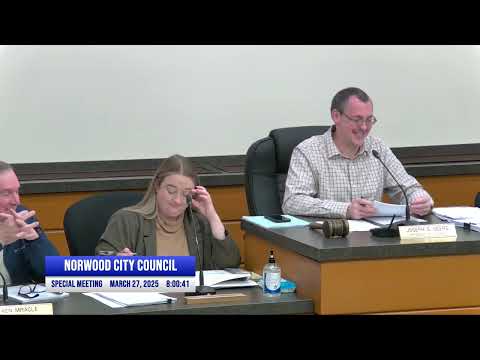
Norwood council advances ninth amendment to financial recovery plan after extended debate, schedules additional readings
Summary
At a special meeting of the Norwood City Council, members approved an amendment to the ninth amendment of the city’s financial recovery plan and gave the ordinance its first and second readings as amended, setting additional readings to meet a state deadline.
At a special meeting of the Norwood City Council, members approved an amendment to the ninth amendment of the city’s financial recovery plan and gave the ordinance its first and second readings as amended, setting additional readings to meet a state deadline.
The council’s discussion focused on the plan’s capital projects assumptions, timing for adoption, and the impact of recently negotiated union contracts. Mayor Schneider said the plan is the best snapshot available and noted the city must submit an approved financial plan to the Financial Planning and Supervision Commission under Section 118 of the Ohio Revised Code; failure to do so could reduce the city’s available budget authority.
Councilmembers spent more than an hour questioning the five-year capital improvement worksheet and particular line items and requested corrections. Councilmember Moore said he had not had sufficient time with the document after its late delivery and declined to support suspending the rules to allow three readings that night. Mayor Schneider and other members described the document as conservative and said negotiated union contracts finalized earlier in the meeting had been incorporated into the numbers.
Council voted unanimously to amend the plan’s exhibit to correct capital-project figures after the mayor and council staff identified a needed adjustment to the police department figures. A motion by Councilmember Gertin to suspend the rules and have three readings of the ordinance as amended failed because the council needed six affirmative votes to suspend the rules; the motion carried 5–1 but did not meet the required two-thirds threshold.
Later, Councilmember Bowling moved and Councilmember Franzen seconded a motion to suspend the rules for the first and second readings only; the motion carried on a roll call vote of the members present. As a result, the council recorded the first and second readings of the ordinance as amended and scheduled the remaining third reading and final vote to occur during additional meetings the body posted for Friday evening and Saturday morning so the plan could be acted on before the Financial Planning and Supervision Commission’s deadline.
Chief McCabe, representing the fire department, described the department’s multi-year capital planning and told council the majority of requested apparatus and capital needs were included in the five- and ten-year plans. Councilmembers emphasized the plan’s role in allowing multi-year street and infrastructure projects and noted carryover fund projections and conservative assumptions on revenue collection.
The ordinance remains pending final council action at the scheduled follow-up meetings. Council members said the ordinance can be revised after passage if inaccuracies are found, but several speakers warned of state penalties tied to missing the commission deadline and urged timely action.
Mayor Schneider: “This is the best plan that we have right now with this snapshot in time,” he said, adding that union contract outcomes and recently hired financial staff affected final numbers.
Councilmember Moore: “I would like to spend more time with the document,” Moore said, explaining his reluctance to approve all three readings the same night.
The council adjourned after completing the procedural votes and scheduling the follow-up readings.