Get Full Government Meeting Transcripts, Videos, & Alerts Forever!
Get email alerts on the Education Funding topic
No spam. Unsubscribe anytime.
House backs lowering equalization threshold for school funding; bill includes rollback penalty
Summary
The House passed Senate Bill 44, which lowers the equalization eligibility threshold for school funding from 14 mills to 10 mills and adds a penalty for systems that roll back millage below 10, with a recorded vote of 138–23.
The Georgia House voted Friday to pass Senate Bill 44, a measure that lowers the threshold for equalization eligibility and adds a penalty provision for school systems that reduce millage below the new threshold.
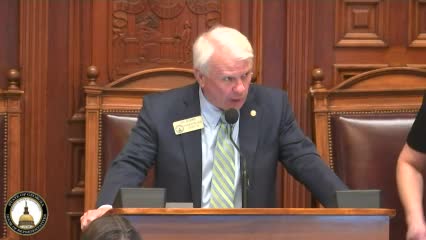
Representative Cannon, presenting the bill, said the measure lowers the equalization eligibility threshold from 14 mills to 10 mills but does not change the underlying equalization or Quality Basic Education (QBE) formulas. Cannon said the bill does not require local systems to roll back millage but would permit a local system that receives equalization to roll back over time to a new minimum threshold of 10 mills if it chooses.
The sponsor also described an added penalty provision: a local system that later reduces millage below 10 mills would face a 25% penalty on their equalization funding.
Representative Martin registered concerns on the floor, saying the QBE funding formula is complex and that changing one pillar of the formula without a comprehensive review could produce inequities among counties with different tax bases. Martin asked for a larger review of the QBE formula rather than an isolated change to the equalization threshold.
After debate the House passed the bill by roll call; the clerk recorded 138 yeas and 23 nays. The bill had passed the House in an earlier form the prior year and cleared committee earlier in the day.
Why it matters
Equalization funding affects school systems’ state aid and local tax policy. Supporters said lowering the eligibility threshold expands access to equalization; opponents cautioned that piecemeal changes to funding formulas can produce unintended consequences and urged a comprehensive review.
Ending
The House’s passage sends the proposal to the Senate; members who raised concern said they want a broader review of QBE and the state’s approach to school funding.