Get Full Government Meeting Transcripts, Videos, & Alerts Forever!
Get email alerts on the Higher Education Workforce topic
No spam. Unsubscribe anytime.
UW biology chair outlines undergraduate pipeline, lab training and employer connections
Summary
University of Washington Biology Chair Martha Bosma told a Washington House committee that UW graduates strong numbers of undergraduates with hands-on lab and research experience and urged stronger employer connections and internships.
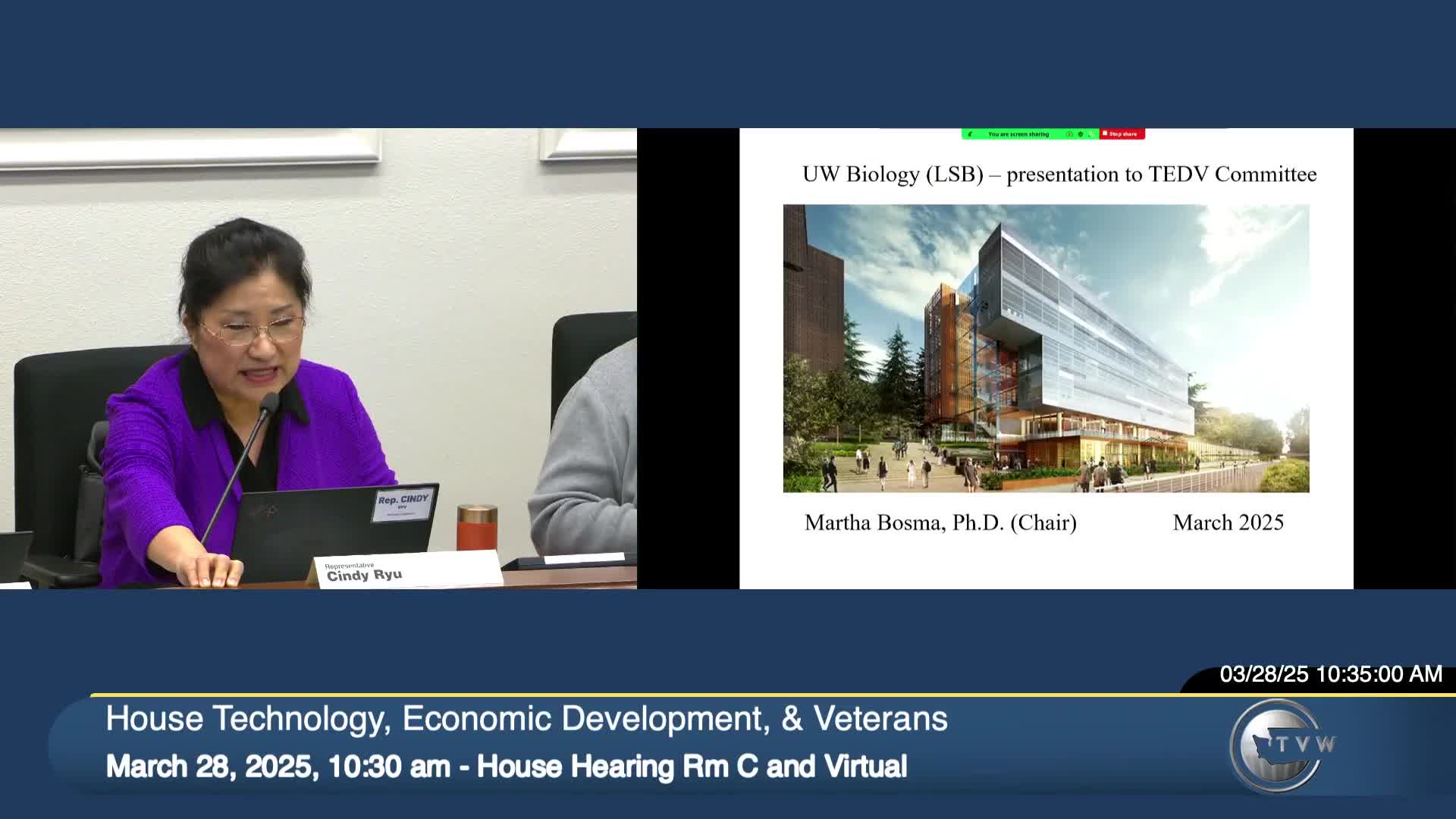
Martha Bosma, chair of the Department of Biology at the University of Washington, told the Washington State House Technology, Economic Development, and Veterans Committee on March 28 that UW’s biology program produces hundreds of graduates a year who receive lab-based, hands-on training that prepares many to enter health care, research and technology jobs.
Bosma said the program “graduates about 500 to 600 people every year,” and described a curriculum that emphasizes small lab and discussion sections, field- and course-based research experiences and a statewide UW in the High School program.
The presentation explained why the department prioritizes hands-on lab work and small-group instruction. “Undergraduates are absolutely crucial to the research mission of our department. Every lab has 3, 4, maybe even more undergraduates working in it,” Bosma said. She described course-embedded research (CUREs) and course sequences in which students complete extensive lab and lecture hours: “the students who take this full sequence take 90 hours of lab and 120 hours of lecture.”
Bosma told lawmakers that many students gain practical laboratory skills — PCR primer design, gel electrophoresis, pipetting and R programming for data analysis — and that about a quarter of undergraduates work in research labs. She also noted outreach to K–12 through UW in the High School: biology 100, 118 and 119 are offered in high schools across the state; Bosma said the program reaches “34 high schools distributed across the state.”
Committee members asked about employer connections and career outcomes. Representative Barnard asked how many students already have jobs through UW connections; Bosma answered that the department would like more employer partnerships and suggested internships and one-day-per-week placements during the academic year and summer internships as a model. Representative Keaton asked about common career paths; Bosma said neuroscience majors often move into health-care fields — medicine, dentistry, physical therapy — while biology majors pursue a broad range of careers including teaching, journalism and industry roles.
Bosma gave examples of undergraduate contributions to research and technology: undergraduates in faculty labs have published (she said, “I’ve had 12 undergraduates publish from my lab”), have participated in the Mary Gates Research Symposium, and have used AI-based image and tracking analysis in projects ranging from cell-shape analysis to animal movement tracking. She also described the department’s role training peer instructors and community-college transfers through expanded 300-level literature-and-lab courses.
The presentation closed with Bosma urging more industry partnerships so students can move more directly into local employers, and with an offer to provide the list of high schools participating in UW in the High School courses to the committee.
Less-critical details: Bosma noted that majors typically start at the 200 level, lab sections are capped at about 24–25 students, and that the biology curriculum spans molecules to ecosystems. She emphasized that the college places scientific training in a social and historical context because the biology program is housed in the College of Arts and Sciences.
Looking ahead, Bosma said tracking alumni outcomes is a priority for her as department chair so the program can better document where graduates work and how employer connections could be strengthened.