Get Full Government Meeting Transcripts, Videos, & Alerts Forever!
Get email alerts on the Foreign Adversary Land topic
No spam. Unsubscribe anytime.
Committee advances bill to force divestiture when foreign adversaries own strategic Idaho land near military ranges
Summary
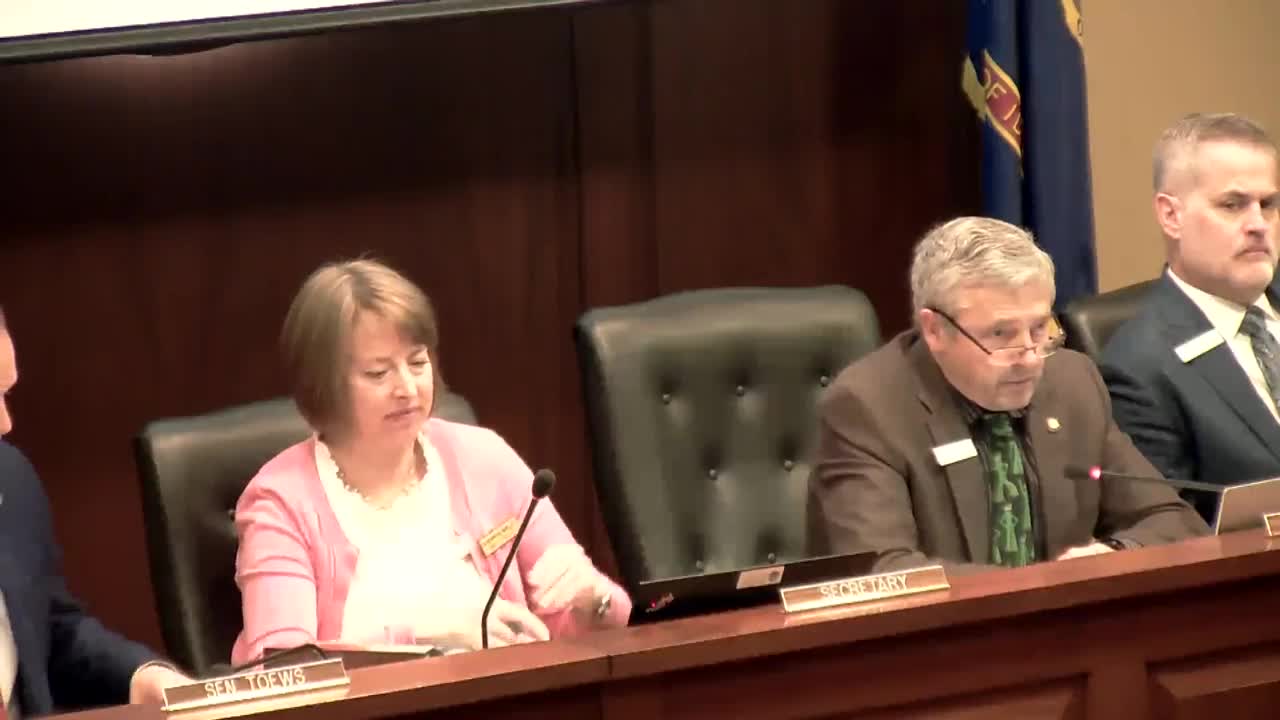
House Bill 3-56, a measure aimed at preventing foreign adversaries from owning Idaho land near federal training ranges and strategically important areas, was sent to the Senate floor with a due pass recommendation after sponsor and expert testimony and debate over technical and constitutional issues.
House Bill 3-56, a measure aimed at preventing foreign adversaries from owning Idaho land near federal training ranges and strategically important areas, was sent to the Senate floor with a due pass recommendation after sponsor and expert testimony and debate over technical and constitutional issues.
Representative Ted Hill, R., presented the measure and said it builds on other state actions to prevent ownership by foreign adversaries. Hill said the bill is modeled in part on Arkansas Act 636 and would require divestiture if a foreign adversary is determined to own agricultural land, forest land, water rights or mining claims in the areas described in the bill. He told the committee a foreign-adversary owner would be required to sell within 180 days or face foreclosure through the Attorney General; proceeds would be distributed to lienholders and costs, with a qualified whistleblower eligible for 30% of net proceeds.
Hill said the bill targets foreign adversaries defined by federal code — the sponsor cited countries such as China, Russia, North Korea, Cuba and Venezuela — and stressed the national-security rationale for the measure, arguing adversaries exploit small-footprint ownerships to conduct surveillance near ranges. “This is about Idaho’s defense and our nation’s defense,” Hill said.
Military witnesses described the training importance of southwestern Idaho. Colonel Kyle Carpenter of the Idaho National Guard said Mountain Home Range Complex is roughly the size of Vermont and supports combined live-fire exercises and training that cannot take place in most other areas. Lieutenant Colonel Travis Sligh, representing Mountain Home Air Force Base operations, said even small encroachments can have outsized impacts on training safety, effectiveness and operational security.
The Idaho Land Title Association’s representative, Bob Rice, testified against HB 3-56 on technical grounds and asked for cleanup of retroactive and invalidation language. Rice pointed to a provision that would declare existing deeds and contracts “invalid from the date of the adoption” unless otherwise provided; he said that creates conflicts with mortgages and lienholders and asked the committee to remove the subsection or clarify lienholder protections. Chair and committee members discussed retroactivity, disbursement priority and constitutional risk.
Representative Hill said the bill includes protections for lienholders and that the whistleblower provision is modeled on Arkansas law. He acknowledged the measure is targeted at “foreign adversaries” as defined by federal code and said the intent is deterrence and removal of covert surveillance access points near ranges and critical infrastructure.
Senator Adams moved and Senator Dan Hartog seconded that House Bill 3-56 be sent to the floor with a due pass recommendation. The motion carried on a voice vote; the chair recorded a no vote. The committee’s action advances the bill to the full Senate for further consideration, where sponsors and opponents may offer amendments addressing technical concerns such as deed and lien treatment, retroactivity and the timing and mechanics of divestiture.