Get Full Government Meeting Transcripts, Videos, & Alerts Forever!
Get email alerts on the Higher Education Doctorates Policy topic
No spam. Unsubscribe anytime.
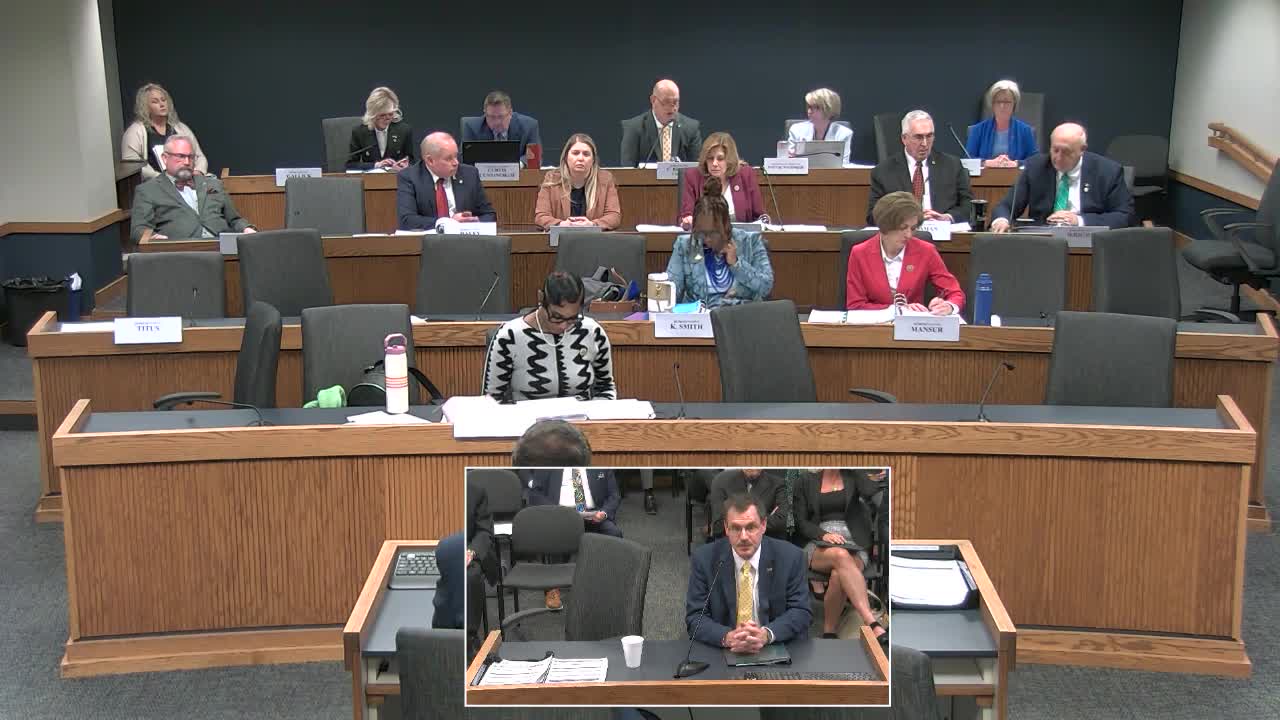
Law limiting doctoral and certain professional degrees to University of Missouri faces challenge; committee hears extensive pro and con testimony
Summary
Representatives Griffith and Stinnett asked the committee to remove statutory limits that reserve many doctoral and specified professional degrees to the University of Missouri; hearings drew extensive testimony from university leaders, consultants, and system representatives on access, workforce needs, and fiscal risk.
Representatives Dave Griffith and Melanie Stinnett presented House Bill 90 and House Bill 616, companion proposals intended to remove long‑standing statutory limits that reserve issuance of research doctorates and specified first‑professional degrees primarily to the University of Missouri system. Sponsors told the committee the bills are designed to allow other public universities to offer doctoral and certain professional programs—subject to existing program‑approval processes—so students can pursue terminal degrees closer to home and the state can better meet workforce needs.
Supporters included university presidents, community advocates, and higher‑education consultants. Tom Strong testified that the current law is “archaic” and singled out Missouri as the only state that restricts engineering degrees to a single public institution; he said the bills would let students stay in state and would not, by their text, require additional legislative appropriations. John Hutchinson, a higher‑education consultant who said he surveyed state higher‑education executive officers, testified that no other state except California has limitations comparable to Missouri's, and he urged lifting restrictions that he said are unusually strict. Biff Williams, president of Missouri State University, testified that Missouri State is growing (he cited about 27,000 students and record enrollment) and said statutory restrictions prevent institutions from responding nimbly to market and workforce demand; he said many doctoral programs can be stood up using existing institutional resources without immediate state funding.
Witnesses in opposition included Ryan Grama, chief financial officer for the University of Missouri System, and Chuck Brazil, chair of the University of Missouri Flagship Council. Grama said the existing framework (the so‑called “swim lanes” law) allows collaboration between institutions and that starting standalone doctoral or professional programs typically requires significant ongoing funding—federal grants, state support, or undergraduate tuition—and that expanding degree‑granting authority would risk duplicating expensive programs, driving long‑term costs and potentially increasing tuition for Missouri residents. He said Missouri’s four University of Missouri campuses together conduct roughly $650,000,000 in research annually and that initiating research‑intensive programs without that existing foundation would place new funding demands on the state and institutions.
Committee members asked detailed questions about workforce needs, federal research funding, whether the Coordinating Board for Higher Education has sufficient rigor in program approvals, enrollment patterns for international students who historically populated doctoral programs, and how new programs would be sustained. Representative Shields, who chairs a committee working on higher‑education funding, repeatedly voiced caution about diluting limited state resources across more doctoral programs and emphasized concerns about long‑term state support for costly professional programs such as medicine. Other members emphasized student access—especially for rural and border regions—and noted the coordinating board’s review authority.
Many witnesses and committee members said collaboration with the University of Missouri remains an option under current law; sponsors argued the statutory requirement that MU approve or be the degree‑granting home is an unnecessary constraint. The transcript records robust, often civil debate; no committee vote on either bill appears in the provided record.
Key factual points drawn from testimony - John Hutchinson (higher‑education consultant) reported a nation‑wide survey finding that only Missouri—and to a lesser extent California—have statutory limits comparable to those at issue; he said 40 states have no statutory limitations on issuance of doctorates by institution. - Biff Williams (Missouri State University) said Missouri State reported approximately $63,000,000 in external grant funding in the last year and serves roughly 27,000 students. - Ryan Grama (University of Missouri System CFO) testified that the UM system conducts roughly $650,000,000 in total research annually and said some disciplines require substantial federal grant support to sustain research‑intensive doctoral programs.
No committee action or votes on the bills were recorded in the transcript. The hearing produced extensive witness lists, with supporters urging greater access and opponents warning about potential fiscal impacts and duplication.