Get Full Government Meeting Transcripts, Videos, & Alerts Forever!
Get email alerts on the Ev Service Center topic
No spam. Unsubscribe anytime.
Planning Commission studies Rivian service center proposal for 60 Seventh Street; commissioners press on fire protection, parking and transportation measures
Summary
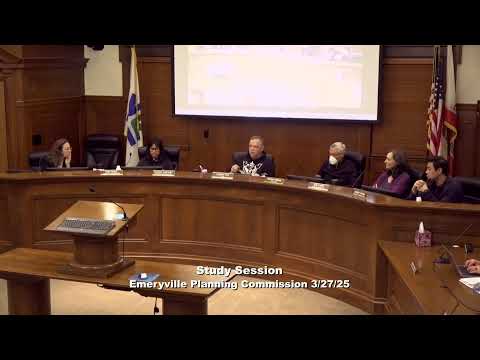
The Emeryville Planning Commission on March 27, 2025 held a study session on a proposed Rivian service and limited sales center at 60 Seventh Street (addresses 1483, 1485 and 1499) and provided feedback on fire protection, hazardous‑materials handling, noise and parking and encouraged stronger transportation‑demand‑management measures; the commission took no permit action at the session.
The Emeryville Planning Commission on March 27, 2025 held a study session on a proposed Rivian service and limited sales center at 60 Seventh Street (addresses 1483, 1485 and 1499) and provided feedback on fire protection, hazardous‑materials handling, noise and parking and encouraged stronger transportation-demand-management measures; the commission took no permit action at the session.
City staff and Rivian representatives described the proposal as conversion of three connected warehouse parcels into a 61,775‑square‑foot service center with accessory office, storage and parking. Rivian said it would perform light vehicle service — tire changes, wheel alignments, hardware replacement, software updates and battery replacement — but not collision, body or paint work. Staff said exterior changes would require design review and building permits; fire and building plan reviewers have requested additional, code‑specific clarifications for electric‑vehicle battery handling that will be reviewed at the building‑permit stage.
Key operational details presented by staff and Rivian included customer hours and staffing: customer hours proposed 8 a.m.–6 p.m. Monday–Friday and 9 a.m.–4 p.m. Saturday; Rivian described two operational shifts with up to 30 employees on the primary daytime shift (roughly 8 a.m.–5 p.m.) and up to 15 employees on a second shift (5 p.m.–2 a.m.), Monday–Saturday. Rivian estimated about 20–25 appointments per day, 0–2 tow‑ins per day, up to four deliveries daily, up to 60 on‑site parking spaces (30 employee, 25 service storage, 5 loaner/ fleet) and four customer drop‑off spaces; 18 of the on‑site spaces would include EV chargers.
Rivian representatives said the company generally keeps battery storage short‑term and tracks battery‑swap frequency at similar West Coast service centers. "We do expect approximately 40 to 45 battery swaps to occur throughout the year," said Florida, acting regional manager for the Bay Area, during the meeting. Staff and Rivian said batteries would be stored temporarily in a dedicated portion of the service area, removed from a vehicle into a crate and shipped offsite; staff proposed a condition requiring a hazardous‑materials management plan reviewed by building, fire and planning staff before a building permit is issued.
Fire‑safety questions were a central focus. Staff noted that Alameda County Fire Department (ACFD) and the city’s building reviewer requested additional information about battery handling, suppression and hazardous‑materials storage, and that batteries on site would be subject to fire‑code storage limits (staff cited that batteries would not be stored for more than about 48–72 hours). ACFD’s deputy fire marshal recommended a fire‑protection engineering analysis; several commissioners supported that recommendation or asked the applicant to retain a fire protection engineer (FPE) to coordinate with ACFD and city staff. Rivian said its service centers meet NFPA 13 sprinkler requirements and that required suppression and water‑supply criteria would be addressed at the building permit stage.
Noise and hours also drew questions. Staff described the city noise rules (a 70‑dBA daytime threshold and 60‑dBA nighttime threshold in planning regulations, and a municipal noise provision that historically restricts sustained truck idling and repair of vehicles after 9 p.m.). Staff said their reading of the noise provision is that it targets internal‑combustion‑engine uses (sustained idling) and does not categorically prohibit EV service after 9 p.m.; commissioners asked for examples and for the applicant to provide data on noise complaints at existing Rivian facilities. Rivian said its loudest equipment is an air compressor (about 67 dBA) and that most repair work would occur behind closed overhead doors.
Transportation and parking drew sustained discussion. Commissioners noted the site’s proximity to Aquatic Park and several transit routes, encouraged the applicant to expand transportation‑demand‑management (TDM) measures, and asked for more justification of 30 employee parking stalls. Staff noted bicycle parking is required by code (three short‑term and three long‑term spaces noted in the staff report) and that curb and sidewalk configuration would be determined in the landlord’s encroachment permit process; public charging was not planned because Rivian intends to locate chargers internally and not for public use at this site.
Commissioners and members of the public urged additional landscaping, sidewalk improvements and better pedestrian/bicycle access along 60 Seventh Street; staff said the landlord’s separate encroachment permit would construct a new sidewalk roughly 390 feet long and between 6 and 12 feet wide with a 4‑foot amenity strip and that up to four street trees were under consideration (tree placement constrained by existing light poles and driveways). Public Works raised questions about whether new sidewalks could be 'underground‑ready' (prepared for future utility undergrounding) and whether the small strip adjacent to the railroad could be improved; Rivian said those items are the landlord’s responsibility and are under discussion.
Because the item was a study session, no use permit or conditional‑use decision was made; staff listed next steps including continued coordination on hazardous‑materials and fire‑safety submittals at building‑permit review, potential requirement for a hazardous‑materials management plan, coordination with ACFD on fire‑protection engineering, and public‑works review of encroachment and sidewalk details. Rivian said it will refine plans and coordinate with city reviewers and Alameda County Fire Department before submitting building permits.
Commissioners who spoke included concerns about late‑hour operations, the potential for battery or thermal events and the volume of employee parking. Several commissioners encouraged Rivian to expand TDM offerings (for example, transit subsidies, bicycle amenities or short‑term shared micromobility for customers) and to explore whether some employee vehicle trips could be shifted to alternatives. The commission requested that Rivian provide additional documentation on noise complaints at existing centers, confirm sprinkler and suppression plans at building permit submittal, and consider retaining a fire‑protection engineer to address ACFD comments.