Get Full Government Meeting Transcripts, Videos, & Alerts Forever!
Get email alerts on the Rail Safety Hb396 topic
No spam. Unsubscribe anytime.
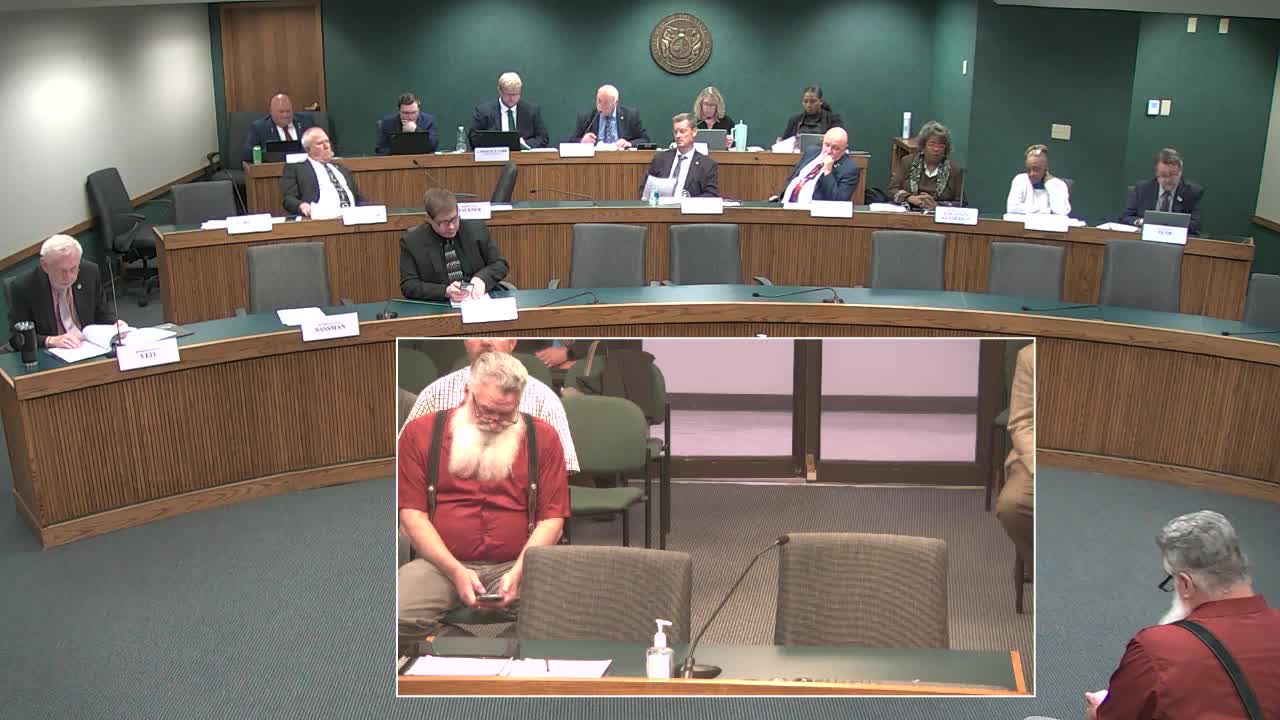
Committee hears emotional testimony on bill to extend clear zone for parked railcars after Rosati fatality
Summary
Representative Peters told the House Committee on Corrections and Public Institutions that House Bill 396 was filed after a 2022 fatality in District 122 and would raise the state's minimum clearance for parked railcars near crossings from 250 feet to 500 feet.
Representative Peters opened a public hearing on House Bill 396, saying the bill responds to a 2022 fatality in her District 122 and asking lawmakers to increase the minimum clear distance for parked railroad rolling stock near crossings from 250 feet to 500 feet.
"Currently, the state statute allows for railroad cars that sit on tracks, to be 250 feet. This bill merely asks that we extend that portion to 500 feet," Representative Peters said, describing the measure as a “very simple bill.” She told the committee the proposal grew out of community requests following the death of Katie Rogers and that constituents from Rosati traveled to testify in support.
Several Rosati residents and family members testified in favor. One longtime resident who said he had studied the intersection told the committee, "I believe 500 feet is a minimum would be safe." Amanda Smith, who identified herself as the victim's mother, described the curve and sight-line limitations where her daughter was killed and said, "She was 10 and 2," referring to the position of the vehicle's hands on the wheel to indicate she was driving properly. Courtney Kale, the older sister, presented state crossing-incident figures and told the committee, "This could have saved Katie's life." Witnesses urged either the statutory change or other safety work, saying waiting for an overpass would take years.
Jeff Davis, testifying for BNSF Railway in opposition, offered a technical and operational counterargument, saying: "Requiring railroads to not park rolling stock within 500 foot of any crossing is not going to prevent another accident like this from happening." Davis noted the current 250-foot standard is embedded in Missouri law, in MoDOT practice, and in industry operating rules; he said changing the clearance to 500 feet could shift stored rolling stock and risk blocking other crossings. He noted exemptions in the bill for customer loading/unloading and for cars taken out of service for safety/repairs and recommended pursuing more permanent solutions such as closing multiple crossings and building an overpass, backed by a formal diagnostic and a federal grant search.
Committee members pressed for details and alternatives. Representative Lucas, Representative Elliott, Representative Cook and others asked about train speeds, the length of sidings, whether gates and lights could qualify under MoDOT diagnostics, and the cost and timetable for an overpass. Committee members raised that the state set aside funds for grade-crossing safety previously (discussed in testimony as an approximately $60 million appropriation statewide), and suggested a targeted study and involving local emergency services and MoDOT in planning. BNSF estimated an overpass could take about five years to complete and suggested gates and lights or full closure as other possible remedies.
Testimony included operational details supplied by BNSF: average freight train length of more than 5,000 feet, stopping distances measured in thousands of feet under normal conditions, and that drivers’ distraction or impairment and trespassing are leading causes of grade-crossing fatalities. BNSF emphasized that many crossings statewide are "passive" (no gates or lights) and that MoDOT’s diagnostic process and the Manual on Uniform Traffic Control Devices guide decisions about where to install active protection.
No committee vote on HB396 was recorded during this hearing. Committee members expressed interest in pursuing a study of the Rosati crossings, coordinating with MoDOT and local emergency responders, and exploring available state grade-crossing safety funds or federal grants for either gates or an overpass. Witnesses and family members urged quicker action; industry witnesses urged caution and noted operational constraints.
Votes and formal committee actions recorded earlier in the same meeting included recommendations on unrelated bills: HB492 (do pass, 11-1); a House Committee substitute for HB617 (do pass, 12-0); and HB1100 (do pass, 11-0).