Get Full Government Meeting Transcripts, Videos, & Alerts Forever!
Get email alerts on the Meter Charges Customer Charge topic
No spam. Unsubscribe anytime.
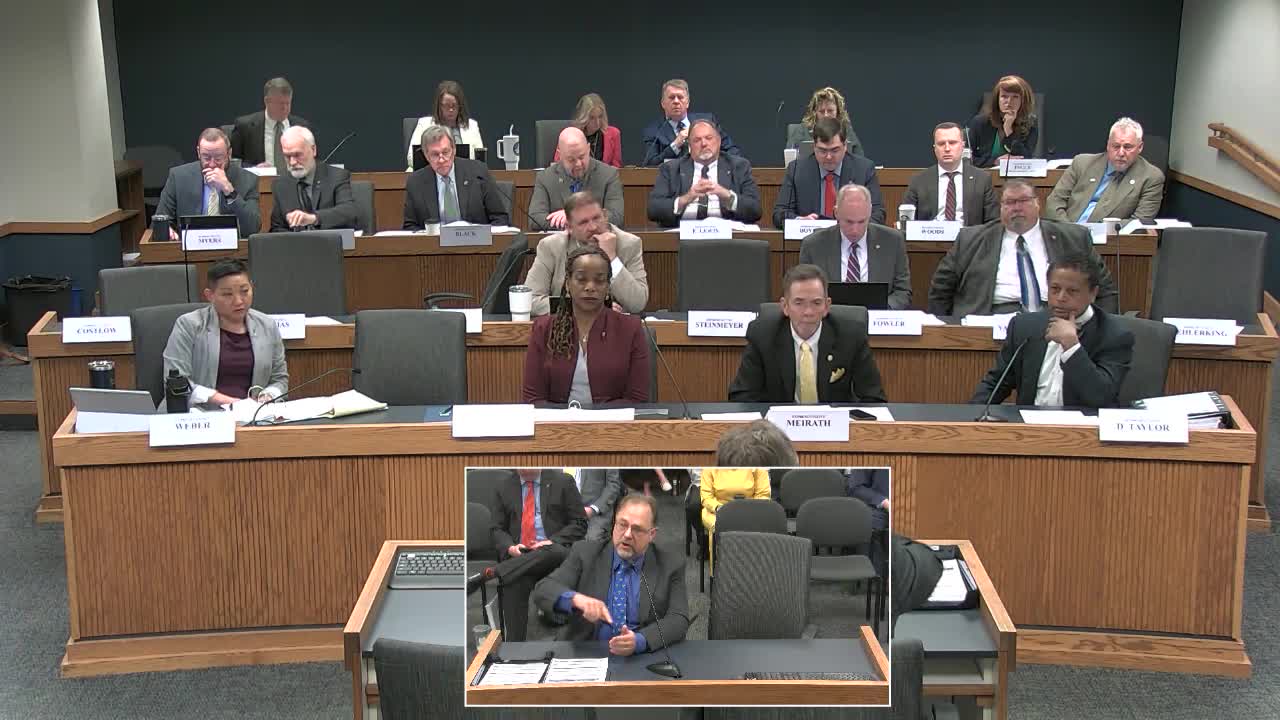
Committee hears widespread concern over bill limiting additional meter charges; sponsors say language needs work
Summary
House Bill 1178 would limit a utility’s ability to charge an ongoing additional meter (customer) fee at the same postal address. Municipal utilities, cooperatives and investor‑owned utilities told the House Committee on Utilities the bill is too broad and needs clearer definitions for customer charge, service location and rate classes.
The Missouri House Committee on Utilities took testimony on House Bill 1178, a proposal to limit a utility’s ability to collect an ongoing fixed monthly meter (customer) charge for additional meters at the same physical address. Representative Vanderman, sponsor of the bill, told the committee the measure is intended to prevent ongoing duplicative fixed charges where no additional fixed infrastructure was installed.
Vanderman described an example from a constituent who had an outbuilding about 50 feet from a primary residence and said the household was paying an additional monthly meter charge of about $48 while the incremental billed usage averaged about $7 per month. “My idea behind the bill was to limit the ability for an ongoing fixed cost charge to an additional meter when there isn’t any additional fixed costs,” the sponsor said, while acknowledging the bill’s language is broad and “needs some work.” The bill would, as drafted, allow utilities to recover the meter charge for one year to offset the initial installation.
Municipal utilities, electric cooperatives and investor‑owned gas and electric companies testified in opposition or requested clarification. Connie Ford, chief member services officer for the Missouri Association of Municipal Utilities, said the bill fails to define whether the customer charge applies per utility service (electric, water, gas) or per postal address and urged clearer definitions for “customer charge” and for how multiple utilities serving the same postal address would be treated.
Amber Overfelt, general manager and CEO of Howard Electric Cooperative, said many rural members prefer separate meters for farm shops, irrigation and seasonal loads; cooperatives set customer charges and line‑extension policies through member‑elected boards and said removing a second service fee could reduce revenue and shift costs to other members. Overfelt said her cooperative’s residential service availability fee is $39 a month and explained that cooperative rate classes and line‑extension practices vary widely.
Investor‑owned utilities told the committee the proposal raises regulatory conflicts. Zach Monroe of Ameren Missouri cited the Public Service Commission’s tariff definition of a customer charge and used Ameren’s existing tariffs to show how meter charges and kilowatt‑hour rates interact: under Ameren’s current residential and small‑general‑service tariffs, Monroe said, a second meter can become cost‑effective for a customer once usage in the outbuilding exceeds about 70 kilowatt‑hours per month.
Other witnesses in opposition included Evergy, Liberty Utilities and the Missouri Natural Gas Association. Testimony highlighted several recurring concerns: the bill’s use of “postal address” as the trigger for a single customer charge, the need to preserve rate‑class distinctions (residential, small commercial, large commercial, irrigation), and the risk of unintended cross‑subsidization where one customer’s decisions would shift fixed costs to other customers.
Committee members asked practical questions about multiple homes sharing a single bill, situations on large rural properties with a single postal address, and how investor‑owned utilities and municipals recover fixed costs through tariffs or board decisions. Representative Vanderman said the hearing had been “very informational” and that the bill would need drafting changes to address the many operational and regulatory complexities raised by witnesses. No committee vote was taken.
Because the testimony raised significant definitional and regulatory issues, several witnesses and members urged more precise drafting before the bill is moved further in the process.