Get Full Government Meeting Transcripts, Videos, & Alerts Forever!
Get email alerts on the Insurance Settlement Law topic
No spam. Unsubscribe anytime.
Missouri House advances bill specifying 90-day written settlement window for extra-contractual claims
Summary
Lawmakers debated House Bill 437, a measure that would require written settlement demands to be held open 90 days and reference the statute before a plaintiff may bring extra-contractual (bad-faith) claims against insurers; the House perfected and printed the bill after extended questioning about effects on injured people.
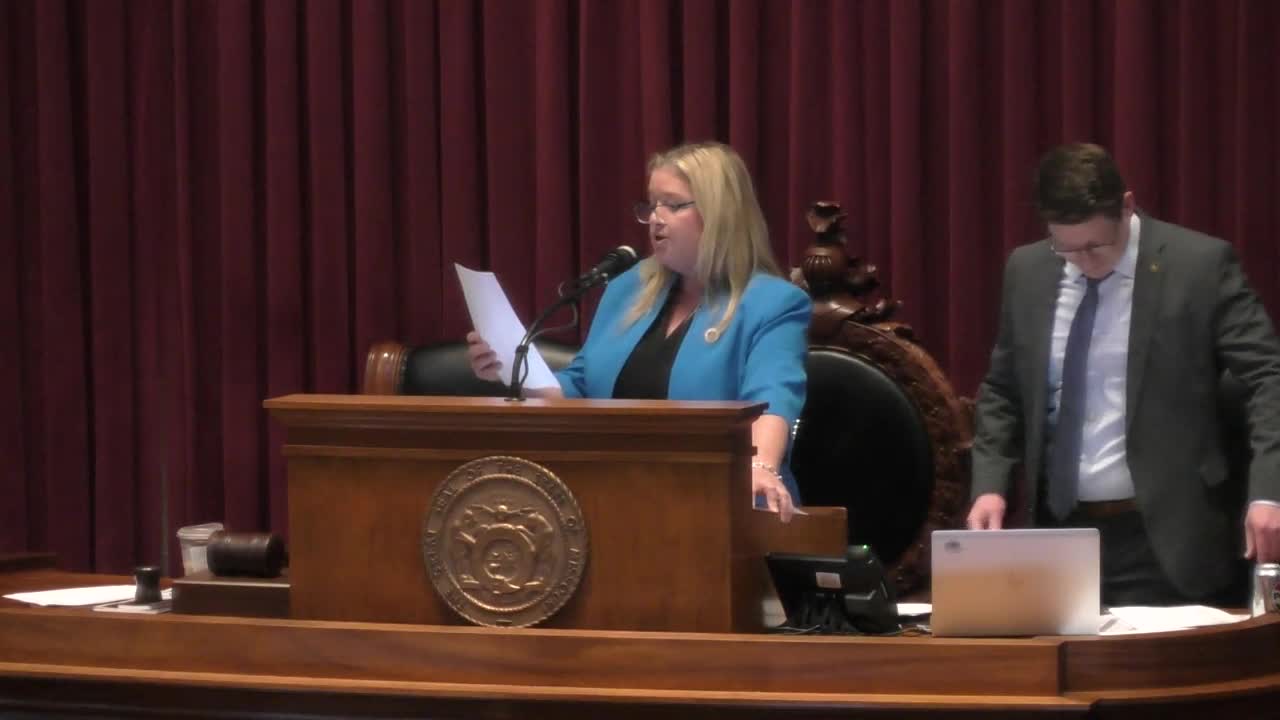
The Missouri House on March 20 moved House Bill 4 37 forward after an extended debate about how insurers and claimants negotiate settlements. The bill’s sponsor, the gentleman from Pulaski, described it as a narrowly drawn rule: offers related to extra-contractual damages must be in writing, held open for 90 days and reference the statute so parties know when an extra-contractual claim might be pursued.
The sponsor said the measure is intended to clarify when a claimant can bring an extra-contractual or bad-faith claim and to reduce gamesmanship such as brief, untimed demands that are later withdrawn. “If you’re going to file or make a claim for extra-contractual damages, for example, claim of bad faith, you need to make sure that the offer to settle is held open for 90 days. It’s in writing and it references this statute,” the gentleman from Pulaski said.
Opponents and questioners pressed the sponsor on possible consequences for injured people who need prompt payment for medical bills and lost wages. The gentleman from Saint Louis City asked whether the measure could allow insurers to “drag out settlement timelines and avoid accountability to the victims.” The sponsor replied that contractual rights remain unaffected and that 90 days is intended as a reasonable minimum to process large or complex claims. “If you want to file your bad faith claim, it’s held open for 90 days, which seems feasible as a general rule of thumb,” he said.
Other lawmakers raised scenarios where plaintiffs do not know policy limits immediately and where extended timelines could create pressure on injured people who lack income or insurance while a claim is processed. The sponsor and supporters countered that discovery and typical claim processing commonly take weeks to months, and that statutory clarity about timing could reduce litigation over procedural ambiguity.
After roughly two hours of back-and-forth questioning and clarification, the House moved the previous question and then perfected and printed House Bill 4 37. A recorded vote on the previous question passed 94 yeas to 45 nays; the subsequent perfection and printing were announced by voice vote.